
Translated material
How to talk with bee
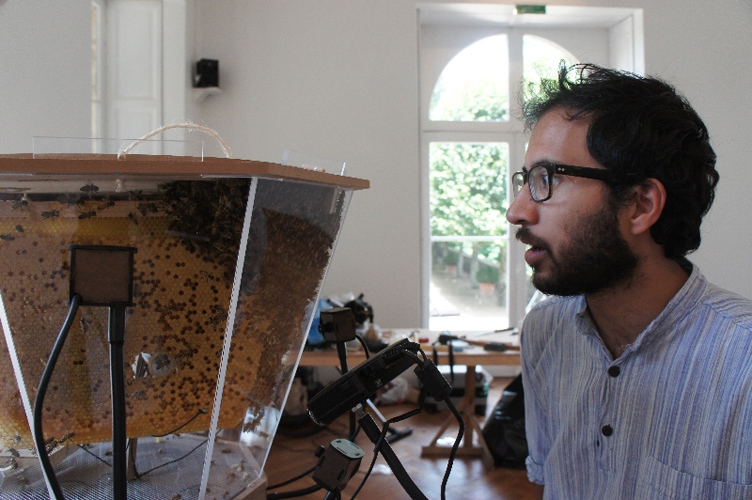
From October 4 to 8, Nikola-Lenivtsa is represented by the first part of the Apiarium project / Apiarium , which is devoted to the study of the interaction of man and the Beadly Community (Science-Art-resident, IF The Lion Couple Speak). The Apiarium project, uniting artists, zoologists, programmers and architects, is trying to understand how to prevent the extinction of these insects and build a system of communications with them. One of the authors of the project is the Swiss artist Robin Meyer told Colta.ru about the connection of science and art and what the bees are similar to people.
-You show in Nikola-Lenivts a rather unusual project for the Russian viewer. What is its meaning?
- We are trying, using the language of art, to raise the problem of the disappearance of the endangered species of insects - honey bees that are vital for a person. To do this, we came up with a transparent hive and launched bees there so that we could watch how they work, communicate with each other, react to external phenomena. Of course, everyone knows that a hive is a highly organized community, where there are leaders, queens, nurse, workers. The production of honey resembles a virtuoso dance that occurs outside the hive and continues inside. Everyone knows abstractly about this, but who could still watch this? Our transparent hive makes such an observation common. Together with my colleagues and co -authors, I want to go even further with my colleagues and co -authors Dmitry Morozov: with the help of special feeders and soldering stations, we will create a special space to train the bees to respond to certain codes and colors.
- That is?
- As part of our experiment, we are trying to communicate with bees using computer technology and programming. At the same time, we want to find out how the behavior of bees is changing under the influence of certain external factors - for example, light or magnetic fields. A separate task is to understand how music or any acoustic signs affects them. Using various tools, we will explore how to help bees first navigate the pesticides and monocultures, and then avoid them. Thanks to our “sound” training, they are likely to learn how to “calculate” plants treated with harmful substances and stay away from them. In fact, one of the main causes of extinction of bees is pesticides.
We conducted a dialogue with bees using music sent to space as a message for aliens.
- Why suddenly bees?
- These are quite exciting insects full of paradoxes. On the one hand, we know a lot about them, on the other - nothing. Bees are necessary as pollinators, this is their most important function, which no one other than them can fulfill. So people need them. At the same time, their bites can be dangerous for humans. We believe that we can decode a bee language, but nevertheless, we still do not fully understand their chaotic movement. There is something deeply strange and contradictory in the system of relations of man and bees. It only fuel our interest.
- In general, attention to bees in art is not news.
- The most interesting thing is the decoding of a bee language that people have been trying to understand since ancient times. One of the evidence is the preserved images of the hives in the Egyptian pyramids. In addition, even then it was known about their pharmacological properties. For centuries, the bees actually have repeatedly found themselves in the focus of the attention of artists. Now it's time to build communication with them with the help of science tools. We want to get quite applied results, for example, to develop a line of electronic tools and programs for beekeepers in order to calculate the number of bees, monitor their growth, health status, and activity.
- And how can the problem of reducing the population be solved?
- One method can not cope here. It is necessary to reduce the load on the bees in industrial beekeeping, which weakens their health, to reduce the breeding of monocultures in agriculture. In cities there should be more green spaces not only in parks, but also on roofs - this will create a full -fledged ecosystem. In addition, pesticides, parasites, industrial waste are harmful to bees - their number must be significantly reduced. Remote hive monitoring using modern computer technology will help prevent many diseases.
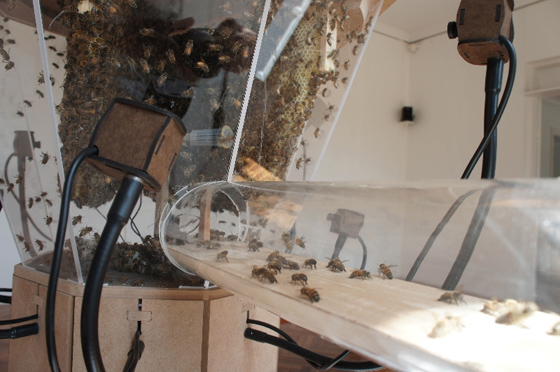 © Robin Meier
- You do not seem to do this for the first time?
- Yes, sure. For example, two years ago, together with Ali Momenia, we already did something similar. Inside the gallery located in one park - it was in the French city of Nantes - a transparent hive was installed, created on the model of the Voyager space probe. We, like now, tried to build a dialogue with bees using music, which was sent into space on board Voyager as a message for foreign creatures. On the example of bees, we wanted to understand how universal these sounds are.
- And art can really help in solving eco -problem?
- The artistic approach is fundamentally different from the scientific. Art is built on intuition, on subjective sensations. This allows the artist to experiment with things that may seem meaningless science, but still important. In other words, art can look at any problem under a new, often unexpected, angle.
- It is clear, how will your project develop further? Continue the experiment or start a new one?
- Our next goal is the construction of an architectural object, a whole large pavilion to observe the life of bees. True, these are only our plans, it will turn out or not, it’s difficult to say so far.