
Translated material
LGBT and law
Authoritative opinion
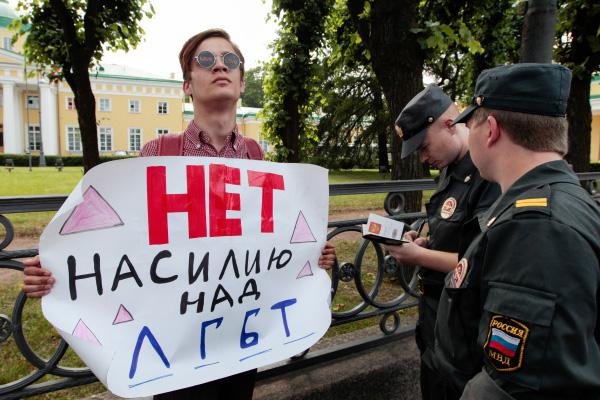
The Constitutional Court made an explanation on the scandalous law on the ban on the distribution among minor information that promotes unconventional sexual relations (the domestic name is the Law on the prohibition of propaganda of homosexuality ”). The reason for the clarification was the appeal to the Constitutional Court of LGBT activists Nikolai Alekseev, Yaroslav Yevtushenko and Dmitry Isakov: in accordance with this law, they were found guilty of an offense for conducting public events. The law on administrative offenses introduced Article 6.21 - “Propaganda of non -traditional sexual relations among minors”, which implies a fine of four to five thousand rubles. Alekseev and Yevtushenko were the first in the country convicted under this law-for single pickets near the building of the children's library in Arkhangelsk with a poster “Gay-propaganda’s poster. They don’t become gays, gays are born! ”(The Arkhangelsk region was one of the first regions where this law was adopted before consideration in the Duma). Isakov, who conducted a single picket in Kazan, received his fine due to the fact that the teenager from Arkhangelsk read about this picket on the Internet. All three activists filed complaints in the European court on the European court Human rights.
The Constitutional Court calculated the law and the article introduced into the Code of Administrative Offenses not contradicting the constitution. But besides, the judge of the Constitutional Court, Nikolai Bondar, commenting on the position of the court, said that the article “does not interfere with the impartial public discussion of the legal status of sexual minorities, including by conducting public events in the manner prescribed by law. However, minors should not be involved in the relevant measures, and the distributed information should not be focused on them. ”
Nikolai Alekseev, one of the most active figures of the Moscow LGBT movement, has already managed to name this clarification of the Constitutional Court with a serious breakthrough in the struggle for LGBT rights. Natalia Tsymbalova, the coordinator of the heterosexual alliance for the equal rights of LGBT, agrees with him: “The decision of the Constitutional Court of the Russian Federation seems to me a very important milestone in the struggle for the right to freedom of assembly of the LGBT community,” she said, but she added that “ideally, the lawsuit should have recognized the notorious law on“ gay propaganda ”, union constitular But she agreed that "no one from him in the current political situation, of course, was waiting for him." Nevertheless, according to her, it is important that “the court forbade the expansionly interpreting the law, that we often make various political frauds and homophobes. Now it is explicitly stated that the law cannot be the basis for the ban on public actions, discussions and other events in defense of the rights of LGBT. ”
Nevertheless, Tsymbalov, who has extensive experience in holding shares in defense of the LGBT and negotiations with the St. Petersburg administration, noted that “the practice of St. Petersburg is such that our rights to freedom of assembly of the authorities are often violated at all on the basis of the Law on Gay Propaganda. In St. Petersburg, this law was rarely applied, here more often officials come up with different loopholes in order to refuse to agree on shares. For example, in February 2013, with the support of the Coalition, Democratic Petersburg tried to organize a rally against the Law on Gay Propaganda, which was then still a bill and was considered in the next reading of the State Duma. The authorities refused to coordinate this rally in 20 (twenty!) Different places, having come up with a variety of excuses (such as repair work, the proximity of court buildings, that we will allegedly interfere with passers -by and the like). Obviously, the ban on the rally was a political decision, but the law on propaganda in failures did not appear in any way. ”
Another St. Petersburg activist, gender researcher Valery Zaozaev in a conversation with the OVD-Info also noted that, despite what the Constitutional Court says, "there is real local practice." He stated that in addition to the prohibitions of shares, some government officials are going to frankly to disrupt the LGBT event: so, a deputy of the St. Petersburg Legislative Assembly Vitaly Milonov, known for his furious struggle with LGBT, and his assistant Anatoly Artyukh “constantly bring minors to our shares for the purpose of provocation. Milonov comes with his own children to the shares of LGBT activists, thus provoking law enforcement officers, the police to stop these actions. ” Sozaev suspects that law enforcement practice will change little with the advent of an explanation: “There were decisions of the Constitutional Court regarding regional laws - Arkhangelsk, St. Petersburg, Kostroma. LGBT activists use these decisions, but there is no sense in this either. ”
Serious concern
Almost simultaneously with the appearance of the explanation of the Constitutional Court of LGBT Actions in Russian cities, the Committee of Ministers of the Council of Europe, which condemned Russia for the non-fulfillment of the verdicts of the ECHR, paid attention. The members of the committee “expressed serious concern in connection with the fact that most of the notifications filed in Moscow, St. Petersburg, Kostroma and Arkhangelsk from July 1, 2013 to May 1, 2014, on the conduct of public events ... were met on the basis of federal law prohibiting“ propaganda of non-traditional sexual relations “among minors, despite the certification of the Russian authorities for the certification The 1179th meeting (September 2013) (by human rights) that this federal law does not imply interference in such events. ” In this regard, the committee called on the Russian authorities to provide "updated information, including statistics on the current practice regarding the organization of public events ... from May 1, 2014 to February 1, 2015." The Committee “with great regret noted that the application of the most important right to gather is recognized and defended by the Russian authorities in insufficient” and demanded to take the necessary measures, “including an educational nature”, to correct the situation.
Tsymbalova noted that “the European Council is much more concerned about observing the rights of Russian citizens than those state structures in Russia that are actually called to protect these rights. So far, Russia has not yet left the Council of Europe (which is very likely in the current situation), the Council of Europe and its judicial system in the person of the ECHR remains in fact the only instance where we can appeal in the hope of finding protection from the arbitrariness of the authorities. " According to Sozaev, the “Committee of Ministers of the Council of Europe always expresses serious concern-this, unfortunately, is the only opportunity to do anything from them. And it is clear why-lawyers in the Council of Europe do not understand what the propaganda of homosexuality is, how can someone can be able to become a homosexual person. ”
Law enforcement
Article 6.21 of the Code of Administrative Offenses is still quite rarely used in the wake of past shares. In Moscow, for the first time, this article was charged last year against LGBT activist Alexei Davydov, detained during the picket near the building of the Russian State Children's Library with a poster “to be gay is normal”, and five more people detained with him (this was the only case of accusation on this article in Moscow for a year).
In this context, the decision of the justice of the judicial section No. 423 of the Tver district of Moscow on the payment of compensation of the LGBT activist Irina Fedotova (FET), sentenced to a fine for a single picket against the Law of the Ryazan Region on “promoting homosexuality” adopted back in 2006, was unprecedented.
Measures in defense of the rights of LGBT are often the reason for the detention even without the application of the relevant article: according to the ATS-INFO, in 2013 the relative number of measures of the subject on which the detentions occur in Moscow is 7.1% (in 2012-0.9%), the number of detentions on them is 11.4% (in 2012-1.2%). The average number of detentions, which arrives in one event in support of LGBT, in 2013 is 13.9. In St. Petersburg, for the same period, the share of LGBT detainees from the total number of detainees at mass events was 12.1%, the number of LGBT events with detentions is 7.1% of the total. The average number of detentions per LGBT event in St. Petersburg is 18.7.
Much more often, the article is used by regional authorities to refuse to agree on measures. No further than October 1, the Moscow authorities banned the holding of LGBTs per hundred people, since “the notification contained in the text of the public event suggests that the goals of the planned procession violate the prohibitions provided for by federal laws Article 6.21 of the Administrative Code of the Russian Federation”; “Conducting a public event indicated by a group of citizens in the places open to free visits will cause moral harm to children and adolescents who have become involuntary witnesses, insulting religious and moral feelings, will humiliate the human dignity of other citizens, violate their rights and freedoms, which will cause a negative reaction of society and can provoke people who do not share the views of their participants”; And besides, the procession "will interfere with the movement of pedestrians, violate the rights of citizens who do not participate in it."
In Moscow, in general, the prohibitions of such events actually became a response to the campaign to protect the freedom of meetings, which was announced by LGBT activists after the adoption of the law. Activists submitted notifications about the conduct of measures to “express the opinion of the LGBT community in defense of the heart of the journalist of the Russia-1 TV channel Dmitry Kiselev from burning and digging into the ground”, “Distribution of objective scientific data on homosexual relations in the animal world”, “Speed of LGBT communities in supporting pensions of citizens of the Russian Federation”, “Speech against exploitation homosexual deer Santa Claus in Western countries, “speaking against discrimination against blue fir trees on New Year's Eve”, “Speech by gays and lesbians against global warming in the Russian Federation” and even “Expressions of support and calling for the statements of Russian President V.V. Putin about the non-discrimination of the Olympic Games in Sochi on the sign of nationality, racial affiliation and sexual orientation pronounced on October 28, 2013. ” The march of bearded women and men named after Conchita Vurst was planned . All these notifications were rejected, activists appealed them in the courts and, after recognition of the prohibitions, sent complaints to the ECHR (some events, the prohibitions on which were recognized as legitimate the Moscow City Court, are listed on the Gayrussia website). However, not all stated topics of events sound as absurd as the above-so on September 27, activists of the Moscow gay pride appealed to the ECHR a ban on a rally in support of legislative tightening the punishment for hatred against gays, lesbians, bisexuals and transgender people. Similarly, activists act in Kostroma, Arkhangelsk. Particular attention of LGBT activists was riveted to the Olympics as the main international event in Russia after the adoption of the law. Gay parade in Sochi was banned on the same basis. After March 2014, the law began to operate both in the Crimea and gay parades were banned in Simferopol and Sevastopol.
A curious story occurred with the coordination of LGBT promotions in Kostroma in June. On the gay of a gay on June 1, it was immediately refused in connection with celebrations in the city of Children's Day. The procession planned for June 2 was unexpectedly agreed (though not in the place where the organizers wanted), but later the approval was withdrawn in connection with the sewage accident . After long trials, Nikolai Alekseev managed to obtain both failures illegal.
The propaganda law was also used to suppress the measures, as happened in St. Petersburg on June 29, 2013 on the territory of the “Hayda Park” on the Marse Field, where LGBT PRIDE was to be held: the chairman of the organizing committee said that on the basis of certain complaints of citizens who saw the Police, the police were transferred to the police on the termination of the promotion, after which the police became the police, after which the police became To detain people. In total, 54 people were detained. A similar event in 2014 passed peacefully, but one activist was detained by a poster in which representatives of the local committee by legality saw the propaganda of non -traditional sexual orientation.
Some LGBT activists, focusing on the prevailing legislative and law enforcement practice, prefer to depart from symbols and even words directly related to LGBT tematics during the activities. As the head of the Murmansk LGBT-Organization “Maximum Center” Sergei Alekseenko told the OTD-Info, recently all their public events “have been organized so that there were not even words with the root of“ homo ”or“ LGBT ”. We try to get away from these words so that we are not accused of violating this law. ” “We did not have a single refusal, but we do not declare the shares precisely as LGBT, we often apply for promotions against xenophobia in society in general, and not just against homophobia,” says Alekseenko. -We do not leave with rainbow flags, we do not leave with some sharp slogans, as do in St. Petersburg and Moscow, especially the ultra-activists. We are moderate. We are not trying to make a provocation, we want people to see and think once again. ” According to him, the authorities usually do not refuse to hold an event. On May 17, a flash mob was torn in one of the Hyde Parks, but, as Alekseenko believes, “it was the bzik of the head of the district administration, on whose territory there is a Hyde Park, who stated that the Hyde Parks in America, and here is a platform for normal people-get out, they say.” Despite the fact that the activities in the guide parks do not require the submission of notifications, the LGBT activists of Murmansk still submit notifications, since in such cases the administration is obliged to ensure security. “If we do not submit a notification, we must ensure security ourselves,” explains Alekseenko. “But who knows - one person can come with a rotten egg, or maybe a crowd.” I would not want any injuries on either side. We try to protect ourselves and the people who come to our actions. ”
Not only promotions
The law on prohibition of propaganda among minors of “non -traditional sexual relations” has repeatedly tried to use specific people without communication with public street events. In the Khabarovsk Territory, a fine of 50 thousand rubles was sentenced by the editor-in-chief of the local newspaper “Young Far East” Alexander Suturin for publishing an interview with geography teacher Alexander Ermoshkin, dismissed from work for LGBT activism. Sutorin was accused of violating part 2 of Article 6.21 - on propaganda through the media, which is already entailing a much larger fine than participation in the event. In May of this year, the Murmansk activist Violette Grudina was charged in connection with the fact that in the group of “Maximum Center” on the VKontakte social network, one of the administrators of which it is, minors were discovered.
In addition, the journalist from Nizhny Tagil Elena Klimova, the author of the Children-404 project about homosexual adolescents, was accused of creating “pages that promote non-traditional sexual relations on the VKontakte social network. An application for an offense was filed by the St. Petersburg deputy Vitaliy Milonov. However, the Dzerzhinsky District Court of Nizhny Tagil terminated the proceedings in connection with the fact that the administrative protocol against Klimova was drawn up with violations.
In addition to the fact that LGBT activists are persecuted both in the judicial and out-of-court order, the authorities often do not meet them in the investigation of crimes. So, in Voronezh, the court did not satisfy a statement about the inaction of the police, filed by activists Pavel Lebedev and Andrei Nasonov, who suffered as a result of an attack on the LGBT picket. And Nikolai Alekseev, on whom in Kostroma was an attack, refused to initiate a criminal case.