
Translated material
Why don't the USSR let us go?
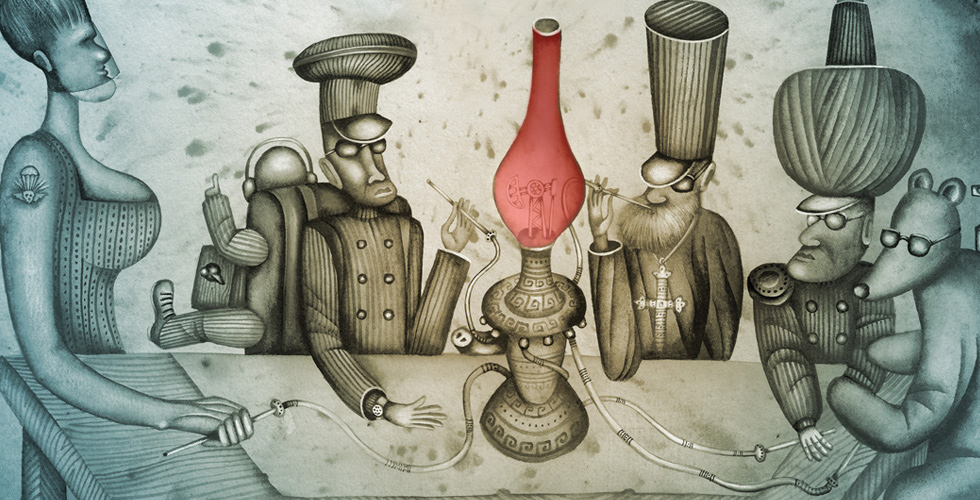
We continue our shows in the Cinema Cycle Believe . Already tomorrow, October 8, we will show Daria Khleskina's film “The Last Limousine”, which received many bonuses and prizes, including the Lavr Award and the Award at Artdokfest. After the film about the collapse of the Soviet automobile industry, we are together with you, dear readers, as well as with Marina Razbuzhkina, Yuri Saprykin, Alexander Morozov and Evgenia Pishchikova, we will talk about how the myth of the country named the USSR lives today. You can still sign up for tomorrow's show at this link .
Alexander Morozov
political scientist
I think that a lot of what reminds us of the Soviet past, in fact, has nothing to do with it. We often think that imperial sentiments, the desire for collectivity, the rejection of individualism, the conviction in our right to easily decide the fate of neighboring peoples are the return of the Soviet one. In my opinion, all these are new phenomena, almost unrelated to the Soviet period. This is the first moment.
The second point is that the Soviet is partially returned, but not because it has any special virtues that are not in the bottom of today, but because, looking back, a modern person can no longer correlate himself with pre-Soviet. When I was young, in the late 70s, all my generation eagerly read what was concerned about the Russian pre-revolutionary culture. Everyone correlated themselves with the silver age, XIX century. But for new generations, the connection with the pre -revolutionary weakened, this is already too far for them. And Soviet samples now seem classic. A whole generation has grown up, which believes that the Soviet cartoons are humanistic, cultivate good and love, while modern ones are much more stringent and inhuman. In my opinion, this is an illusion of perception. Cartoons then were shot then, not because they were Soviet. Soviet is now perceived as a general cultural past. After all, each generation remembers something that parents read as a cultural model.
Let's create an isolated world with a special project and will be happy.
Yes, it is obvious that in Russia there are political forces that want specifically the return of the Soviet. Property - state, justice - distribution: the same rations, a simple idea of equality. They like how groups were organized in the USSR, they attach great importance to the mass heroism of the Soviet period. Soviet, if you take it as an experience, is a psychological trauma that continues to exert pressure on consciousness. And although we have already gone very far from the Soviet and strive for achievements in the global world, this injury continues to whisper in the ear: “Let's close, be reserved, create ourselves an isolated world with a special project and then we will be happy.” I think then we will not be happy.
Tamara Eidelman
historian
It is always not easy to part with the past. In addition, many liked to be part of something that, as they were explained, was huge, great, beautiful. And, having lost this, people did not gain anything in return. I noticed that very often the inferiority complex goes into a mania of greatness: if you have everything bad, involuntarily looking for everything to be proud of. And many find the Soviet Union.
I see among the young generation a lot of leftist and imperial ideas. Of course, these are different things, but we see how whimsily in Sergey Udaltsov his left dream combined with the imperial cries “Our Crimea!”. And imperial sentiments are growing. Just those who did not live in that country have a more idealized image in their heads: in the USSR, everyone was paid salaries, everyone lived calmly. They do not know what kind of salary it was, they don’t understand what it is, when the books cannot be read, the films cannot be watched - what is he like to live in prison, even if calm. Friendship of peoples? Of course, there were no such severe ethnic conflicts as those that exploded in the 90s. But perestroika did not give rise to these conflicts, but simply brought to the surface. Another favorite myth was not crime, but then we just did not know about it.
The past must be released. If you live in the past all the time, nothing good can be done now. Like the USSR or not, it is already impossible to return there.
Boris Grozovsky
publicist
In the most nostalgia for the Soviet years, I do not see anything terrible. As a rule, it is associated with longing for childhood/youth, inevitably painted for most people with joyful tones. You can not dump people from love for your past. There is nothing to do with this, and it is hardly necessary. Finally, nostalgia, or love for the Soviet past, is often not love for it as such, but for different phenomena of this past, including cultural ones. The other day, an eight -year -old boy, choking, told me about the cartoon “last year’s snow” (1983, Alexander Tatarsky). What is this love for the Soviet past? No. But to imagine that such a cartoon is being removed now is strongly impossible. Some “spirit of the era” was reflected in it ... In warm feelings in relation to the past, I do not see anything bad.
It seems to me harmful, something else-not our conscious attitude towards something in the past, but uncritically, unconsciously borrowed from it and phenomena, completely unreleased to the present, inorganic in modern life and poisoning it. First of all, it is paternalism: “Nothing depends on me, they know better at the top, I can’t live myself and need support from the state. This support should be provided to those who love their Fatherland and wish him good, and let criticize it away from their native limits ”, etc. etc.
Archaic social and economic attitudes, purposefully brought up and cultivated in the USSR, are firmly held, not released both by Russians born in the USSR and those who have not seen that time with their own eyes. Infantile socio-economic and political moods are transferred with the upbringing of the house and at school, they are supported by the social environment. The stability of these structures impedes the development of civic activity, interferes with the formation of modern, complex, ambiguous, but corresponding to their own ideas and misconceptions of people of political reality, does not make it possible to form a free market economy, etc. This is the past that does not release us, tenaciously holding and interfering with the construction of a modern country.
The point is not in love and not in nostalgia, but in the fact that the structure of consciousness convenient for many people is uncritically transferred to the present. It is not so important even whether these structures are from the Soviet past: some of them can belong to the imperial past, and also some part-completely ancient, tribal relations. The problem is that many people are trying to organize the present according to the rules developed many hundreds of years ago, but in modern life they look approximately the same as a caftan or charter on participants in business negotiations. Cute, but naive.
Gleb Pavlovsky
political scientist
The term "Soviet nostalgia" hides a lot of motives, none of which is sentimental. 25 years passed, and the equality of the tanned and offended by the phenomenon of the Soviet - or its absence arose. It began to note the banality that the Soviet has different, melting, like a loud cockerel of childhood, a cartoon about a wolf or about the KGB. Today, the “Soviet” is the marking of the unknown, remaining dangerous. This is not nostalgia and is connected with a person lost within reality, which he forbade himself to understand.
The events of 1991 - a conservative revolution from above - the action of a Stalinist man, offended by the decline of his world, devoid of emotional top dressing with paintings of brutal justice. Subsequently, folk peasant anti -communism has developed with the anti -party position of the intellectuals, which themselves claimed the place of the party.
Today, the “Soviet” is the marking of the unknown, remaining dangerous.
The departure of the USSR showed that Soviet ideocracy was actually a residual meritocracy. The journalist, who, in the Union, modestly former only the mediator of the intelligentsia, and not herself, now wanted to be a demiurge and the "creator of meanings." In practice, this meant that the hierarchy was broken in culture. The inequality implanted into the landscape has become a deliberately bright spot. There was nowhere to hide from him, it was exaggerated, brazenly, defiantly. There is no major entrepreneur who would not be photographed in a fucked-up skiing with a pack of dollars in his hands. At the same time, the Soviet intelligentsia was called into power in the role of the so -called Glasses. The imperious identity washed their former diversity and professionalism. The democratic oath of Averintsev, Batkin or Basilashvili is mutually excessive and all together are easily replaced by the releases of the presidential press secretaries.
The revived poststalinsky man compiled the core of the population of the Russian Federation - inappropriately awakened, unsatisfied, moreover, also robbed. Devastated and deprived of even the shadow of world -power, he was designed to become a support of democracy in the Russian Federation, its new sovereign. In a sense, he became them. And by the beginning of the 2000s, the new sovereign finally had the opportunity to choose a new government.
The Soviet is very shining, remaining unidentified. I am convinced that it was a taboo for the understanding of the Soviet - mysterious, but undoubted - has grown into the habit of evading the thinking of social reality, complementing the paraphrases of other people's theories with vulgar quotes from Soviet films. But what of this nostalgia? Everyone who could take something and remove from the USSR.
Marietta Chudakova
Philologist, publicist
The situation is absurd, and at the same time stable. Bye.
The stronger the country of corruption is constrained by the country ... Although much more, if the first posteltsin year has grown up, by the indema monitoring, 10 (ten) times (which does not interfere with the fellow citizens, of course, accusing not “zero”, but the 90s; we are so). So - the more the heads turn towards the happy past. And to Stalin - “He would show them! ..” What were afraid (to put it mildly) - it is difficult to argue.
The more powerless today's citizen of Russia feels, the more he looks back. What kind of lawlessness are we talking about? Well, at least about the right to life - your own and your loved ones. The faint of heart should not be read on the Internet (in Izvestia or in the Rossiye Gazeta you will not read this) that the free blessings are provided with seriously ill British healthcare - both in hospitals and at home.
"What does the USSR have to do with it?" - the logically thinking citizen will ask. But at the same time. About logic, a good citizen, forget (I hope and even sure that temporarily). Since we are explained from morning till night that the West is bad, which means that it cannot be good there, then somewhere it should be good! Where? Yes, there, of course, where did the Stalinist anthem, VDNH, TRP, won and concentration camp near Moscow, are being built for 50 thousand seats - right, comrades, it is time to restore order!
And most importantly - where "Morning meets us with coolness! .."
I generally believe that 70-80% of the USSR nostalgia is due to the fact that our poets-songwriters and composers Shostakovich and Dunaevsky were painfully good. But this is a special and big topic.
The Soviet man in Russia has long become a post -Soviet person - deprived of illusions, much more cruel, much less enlightened.
Oleg Kashin
publicist
Honestly, I poorly imagine who and how the Soviet Union does not let go. Nothing has left from him for a long time, and even those formally Soviet values, habits, institutions, and so on, including even the cult of the war of 1941-1945, - there is nothing Soviet in them, this is all new, purely non -imperial, market goods. The desovetization, which we probably will have to do after Putin, in any case, will be only cosmetic - monuments to Lenin, the name of the streets and so on. In fact, modern Russia has long said goodbye to the Soviet coordinate system. By the way, for some reason, speaking of the USSR, we mean Stalin or Brezhnev, but excuse me: in which country was the People’s Deputy of Sakharov, the rowers sang a “train in fire”, and the circulation of the “New World” with the “Gulag Archipelago” reached two million? These are also the USSR, the Gorbachev years are its highest point, and that country has long been gone. The Maines, applauding Sakharov in Luzhniki, lost their jobs, drank, died. Fans of the New World spent the last money on MMM promotions. The audience of late Soviet rock fought in Chechnya. The Soviet man in Russia has long become a post -Soviet person - deprived of illusions, partly cynical, partly frightened and incredulous, much more cruel, much less enlightened. This is a completely different person, a different biology.
Put several historical or geographical samples - the USSR, European countries, African dictatorships, Latin American dictatorships - and I do not think that in this series Putin's Russia will be most similar to the USSR. And I would not advise to buy on external signs. There was a book in which, after a nuclear war, the wild humanity lives wild tribes and, in some Pygmay tribe, the shaman wears on the neck the Soviet institution’s sign “not to smoke”-like an artifact from some unattainable past civilization. Here are the external Soviet signs of Putin’s Russia-this is the same sign “not to smoke”, and one should not think that it indicates some kind of connection with the Soviet Union, it has long been destroyed, “there is no country, nor those who lived in the country.”
Recorded by Natalia Zotova