
Translated material
How blue light became white
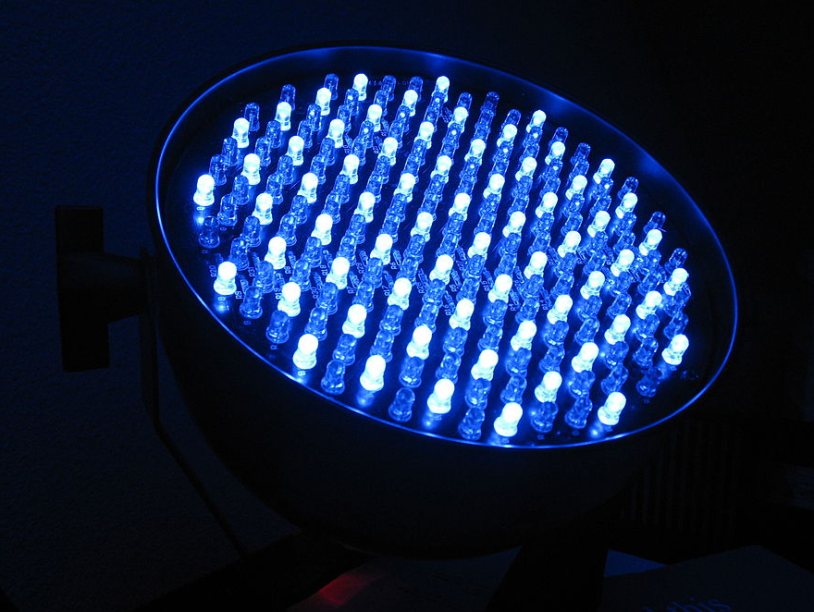
Japanese scientists Isamu Akasaki, Hiroshi Amano and Suudzi Nakamura (the latter now lives in the USA) became Nobel Prize laureates for the invention of the Syny LEDs. Analysts come to their senses from surprise: they could not predict that the Nobel Committee this year would pay attention to the applied sphere. The Japanese government may be enough: the plan “30 Nobel Prizes in half a century” declared in 2001 has been a little more close to implementation. And we will try to figure out what attracted the attention of the Nobel Committee.
Like other semiconductor devices, LEDs consist of two parts with different conductivity: electronic (N-type) and hole (P-type). In the first region there is an excess of negative charges, the second is their lack, therefore, the carriers of a positive charge are vacant places in the electronic membranes of atoms - “holes”. Between the P-region and the N-region is the border-PN transition. If you connect the positive pole of the power source to the p-region of the diode, and the negative, electrons and “holes” rush through the PN transition to the corresponding poles, and an electric current will occur in the circuit. If the polarity of the connection is changed, the current in the circuit will not. This is a common property of diodes.
The LEDs are also characterized by the fact that when the current is connected in the PN transition, they radiate light. This is due to the fact that electrons occupy vacant positions in the membranes of atoms (where there were “holes”), and photons are emitted. The length of the wave, what color the glow we will see depends on the material of the semiconductor
For the first time, the glow of the semiconductor was watched in 1907 by Marconi employee Briton Henry Round . In this effect, the Soviet physicist Oleg Losev , who then worked in Nizhny Novgorod, was independently opened in 1923. But the nature of this phenomenon was not fully understood by scientists, and the prospects for its application are unclear. Losev’s further studies were associated with the other use of semiconductor materials - the creation of crystalline radio detectors, but for a long time in the English literature, the glow of a semiconductor was called Losev Light “Losev’s glow”.
In the early 1960s, an infrared LED (Robert Bayard, Gary Pittman) and the LED, which gives the red light of the visible range ( Nick Holoniak ), was created. At first, the LEDs were satisfied with expensive, and their brightness was still small, but over time, the cost began to decline, and the brightness, on the contrary, would grow, and the LEDs could theoretically become competitors of incandescent lamps if they were able to give a wide spectrum (white). In the meantime, they remained red and was used mainly in various indicators.
In the early 70s, the LEDs of the yellow (George Craford) and the green glow color appeared. The light flow they created by the beginning of the 1990s reached a level of 1 lumen (50 Watte incandescent lamp gives a light flow of 50 lumens). But for successful use as sources of lighting, this, of course, was still not enough.
Today's laureates were able to solve two problems. They developed LEDs of high brightness, and also created the LEDs of blue light. And Isamu Akasaki with Hiroshi Amano, working at the University of Nagoya, and Suudzi Nakamura, who in the 1980s was an employee of the Nichia Chemical Industries, relied on Gauli nitride as the basis of the LEDs. It was already known that the substance gives a blue glow, but when growing nitride gallium crystals, it was very laborious and expensive. Akasaki and Amano were discovered by studying the substance under the scanning electron microscope, which this process increases the effectiveness of the P-layer. This was due to the fact that the stream of electrons removed the hydrogen nucleus from the form of the P-layer of the nucleus. In 1992, they managed to create a bright blue LED. In the same year, he created the LED Nakamura. He managed to get high -quality gallium nitride crystals, growing crystalline layers at first at low, and then at high temperature.
Obtaining blue LEDs gave a new impulse to the development of LED lighting. Semiconductor light sources began to win the competition. They consume less energy, at the same time give light of great brightness. Unlike fluorescent lamps, they do not contain mercury. Unlike incandescent lamps, they convert energy into light without loss, without spending it on heat release. In addition, they are small in size, weigh little, serve for a long time, effectively work at low temperatures, do not require time to warm up or shutdown. Since the LEDs do not heat up during work, they do not create a danger of fire.
The efforts of many developers led to further improvement of LED lamps. The last record achievement in the level of light recoil (attitude of the emitted light flow to the power consumption) is a little more than 300 lumen / watts, that is, one LED in this parameter is approximately 20 cerebrospinal incandescent lamps or 17 table halogen lamps.
Comparative light recoil of an oil lamp, incandescent lamp, fluorescent lamp and LED (Lumen / Watt).
Thanks to the blue LEDs, it became possible to obtain white light. There are two ways for this. White color is obtained using a combination of three LEDs: red, green and blue. Or blue LEDs are used in the lamp, but the phosphor layer converts their radiation into light into a relatively wide spectral strip with a maximum in the yellow area. As a result, the radiation of the LED and phosphor, mixing, give white light of various shades.
The design of the White LED (the chip is the LED, which gives blue light, the phosphor allows you to convert it into white) .
The use of blue light in LEDs gives another benefit. Since the wavelength of blue color is shorter than that, for example, infrared, it can be used more effectively in storage and transmission devices. In compact disks (CD), an infrared laser beam with a wavelength of 780 nm is used to read information. A significantly large BLU-RAY disks capacity is achieved through the use of blue-violet laser (405 Nm). The creation of a blue laser is also the work of Akasaki and Amano on the one hand, as well as Nakamura on the other. The blue LED serves as the most important component of this laser.