
Translated material
Crimea integration into Russia
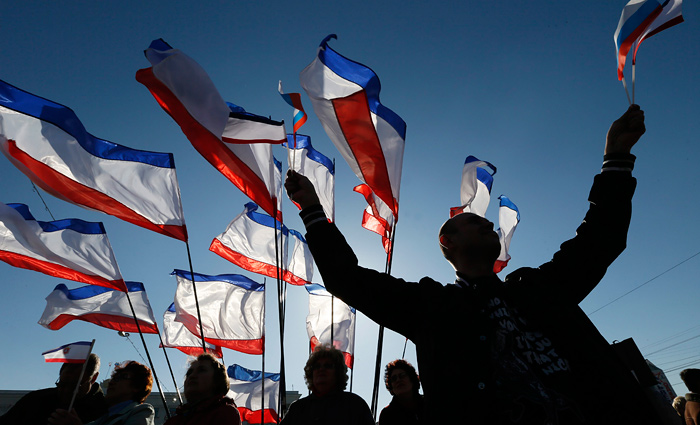
The action in honor of the referendum on the accession of Crimea to Russia. Simferopol, March 15, 2014. Photo: Yuri Kochetkov / TASS
The Crimean Terrorists case is far from the only story of the persecution of pro -Ukrainian activists in Crimea. Mediazona found out what is happening on the peninsula with political and civil activists, and how the situation with the rights of gay activists and drug addicts after the attachment of the peninsula to the Russian Federation changed.
"I was recommended to leave the territory of the Republic of Crimea"
Until the end of August, Roman Gridin headed the department of history in the Yalta historical and literary museum. He often appeared in public: in April 2014, the exhibition “Liberation of Yalta” dedicated to the 70th anniversary of the victory over German troops in the city was opened according to his project.
After the referendum in the Crimea on independence and the adoption of the peninsula in Russia, Gridin did not refuse Ukrainian citizenship and was going to continue working in the museum as a foreigner: he was preparing to get a residence permit in the Russian Federation and work permit. On the evening of August 14, a man with a barce and in a summer suit came to the Gridin museum.
“The man named my name and asked if I was. He presented a certificate in the name of the captain of the FSB Andreev and asked to appear in the FSB department for a conversation. On Kirov Street, house 33. I was made to understand that from the moment Crimea enters the legal zone of the Russian Federation, all my reposts, correspondence and comments are monitored by their service. They received an appropriate signal, ”says the Crimean.
He considers the list of “Maidan -Bender activists” with the “signal” with the names of the residents of Yalta, which was distributed around the city. The list also shows his surname. In addition, Gridin lit up in an action on Mount Chatyr-Dag, dedicated to the memory of the victims of the deportation of the Crimean Tatar people.
“There were standard questions: do I have friends or acquaintances in the“ right sector ”and“ freedom ”, do I have familiar pro -Ukrainian activists in the Crimea. Having received a negative answer, the FSBSHNI recommended me leaving the territory of the Republic of Crimea, ”said the interlocutor of the Mediazones.
Late night, Gridin left the interrogation, wrote a departure statement in the morning, finalized two weeks, collected things and went to Lviv.
Human rights activists working on the peninsula are known for isolated cases of a call for such preventive conversations, Andrei Yurov, chairman of the Crimean Field of Human Rights, told Mediazone.
“There are reasons to believe that there are more of them, just people who call for interrogation and force them to leave, try not to talk about it. For example, due to the fact that they had relatives in the Crimea. I think this applies primarily to activists. Moreover, those who are engaged in completely innocent activities fall under this category, for example, social networks are conducting, ”said Yurov, who recently submitteda report on the observance of human rights in Crimea in Kiev.
"Your neighbor is a bloody traitor from Crimea"
On average, before the start of Euromaidan, about 10 shares per month took place in the Crimea. According to local journalist Alexei Arunyan, most events were non -partisan and wore a social orientation. In Sevastopol, there was traditionally a strong environmental movement, and Simferopol was distinguished by a large number of left -wing organizations.
After the start of the Kyiv Euromaidan, promotions began to be held in the Crimea in support of protesters in the capital. They were held by political parties, and these rallies and pickets did not use particular popularity. No more than 200 people participated in them, and the authorities did not react to the protesters, Arunyan recalls.
In January, after the first serious clashes on Grushevsky Street in Kyiv, the attitude towards the protesters in the Crimea sharply changed from neutral to the negative. Simferopol was filled with leaflets with photographs of journalists, activists and NPO workers.
“Your neighbor is a bloody traitor from Crimea. Supports the criminal "Maidan". On his conscience, the blood and the lives of killed people. He receives money in a public organization financed by American intelligence agencies, ”one of such leaflets read. Next to the portrait of the “traitor”, bright pictures of clashes in Kyiv flaunted: fights, fire and radicals in masks.
Maximum, mentioned in one of the leaflets, suggested that they were glued with the silent consent of the police: “These posters appeared just a couple of days after I submitted a notification about the public campaign (which, by the way, is in no way connected with the Euromaidan or Antimaydan) to the city council of Simferopol and the police. Nowhere else have I "shone" my registration recently. Naturally, the version suggests itself that one of these organs "drains" the data to provocateurs.
In addition to leaflets, there were also videos that were twisted in the routes of the Crimean trolleybus and on a huge screen installed in the city center. At the pro -government rallies, leaflets with portraits of Simferopol ultras were handed out, supporting the Maidan. Even then, in the near -football circles of Crimea, they noticed that photographs of fans coincide with those that the local police made. According to a source of Mediazones, close to fan circles, many ultras left the peninsula for six months. They were followed by “traitors of Crimea” and members of the opposition to the current government of organizations. A number of non -profit organizations also moved to the mainland.
“Part of the NPOs, especially human rights, moved to the mainland. Some non -profit organizations will still continue to work in the Crimea and will re -register, ”says human rights activist Yurov.
Those who, for some reason, remained on the peninsula, retired. All the activity of the “anti -Russian underground”, in which the nationalists are mainly consist of, boils down to laying stickers and drawing graffiti. The second wave of resistance was absolutely autonomous from organizations that showed activity in the Crimea to the Maidan, says journalist Arunyan. The former activist of one of the left -winging organizations confirms: the current Crimean opposition appeared in the summer, its members do not have a protest story and do not contact famous activists.
"Used current, hit the head with a brick"
A week before the referendum on the independence of Crimea, March 9, on the peninsula, two supporters of the Euromaidan who arrived at the Simferopol station were detained: Andrei Shchekin (one of the heroes of the leaflet about traitors) and Anatoly Kovalsky. Whether they were charged with him is unknown. On the same day, at the entrance to the Crimea from Kherson, the journalist Elena Maksimenko, the press secretary of Avtodana, Ekaterina Butko, a resident of Yalta Alexander Ryazantsev and their driver Yevgeny Rakhno, were detained. The son of Ukrainian politician Anatoly Gritsenko Alexei ceased to communicate, and other activists were reported.
Desters on the border of the girls and their driver were released on March 11. Already after the referendum, Shchekin, Gritsenko, Kovalsky and others were released. The prisoners said that Kyiv exchanged them for unknown persons, and said that they were held in the basement and cruelly tortured.
“They beat me, used the current, beat the brick on the head, made cuts with a knife on the body in the heart. The people who interrogated me believed that I was connected with the “right sector” suspected me of preparing for a referendum disruption and asked if Kyiv finances my activity, ”the cheek told Mediazone.
Another opponent of the pro -Russian course of Crimea, the decisions of Ametov were found dead. He conducted a single action against separatist sentiments in the Crimea: silently stood on Lenin Square opposite the Council of Ministers on March 3. Several people in camouflage detained him and put him in a car.
On March 8, the body of the decisions of Ametov was found with traces of torture. Someone hit the victim’s legs handcuffs, and his mouth shook his adhesive tape.
To this day, the fate of Vasily Chernysh, who disappeared in the same period, remains unknown. According to his associates from the Avtomaydan movement, Chernysh worked in the SBU of Sevastopol, from where he left in 2013 due to the conflict with the leadership. During the events in Kyiv, the missing person actively participated in the shares of "Avtomaydan", and before the referendum he went to the Crimea. The last time he updated his Facebook on March 14.
Three supporters of the territorial integrity of Ukraine disappeared in late May. On May 26, Timur Shaimardanov, an activist of the Ukrainian People's House initiative group, did not return. Before the disappearance, he was engaged in the search for his friend Leonid Korzh, who did not appear at the place of residence for several days and did not get in touch.
On May 30, the Crimean activist Seran Zinedinov, also known for his civil activity, disappeared. “He left the house for 10 minutes ... And someone intercepted him ... Without ten, his phone has turned off without eight, for 24 days it hasn’t been in touch for 24 days,” Blagic information about the fate of the son of Elvir Zinedinov shared with the journalists of the Gromysk Telebacon.
Gallery1
The whereabouts of missing activists is still unknown. Shaimardanova and Zinedinova of the Crimea Ministry of Internal Affairs put on the wanted list as missing. There are no messages about Chernysh and Korzh on the police website.
The chairman of the Crimean Field Mission to Human Rights, Yurov believes that the actions of law enforcement agencies for the search for the missing were insufficient.
"Searched drugs and automatic"
Over the past two weeks, it has become known about several cases of the disappearance of the young Crimean Tatars. Eden Asanov, who disappeared in Yevpatoria on September 29 in Yevpatoria, was found hanged in an abandoned sanatorium. The fate of the escorter Apselyamov, who left the house on the evening of October 3 and has not returned, is still unknown. More about two missing ones became known on September 27. About 19 hours near the village of Sarah-Su, unknown people abducted two Crimean Tatars-Islam Dzhepparov and his cousin Jevids Islamov.
“They were pushed into a car that disappeared in the direction of Feodosia,” Refat Chubarov wrote on his Facebook, the head of the Crimean Tatars Majlis.
He himself cannot get to the Crimea since the summer. It was not allowed on July 5: they stopped on the border of Ukraine with Russia at the recently opened border checkpoint of the Chongar check. The politician who refused to accept Russian citizenship was declared an all -around.
Chubarova personally met the prosecutor of Crimea Natalya Poklonskaya, who issued the head of the Crimean Tatars to the head of the Majlis of the Crimean Tatars about the inadmissibility of the Majlis of extremist activity. Chubarov defiantly did not listen to the cockroach text of the warning blonde with the inscription Team Russia and demanded to speak with him either in Ukrainian or in the Crimean Tatar language-the official languages of the republic.
The next five years, Chubarov is forbidden to cross the Russian border. The Peninsula of the Peninsula was made by the National leader of the Crimean Tatars of Mustafa Dzhemilev. He was not allowed through the Armyansk checkpoint on May 3. In response to this decision, the Crimean Tatars came to the checkpoint in order to block the track leading to the peninsula and hold their leader in a living corridor.
To do this, they broke into the mainland, that is, from the point of view of Russian laws, illegally crossed the border. After the action, Russian law enforcement agencies opened a criminal case against unidentified persons under Article 322 of the Criminal Code (illegal crossing of the border), and a wave of searches swept along the peninsula.
In the boarding school for gifted children located in the Bakhchisarai district, students forced to take off all objects with national symbols, from the madrassas located in the city of Kolchugino, they took computers, actively searched the houses of Crimean Tatars.
“As they went into the house, they immediately stated that they were looking for an armed person, they were looking for drugs and an automatic machine. The house revised all the literature. Among all, the book “The Fortress of a Muslim” was seized, ”the son of one of these houses Bekir Chakhalov told the ATR channel.
They also complain about searches in the Ukrainian branch of the Islamic Party "Hizb Ut-Tahrir al-Islami." Since the distribution of Russian legislation on the Crimean Peninsula, the organization has encountered a serious problem. Russia is the only country in the world where this Hizb-Ut-Tahrir is considered terrorist. Party members are also persecuted in Central Asia, but on charges not related to terrorism. Due to the fact that Hizb-Ut-Tahrir does not recognize Israel, the organization is prohibited in Germany.
Now in Crimea there is a transitional period, and the authorities of the peninsula do not pursue members specifically to this Islamic party: the interests of the authorities are applied to all Muslim organizations. The supporters of the Hizb-Ut-Tahrir who did not support the Crimean Tatars campaign on May 3, were searches in the framework of crossing the border. Party representatives believe that the relations of Russia and Muslims in Crimea will develop according to the North Caucasian scenario.
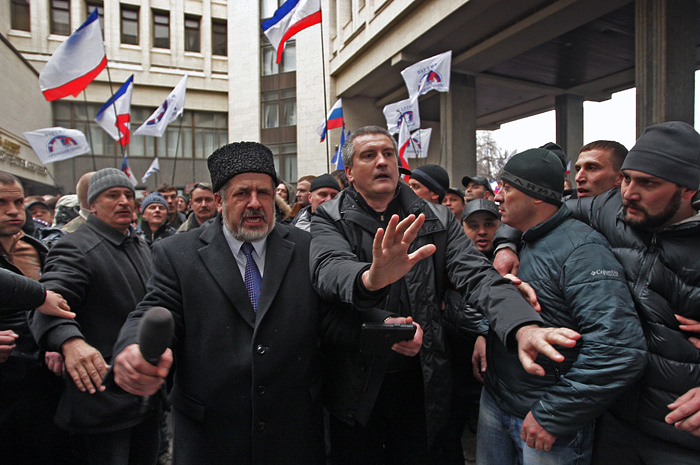
On September 22, the head of Majlis Chubarov published on Facebook the thesis of his speech at the first international conference on indigenous peoples to the UN, in which he accused the Crimean authorities of intention to destroy the national institutions of the Crimean Tatar people - Kurultay and Medzhlis.
According to one of the leaders of the Crimean Tatars, Mustafa Dzhemilev, who is now in forced emigration, from the time of the accession of Crimea to Russia, 18 of his compatriots have already disappeared. Crimean Tatars, he said, constantly undergo pressure from the new authorities.
“A wave of searches of the houses of Crimean Tatars, mosques, educational institutions, and libraries swept throughout Crimea. The last week more than 40 searches for formal occasions have been held, ”Gemielev said on October 2 during a meeting of the Parliamentary Assembly of the Council of Europe.
Constant searches of the Crimean Tatars caused concern among the Muslims of Russia. At a meeting with the head of the Crimea Sergei Aksenov, the chairman of the Council of the Russian Muftis, Ravil Gainutdin, asked to figure out these cases. Aksenov asked journalists to provide specific data testifying to the illegal actions of the security forces. A week later on September 16, exactly half a year after the referendum in the Crimea about the department from Ukraine, the law enforcement agencies searched and sealed the Majlis office. The basis for investigative actions was the same criminal case of the illegal crossing of the border.
"Very correct law"
The new authorities of Crimea drew attention to the LGBT community. In early September, the acting head of the ARC Sergey Aksenov promised the residents of the republic that he would not allow a gay pride in the territory of Crimea, and promised to gay activists the problems with the police and self-defense of the republic.
“If people of non -traditional orientation go out onto the streets, self -defense and the police will react accordingly to this. There will be no gay parades in the Crimea, ”Aksenov wrote on his Twitter.
The statement of the head of the new subject outraged Russian LGBT activists. The first to recording Aksenov was the permanent organizer of the capital's gay graders Nikolai Alekseev. The veteran of the gay movement called the ban on Aksenov illegal and contradicting the federal legislation of Russia.
“If Crimea has become part of Russia, respectively, it must obey federal legislation, which does not delegate such powers to the subjects of the Russian Federation,” Alekseev was indignant on the air of the Radio Says Moscow.
True, in the Crimea itself there were no dissatisfied with the performance of Aksenov.
“It is very good that we switched to Russian legislation, and the adopted law on the ban on gay propaganda is very useful in our perverted society. A very correct law, ”Artem Lavsky, an active participant in the LGBT community in Crimea, told Mediazone. He also assured that the gays of Crimea are ready to refuse to conduct parades.
“We do not need such promotions. They have not been before. We have where to relax, ”says Lavsky.
Igor Shah, the administrator of one of the gay groups of VKontakte for residents of Crimea dedicated to mainly acquaintances, confirmed that the gay community of the peninsula did not notice the pressure of the authorities.
"Several dozen people died after stopping methadone programs"
Back in March, drug addicts could come to the Sevastopol Psychiatric Hospital. The substance relieved heroine breaking and gave them the opportunity to work normally. Together with the methadone, if necessary, the drugs were given - supporting drugs for HIV and hepatitis.
However, the methadone legal in Ukraine is prohibited in Russia, therefore, after the Crimea enters into Russia, the programs that worked in Simferopol, Sevastopol, Dzhankoy, Evpatoria, Saki, Yalta, Kerch and Theodosia had to turn off.
“There really was not even any decision to ban replacement therapy programs. The FSKN of Russia scared those involved in the ZT (replacement therapy - MZ ) of the organization, and the Ukrainian side did not import the drug. The remaining several thousand tablets of the drug simply confiscated, ” recalls the former participant in the methadone program Igor Kuzmenko.
Without therapy, 806 people were left overnight and only 56 of them went to the mainland to continue taking the drug in other cities, Kuzmenko said.
“About 30 more people left for Russia, to undergo rehabilitation. Many left there, fled without waiting for the end. According to our information, one patient from Simferopol died in St. Petersburg during rehabilitation from an overdose of heroin, ”he says.
Kuzmenko is convinced that it was necessary to continue the program. Many of Crimean customers of replacement therapy programs have various diagnoses. 43%-HIV-infected. Almost all of the exception - infected with hepatitis C.
«Для многих окончание программы — просто смертный приговор, без преувеличения. На сегодня, по неподтвержденным данным, несколько десятков человек умерли после остановки программ в Крыму. В одном только Симферополе погибло от пяти до семи человек. К сожалению, эти цифры будут постоянно расти», — переживает бывший участник крымской программы заместительной терапии.
По приблизительным подсчетам Кузьменко, сейчас около 500 человек вернулись на улицы к привычным «грязным» наркотикам, вышли из-под врачебного контроля и окунулись в криминал. Это ставит под угрозу не только самих наркозависимых, но и все население Крыма. В долгосрочной перспективе, полагает Кузьменко, следует ждать резкий рост криминализации и вспышки социально значимых заболеваний, в том числе туберкулеза, ВИЧ и гепатита С.
Резкий обрыв заместительной терапии привел к гибели как минимум 20 человек, подтверждает директор фонда имени Андрея Рылькова Анна Саранг: «Печально, что многих людей обманули. Россия им обещала адекватное лечение, многие поехали к врачам в Санкт-Петербург, но им не обеспечили необходимую терапию и даже не компенсировали проезд».
По ее прогнозам, положение наркозависимых на полуострове значительно ухудшится — российские правовые реалии таковы, что в отношении потребителей наркотиков не соблюдается ряд международных норм. «Они не только не могут получать адекватную терапию. В России наркозависимые лишены нормального медицинского обслуживания. Их права не соблюдаются полицейскими», — говорит Саранг.
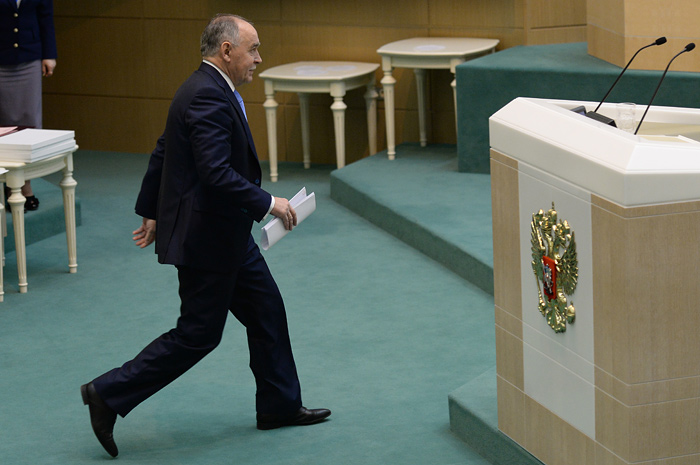
Российские власти оперируют другой статистикой. Глава ФСКН Виктор Иванов подсчитал, что за три года в Крыму умерли 200 участников метадоновой программы, а уровень смертности среди крымских наркопотребителей в два раза превысил российский.
«Данные свидетельствуют: до 90 процентов купленных за деньги налогоплательщиков таблеток уходит прямым трансфертом на криминальный рынок, где продается по цене афганского героина. К сожалению, некоторые медицинские работники в Крыму и сотрудники правоохранительных органов становились соучастниками криминального оборота наркотиков», — отметил Иванов.
«Были перегибы»
Правозащитник Юров полагает, что в данный момент ситуация с соблюдением прав человека в Крыму несколько хуже, чем в других регионах европейской части России.
«Я говорю не о Северном Кавказе, где ситуация абсолютно иная, и не о Москве и Питере. Я сравниваю с такими регионами как Краснодар и Ростов-на-Дону. Это касается фундаментальных свобод. Законы России дальше от европейских стандартов, чем украинские. Для людей это становится шоком. Проблемой являются и местные нормы — Крым попал в список регионов, где власти действую достаточно жестко», — говорит он.
Отчасти это признают и крымские власти. В начале сентября первый вице-премьер Крыма Михаил Шеремет, командовавший силами самообороны, признал, что парамилитарные формирования действовали на территории АРК жестко.
Использование военизированных формирований для поддержания общественного порядка, патрулирования улиц и досмотра вещей в поездах и на железнодорожных станциях — один из пунктов, за которые правозащитники критикуют власти АРК.
«Были перегибы. Когда весной "правосеки" к нам ехали, у многих не выдерживали нервы. Некоторых силовиков приходилось из их кабинетов вытаскивать насильно. Но тогда была революция, ребят надо оправдать», — сказал Шеремет «Коммерсанту».
Госсовет Крыма в начале октября внес в российский парламент проект амнистии для народных ополченцев и дружинников, чьи действия повлекли какой-либо вред или ущерб. По замыслу крымских депутатов, амнистия должна распространиться не только на совершивших административные правонарушения дружинников, но и на подозреваемых и обвиняемых по уголовным делам. Предполагается, что амнистия затронет и ранее осужденных.