
Translated material
When we look at the marriage of others
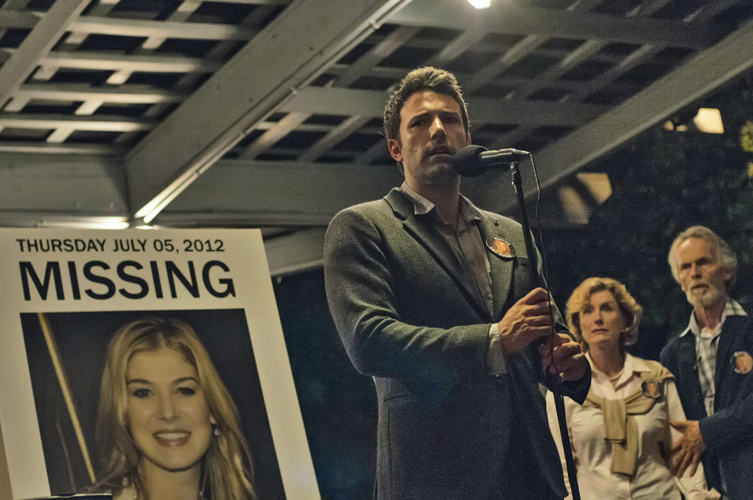
New-and all the old films of David Fincher are customary to watch as a social satire, in this case-a satire for marriage in American. But the story told by writer Gillian Flynn about the sympathy of Madame Revenge in something even flatters the institution of marriage. Showing the marriage as an enterprise, in principle, the hopeless, the scriptwriter and author of the primary source of the “disappeared” nevertheless sees him quite entertaining. Marriage as a detective - ah, if every family story was as action -packed as the case of Nika and his supposedly abducted wife Amy. Each unlucky family is unhappy in their own way: some couples behave like in Bergman’s films, others-as in Woody Allen’s films, but in such relationships there are still fewer drive. Unless with a sense of humor among the heroes of Allen - and Bergman - is usually better.
In the “disappeared”, however, there are also a lot of ridiculous: for example, the scene in which the lawyer teaches the hero Ben Affleck the acting game is almost as good as DiCaprio’s voiceover in the Wall Street Wolf, when he aloud explains how his face expression changes. From the joke, the film begins: the Fincher, the constant defendant in the rating of new Cubrics (according to the latest data, is inferior to P.T. Anderson, but fights for silver with Glazer), in the opening credits puts his own name in the same frame with the cover of the Mastermind's board game. This word is called the one who invisibly and cunningly leads some process, so that the Fincher immediately denotes his own place in his relationship with the audience-otherwise why give the initial credits that have long gone out of fashion? The main character, which directed her own death, so that the suspicion fell on the wrong spouse, is also Mastermind . An ideal crime is a skillfully made text, and it is not surprising that the central element of the Amy plan is a detailed diary describing the fictitious version of her life with the nickname (or not fictitious? We will never know about this). However, the paradox of such a text is that his task will be failed if someone, besides the hero of Affleck, will be able to correctly read the message and evaluate the true beauty of the plan. Another genre, which suggests only one addressee, is a love message, and Amy, as in a romantic correspondence, uses the jokes and words known to them only by the two of them.
The scandalous story of her husband who killed his wife due to insurance remains uninitiated; This is her, obedient to Amy, the media will reconstruct the media. In this sense, the “disappeared” is about the same thing that was the “social network”: modern media is not a map of reality, but by a separate reality. Once on the screen, everyone against his will becomes a character, forced him to play the role (recall again the rehearsal of Nick with a lawyer). This also happened with the heroine of Pike, which the writers-writers with a series of their books turned Super-Emy into a brilliant girl; Moreover, even such an obviously artificial image, fans are still unconditionally identified with the prototype. In the “disappeared”, each of the characters is observed, and they all know about it, changing their role in the situation: what the film expert Laura Malvy called “ TobelookeDatones ” (the property of being an object of view) is applied to all actors.
On Nick, by the way, - first of all (it turns out to be the main target of television), and this despite the fact that in classical Hollywood the object of the look - male gaze - were exclusively women. Hitchcock's “dizziness”, another film about the staging disappearance, generally exclusively talked about this view. The Fincher in the "disappeared" works just in this territory. Flynn has a Hitchcock drama with an ideal crime, spoiler and plot, changing his direction and genre in the middle, as in “birds” or “psycho”. Rosamund Pike has a Hitchcock appearance, and the first thing we see in the film was her blond hair. For fidelity closer to the final, the director also adds a direct quote from the same “psycho”. But Hitchcock’s films are obviously male, but “disappeared” - no: the events of the film are presented to us in the presentation of both spouses, and the viewer thereby gives a rare freedom for the Hollywood film - to choose who to sympathize with. Affleck is a bastard, but the victim, Pike - a somewhat exaggerated reaction, but, in the end, no one was indignant when Nicole Kidman burned Dogville with women and children in response to cruelty. His and her points of view on what is happening differ, as articles about marriage in male and female magazines (where both heroes, in fact, worked when they met): both versions are interpretation of the same narrative, but only interpretation. Nobody knows the ultimate truth, because there is no ultimate truth: another text is always hidden behind the text, behind the mask - another mask. We play roles not only on the screen, but also in any situation when they look at us, and in marriage too; And when no one looks at us, we disappear.