
Translated material
Machine: stories of animation
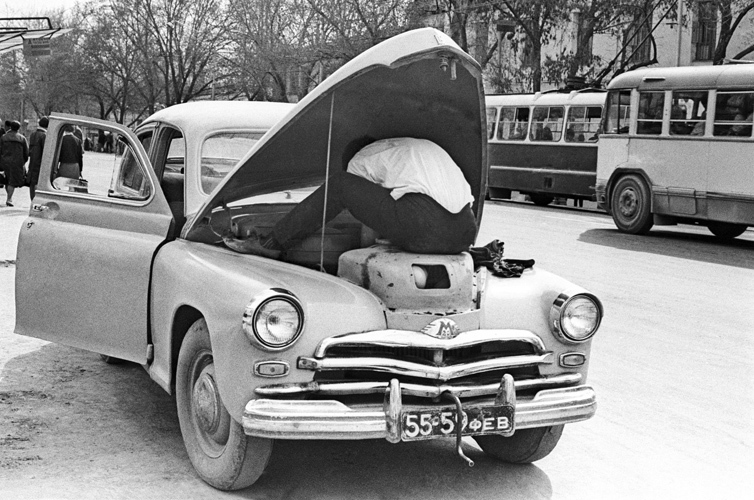
Today at Colta.ru, as part of the Sinema Belief project, you can watch Daria Khleskina's film “Last Limous”. Evgenia Pishchikova also looked at him, who thought about what was and became a car for the Soviet and post -Soviet man.
Last week, the Bright Way was again shown, one of Alexandrov’s most entertaining films with a masked ending. If you watch this film with a fresh eye, without prejudices (or rather, without beliefs), then the plot logic is visible - closer to the final, the heroine Lyubov Orlova, the noble weaver Tanya Morozova, receives the Order and leaves the worries crazy. At first, Soviet Ophelia dances with herself in the hood hall, then talks with his own reflection in the mirror, then reality is replaced by a vision, and the jubilant madman, as it were, enters the mirror and flies with him to the future. A beautiful Soviet limousine rises into the air over Moscow.
The convertible "ZIL" turns out to be a time machine. And in the documentary of Daria Khleskina about the death of ZIL, three convertibles standing in an empty limousine workshop are also a time of time. Only they, ordered to the anniversary parade in honor of the Victory Day of 2010, were supposed to transfer the plant to the past - to return it to the honor and symbolic power.
But in the film Khlestkina, both time and cars are not that the main thing. That is, important - but as part of personal history. Before us is a story about several dozen workers left (in every sense of the word) in empty workshops. Here was an important order for three convertibles for a bright holiday - and he was canceled at the last moment.
And people, and dogs, and cats, and limousines - they forgot all in these workshops. Moreover, on an equal footing.
On equal terms, since the Russian car is always animated. Always-a symbol of something and always-part of personal history.
Figure practices: slave market
“I did not get out of it; Until the money ended, every day he drove her to the sink (then washed himself) and admired her every day, looking from the window. ”
“I really, really love my boy! I spend all the money on it when I am going, I feel that we are one. It sounds funny, but without him I can’t. ”
“I called my“ female dog ”. Today I sold it, and for some reason I am sad. ”
So car owners on the forums write about their cars. The era of new sincerity has come, now a lot of things hidden can be found in network bins. Many secret connections are manifested - and the connection of the Russian person and the car also becomes clearer. Branches on auto forums, where the owners are divided by their hidden and unreasonable pain after the sale of the car, breathe fantastic moods, some kind of Steampankovskaya "Uncle Tom's hut." This is a stylized lamb sorrow, the sale of the living.
“He gave the old woman. Well, where, I didn’t pull it already. You can’t parish a decent store, you will not go to the meeting on it. The young boy took, from the piece of iron. He will devote in two years and quit breath. ”
“There is no respect for a used mafynka, of course, now they drive along the Moscow Ring Road. And she did not know for all seven years of trouble for all seven years: the 95th and the garage. "
And then the commentators-people who add salt:
“I call my call swallow. Well, as it should be, usually men aiming their old Taratayka and calling a swallow, so I am. Previously, I also treated cars like a pile of iron, but when my own appears, you get through to it, you begin to hear, feel. I will not sell it, I will put it on a joke. I don’t even want to think that my swallow will someday go into a car paradise. ”
It would be possible to compare the atmosphere of these sites with the intonations of the forums at which lovers of pets (dogs and cats) gather; And then, the car is a horse force, it’s like a horse (which means that a special type of friendship, partnership, special dramatic and courageous sadness are justified: “Yesaul, why did you abandon the horse?”), But it doesn’t work out: there are too much sensual in relation to the car.
The complainant who wrote that “there is no respect for the used Mafin”, he immediately added with severe male trades: “I took my virgin, in cellophane; At least he knew for sure that she was the first! And now they will take it on it. ” Here, in general, a semi -novel, a semi -shaped theme - reselling a hackneyed girl into a cheaper institution.
I did not even choose the most expressive textosterone posts. There are many of them. It is generally perplex that the car in Russia is anthropomorphic. But who is she - a friend, lover, lover, child? About the child, I’m also not just like that - on many car portals, the owners of the machines are starting “growth lines”, as on parent sites, and write statuses: “We are three years, four months and five days”. Or - "We are together for two years, seven months and four days." These “three years old” and on maternal sites are pre-annoying that bodily sentimental silushka with which mother privatizes the child: “we are growing”, “our teeth are cut”, “we are already three years old”. And here - about “Peugeot”: “I call my machine“ my baby ”, not because she is small, but because we are so nice, I love her so much, she is like a daughter ...”
How did it all begin?
In the Museum of Labor Glory "AvtoVAZ" (now it is just called the Museum of OJSC AvtoVAZ), letters are stored that came to the factory from grateful consumers - car owners of the seventies. E.Yu. Prokofiev, director of the Humanitarian Institute of Togliatti State University, read these letters and described.
For the most part, the happy owners of the “Lada” added a story about their love for the car that he got to the gratitude, wrote that they consider the car a “family member” and called a “swallow”, “girlfriend”, “nurse”, “employee”.
“Her husband affectionately calls“ a swallow ”” (a fragment of a letter from N.A. Korneva); “For many years now I have been calling her“ Nivushka ”,“ girlfriend ”” (fragment of a letter from A.S. Kataev). Most often, these definitions are found - a swallow, a nurse, a hostess, a girlfriend, an assistant, a hard worker. Here, of course, the atmosphere of time works - the car was such an important thing in the hierarchy of things (the main thing) that it was necessary to reduce the hedonistic meaning of the purchase and emphasize the economic benefits.
Just like a TV, a refrigerator, a wall - the car was just a machine. No matter what - she was an eternal thing. Eternal family engine.
Pathos professionals did not do without a decrease in pathos - so, in the collection “Red Cloves. Essays on the Komsomol members of the eighties ”(Moscow Worker Publishing House, 1982) Journalists, describing the Komsomol life, tried not to mention their heroes about the property world. But if it didn’t succeed (it was also necessary about the “hobby”), then it sounded like this: “Garik Sushilin, a senior researcher, had already traveled half-Russia on his own car.” Without a diminutive suffix in any way. Only a little car can belong to a young enthusiast (it’s good that it’s not a car), and then he should be operated in the tail and in the mane and on the romantic occasion of the “road to the unknown”.
However, the car in the seventies and eighties-so it is generally accepted-became a family member of the family also because money for him was collected by a family, a clan; The car could serve two generations in a row and served for decades - the idea is considered to be generally accepted that it was overgrown with individual features because it had no species differences. Rather, they were not important. Just like a TV, a refrigerator, a wall - the car was just a machine. No matter what - she was an eternal thing. Eternal family engine.
Perhaps it is, if it concerns the "people's car". Spartanism did not take root in privileged circles in Soviet times. Where do you get people of a high circle living in a greedy interest in the property hierarchy and accurate knowledge, as the hierarchical staircase is arranged. Here Marshak knew the Littlefond Light well, and stigmatized him:
Writing weight by car
They measured in the conversation:
Genius - on the "zil" long,
Just talent - on Victory.
And who failed to achieve
In the art of special success,
Buys a Moskvich car
Or walks on foot. Like Chekhov.
(S. Marshak, "weight measures")
The last line gives a rooster, fake - although its meaning is understandable: to give satirical corporate observation a different dimension and a “correct” scale.
I was not able to find out whether the great people were given (and the “ZIL” and other Soviet “limousims” - A. Kabakov invented the word - got only to great people) nicknames to their time machines. Perhaps this kind of car is too materialized power to load them with additional meanings.
But folk cars were loaded with meanings on the very rim. The car is like a “midnight gate”, as a symbol of a possible shoot (“midnight gate” in the house of the Chinese mandarin-a door at the far end of the garden, through which the family could try to run away during the next palace coup); as an inalienable private area. The symbol of the maximum permissible private freedom is a car and a tent, as in the film “Three Plus Two”.
The ghost of wealth, of course, - and here the topic of relations between the machine and home, housing enters. Karl Schlegel, describing Moscow in 1982 (in the book “Comprehending Moscow”), mentions a crowd in a banner lane - a crowd of people changing apartments. This is the usual mishmash of citizens in black coats and felt boots. And then in neighboring alleys - a collection of those who change or sells spare parts. A striking impression is an amazing gathering of the Soviet dandy, special people, dandy. The historian notes an entertaining phenomenon for the European mind: owners of housing, apartments, at home - the most important and expensive of everything that an ordinary person receives from life - look as if they had come to a flea market to sell galoshes, while car owners are a higher caste. The distorted relations between “houses and cars” especially showed themselves at the very end of the eighties, when the apartments were changed to the “Zhiguli” of the ninth model (free for the unattainable); But to this day there are intrigue.
The car is an inalienable private area. A symbol of maximum permissible private freedom.
Thirty percent of families buy a more expensive car than they can afford on the total income of their household. Half of the cars that are passing by your window are now bought on credit. There are frequent cases when a family living in a panel apartment acquires a car at a price of fifty and above thousands of dollars, answering sociologists to the questions "Why?" as follows: “We live once”; “And why not, there is still not enough for housing, so at least rejoice”; "This is our second house."
It is clear that a car with such a luggage deserves a naming. But what?
When foreign cars and folk cars were interfered with foreigners in Russia, the “nurse” and the “hard workers” were renamed “Lizards” and “Girls”.
And when by this year the Public Opinion Foundation “conducted a survey among drivers” in order to detect “how motorists relate to their cars”, then 45% of the people admitted that they are so attached to their car that they did not want to call it soulless means of movement. And every fourth gives its car an affectionate name. Among the most popular: a swallow, my girl, boy, baby, baby, beauty, darling, princess.
Sailor and girl
“Each driver, without hesitation, will tell you what gender of his car at any time of the day and tell his name” - such a status is on one of the machine portals.
And then, immediately under the status, the answers to the question of Neophyte are fastened: "Why a swallow?" Choir of Voice: “When you have your own, maybe you will understand!”; “The motor seals - maybe that's why?”; "Because she becomes like a pet or a second girl."
There are a lot of sensuality in the names of cars - but the attitude to the sexual issue in the automotive community is rather conservative. Masculinity is welcomed by the most combat - exaggerated, with gadness, with rootedism; But femininity in honor is only touching and bright.
The car is rather a young lady, a girl - it will be called a “girl” in most cases. The nicknames of aggressive sexual are not very common among men-carriers or the ladies-which is even strange. No “tigress” there or “panther”.
Half of the cars that are passing by your window are now bought on credit.
If the lady has a car - a girl, then most often she will be (not counting the already listed by the most popular names) a bird or a man. If the boy, then nicknames are night, bed, but chirping: eggplant, pepper, jipetz, wad, chiz, Zhyp, zeal. However, in each community there is a girl who will speak out with a certainty - say, he will call his SUV with a stallion or beast.
But men pay tribute to the highest style. They, in general, are the “girls” “their girls” and they call (as an option - Krasava Putyatish, Juliet, Mafynko, Mamzel, old woman, cutie), but if their car is a combat comrade, there is no limit to beauty and strength.
Lizard. Dragon. Terminator. Tsunami. Tank. Armen -player by chicks. Athlete. Red partisan. Dviglo.
Is the car a personal territory or part of the family history? Both. The car is certainly included in family and birth rituals.
Around the car is a family - American Richard Rangham in the book “Tilted Fire. How cooking has made us people ”writes that a daily family dinner around the hearth created a family in a classical sense, gender order. The disappearance of joint meal makes us look for "new forms of family solidarity." All like this - and these forms are: not absorption of food, but a joint anticipation of food unites the family in the new ritual of the weekly trip "For products". Again, the machine takes on the functions of the house: produces family warmth instead of a hearth.
When a man marries, buying a car for many young couples becomes a prerequisite for the home world. Ritual of unity. Everything converges here: the desired sobriety, a common loan as a rally factor and, finally, comfort. The marriage in modern Slobodic mythology is considered not as a well -deserved transition from the status of a “boy” to the status of “husband”, not as a factor in confirmation of masculinity, but on the contrary, as an infringement (caught, surrendered, switched to the female side of life). The machine is necessary to restore masculinity.
And what is it?
Journalist Molly Young from New York Magazine suggested that Russian men compensate for their secret craving for polygamy in love with expensive cars: most of the jeep owners interviewed by it said that in the car they feel protected; “Like in a house on wheels,” the machine covers them from all sides.
"What is it, if not the triumph of the victorious?" - asked Molly.
For example, the triumph of the victorious-humorous. Or winning and social.
After all, the car is a “girl”, not a woman - precisely because our hero is ready to flee from the celebration of “female”.
The machine becomes a metaphor for absolute possession - both horse force and a car soul. An excess of external domination requires its personal domination - and the attitude to the car shows a social attitude to the authorities. On the one hand, we are glad to treat the subcutaneous creature as a child, a kitten (and recognize the correctness and naturalness of the paternalistic approach), on the other hand, we feel acutely the erotic side of the authorities.
We are constantly naked in front of her, we can constantly take away something basic, the original-food, house. Or intimate - smoke and lace underpants. For twenty years, we never even agreed - who we should call each other: there is no social protection with status, appeal. So we walk the streets - “Men” and “Women”.
But we have very beautiful, expensive cars. Our “kids” and “girls”, our animated tanks, princesses and red partisans.
And I must tell you that the undivided ownership of even one soul is very able to reconcile with life - or at least console.