
Translated material
See the "Last Limousine" Daria Khlestkina
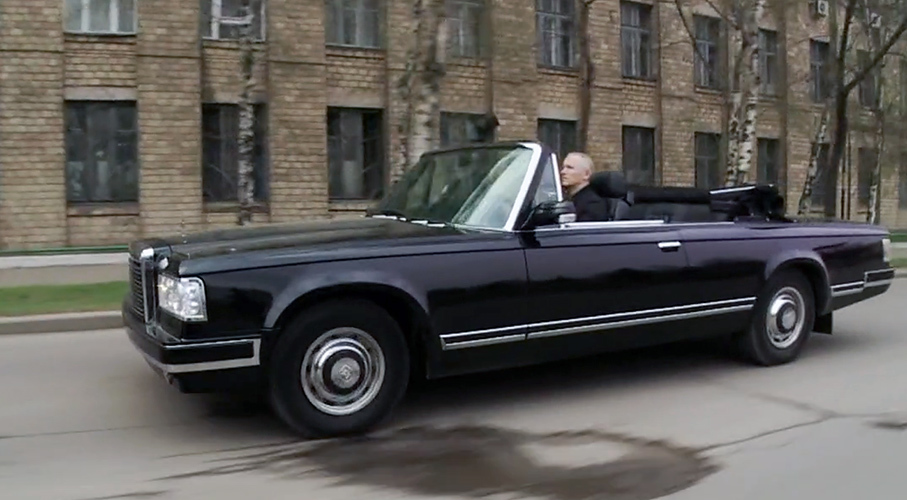
Today and only today, within the framework of the Sinma Belief project, from 11:00 to 23:00 you can see the wonderful film by Daria Khleskina's Last Limousine. On October 8, we watched this movie with readers of the Coobes on Artplay - and discussed with his producer Marina Razbuzhkina, publicist Evgenia Pishchikova, political scientist Alexander Morozov and philosopher Mikhail Mensetsky. From COLTA . Ru at the show was Mikhail Ratgauz.
Mikhail Ratgauz: We watched this not too cheerful film, let's talk.
Alexander Morozov: First of all, I want to thank Daria Khleskina and Marina I scan for a magnificent film, completely brilliant. I can briefly say my main impression at the entrance: this is such a documentary “Solaris”. Before us is a spacecraft abandoned in space, it was once put in orbit, some Banionis, Solonitsyn, Yurita still function on it, they are raving ... In principle, they are able to carry out some biological experiments, possibly derive a strain. But the connection with the earth has long been lost. Sometimes signals come from the Earth, and according to these signals they try to collect a certain analogue of the robot, which was collected before that. But at the same time, all the characters cause tremendous sympathy, tremendous interest, even superior to sympathy. And it seems to me important that this is not a left, not a social film, but completely metaphysical. Its characters do not cause thoughts about the collapse of the Soviet Union, but the primary, almost animal sympathy. Despite the fact that this is the world of people distorted ... I have well known in the past: many years of work, drunkenness in production, and so on ... At the same time, it can be seen how power is maintained in them.
Evgenia Pishchikova: And it seemed to me interesting that nothing had changed. The working Soviet plant in 1970 and what we saw in the film is almost the same thing. These are people who feel at home. Yes, there are few of them, but they retain the usual lifestyle. This absolute preservation of their inner world struck me.
Mikhail Mayatsky: Thank you very much for this film, really amazing! It is difficult to get rid of the thought that this is a monument not only to the plant, but also to hundreds and thousands of other similar situations that will be unheated, unprotected. Nameless ruins remaining throughout the country, and the ruins of human lives. That generation simply disappeared, burned, and this is the remnants surviving the catastrophe. I still saw a social film that serves as an addition to the measurement of the collapse of the Soviet project, which they talk about a lot-to the geopolitical one. Social collapse is not comprehended, little is pronounced.
Morozov: I want to object to Mikhail right away, because a great achievement of this film is the absolute equalization of a person to cats and dogs. I will say now, as Bruno Latur would say that there is no difference between a person and a cat in a stream of life. Therefore, we are distracted precisely from the context of geopolitics and see that people, dogs and machines themselves, debris, details themselves are the content of one life flow. And it is not so easy to answer the question of what is his semantic nucleus. The plot is the assembly assembly, but we understand that this is an accidental episode. That is, they could not collect a convertible, and in front of them they could set the task of writing a symphony, they would have gathered and began to write it. And these wonderful storekeepers, women who are obviously thrown into the past, but they still feel the life pressure, these strange, hired new Kyrgyzes that integrate into the dead space station ... It seems to me that the plot is not a assembly assembly, but a difficult topic of preserving the living. These people, extremely already destroyed, are alive, and the fire there alive. And the director organizes the space so that we see, like this absolutely dead factory is also on this side of life.
Pishchikova: I have experience, this is confirming. I began to work at the second time factory, there were workers of the dynasties, it was a place of power for a huge number of people. I worked in the newspaper "For accuracy and quality", the newspaper was beautiful. I remember a wonderful quote from there: "The pipe burst, and the propeller doused." But this is not the point, but that the plant began to disassemble. And I came to see and saw a familiar woman who stood, cried and said: “I still had flowers. They forgot to warn me. They cannot ... These flowers will die. " And I realized that now she would run and would scream: “Stop, I want to take my flowers!”
Ratgauz: Marina, what do you say? Is this a social movie?
Marina Razbuzhkina: This film has a preface. For those who do not know: I still manage the documentary cinema and documentary theater with Misha Ugarov. We devote each course to some social group, because we live in different spaces that do not intersect. And, I think, a huge number of young people sitting here have never been in factories and farms. One year was dedicated to factories, the other to farmers. We even had a sponsored plant in the Vladimir region, and our students went there to shoot and returned with the material, there was a task - to introduce them to people who will no longer be. Because, for example, in Scandinavia there is no longer the term "worker". There is an operator of cars, everywhere electronics. Those who love documentary cinema remember the work of the Glavogger “Death of the Worker”, which he shot in five countries about the death of the working class: he leaves because he fulfilled his social function. There is a brilliant picture of one of the best documentaries in the world of Chinese van bin, it goes 12 hours and talks about the death of factory production in China. I’m just from China, literally a few days ago I arrived, and I see that their working class also disappeared, as in the whole world, and was replaced by high -tech industries.
The plot is not the assembly of the convertible, but a difficult topic of preserving the living.
I was very glad that Dasha wanted to shoot in Moscow, because it was hard to shoot in Moscow, but she wanted to shoot in ZIL. And we could not put an end. She could be closed the plant, and they tried to close it, but did not close it, so the shooting lasted a year, two and three. As a result, the last frames were removed when many workshops were simply destroyed, papers were burned and cars were taken to scrap metal.
The second line is the manufacture of a limousine, and it gives the film a certain Gogol scale. Because for two years, people worked on a state order, and took it seriously. Naturally, the rejection of the limousine, which was already ready, was a complete surprise. And we thought that maybe this was a point, but still we waited for the closure of the plant. Although the limousine workshop has remained, and they are still waiting for some kind of order.
In general, maybe the 1980s were already similar to the beginning of the 21st century, but, in my opinion, the personnel workers still had a responsible existence. What, of course, there can be no guest workers who just need to earn a pretty penny in order to survive in a completely unfamiliar situation in a terrible city where no one understands anyone. It seems to me that people in the film are still ready to work, they are not migrant workers, not temporary workers, these are working dynasties. Drinking, having fun, but still quite responsible for what they do. The life of this wonderful woman, the foreman Nina Mikhailovna, is literally connected with the factory, because the people who once came from the surrounding villages became its basis. So this is a movie about a sharp change in eras, and people are really madly sorry, because they fall into a fracture, while not understanding what their tram moved for. The tram goes its own way, but they still do not know that the rails are laid on their heads. Although, in general, there is probably no other road. Here is the production in the Vladimir region, where our almost permanent base is - it is born in 1850, and some workshops work on the equipment of the 19th century.
Ratgauz: I wanted to ask you, Mikhail, as a specialist in post -industrial: can the situation in Scandinavia, China and Russia be united by one brackets? How does the post -industrial scenario develop, say, in Europe and ours, is this one scenario or different?
Mayatsky: A key question. It seems to me that it is quite seductive and dangerous to unite all these cases with one brackets, as you said. This film is not only about the death of the worker, but also about the death of the engineer, and this is the specificity of our situation. When students replied that Marx dreamed that the proletariat would bury the bourgeoisie, they forget to say that, in fact, according to Marx, the proletariat and the bourgeoisie are two poles of one whole, and the death of one naturally implies the death of another. The proletariat is a burial to the bourgeoisie, but exactly because of this and its own burial ground. The hiring relations themselves must develop, plow, reorganize into something else. A post -Wrong worker, a qualified worker who is more like, say, a surgeon, is a logical evolution of the working class. And the fact that in Russia is just an anomaly, since this transformation does not occur. A common dead end occurs, the engineer dies primarily, and this is the tragedy of the social situation.
You mentioned the Gogol dimension: it, of course, is aggravated by the fact that these supermachines, which should embody pride and some super-stratus-and it must compensate for all numerous losses on other fronts-these cars in the film are actually made on the knee with a bricolae . They are made by bricoles, and not engineers, with the help of someone’s mother, by the method of “poured, guys”, everyone advises something from himself ... At least, such an illusion is formed by the viewer, perhaps in reality everything happens not so exaggerated. All the functioning of this plant, of course, has changed in relation to the 70-80s, and it is not the work of the author of the film to trace this. But all these barring aunts seem to perform the reasons for the collapse, which the cellar under the ruins of themselves. It is precisely due to the fact that all this was organized like this, then it could not exist in this form. This is a vicious tragic circle.
Ratgauz: What is replacing? It is clear that there is a post -industry, but here?
Mayatsky: You go into the category of insoluble questions ... Reality is made before our eyes. Now the country is in an unstable situation, when the power is non -humble, heterogeneous and in its heterogeneity also does not know who to bet on these lumpen, the colossal process of breaking, which did not give any prospects? When the Western world, industrial, is rebuilt in the direction of, say, requests , when a person contributes to production with his consumption, this needs a different culture of the organization of everything. This does not happen here. I will not repeat banal things, but an extractive economy cannot exist for a long time, it is dead -end, there are no other systems, there are no systems or alternatives, and alternatives appear with point foci, which are quickly trampled in the same power, corporate and uncompetitive. In general, the situation is unstable, dangerous, fraught.
A post -Wrong worker, a qualified worker who is more like, say, a surgeon, is a logical evolution of the working class.
Morozov: I want to intervene. I can support Evgeny Pishchikov, I got a job for ZIL in 1985. I must say that in 1985, the factory of machine -to captive or ZIL was no different from what we see in this movie. That is, I do not see any special traces of decline in what Daria Khlestkina has now been shot. These people worked in exactly the same conditions. What am I saying? Here, rather, there are neither engineers, nor workers, and even more so competitions. Maybe Khleskina read Agamben - this is what is called “naked life”, life in an extreme form, in the form of a concentration camp, relatively speaking; Maybe she knows that people in this position are not much different from people in the understanding of Agamben? We see a life form that greatly belittles a person makes it part of the production. And these conditions put him on the brink of some kind of extra-historical existence.
I was scared in this film I liked one place where they burn these pieces of paper. After all, I clearly see that the director completely refuses this plant in historicality. We have ruins, but they have no past. That is, if Dasha wanted to show history, she would show us the former merits of this plant, past success. On the contrary, she refused to show this triumph, and as historicism there are only two elements - a fragment of newsreels, very short and extremely unconvincing from the point of view of triumphism, and ironic, without any pity, the burning of these false and calculation sheets of the past. Of course, in this film it is not a matter of history, but in the supplies of a person on the brink of a specific existence.
Vybizhkina: you know, I, having become interested in the working theme, collected about 40 films dedicated to workers, documentary, made in all countries. Films made in the 70s in the United States are approximately talking about the same situation: the destruction of large factories, after the disappearance of factories, the city disappears, a person disappears.
Morozov: I still remember 1985 all the time. The terrible working class was both in 1985 and in this film. That is, I do not want to live inside this working class. I remember that in 1985 I wanted to run (laughs) ! And now, looking at this, I think that, of course, I have become much older, I feel more confident, and I even think that I could participate in the assembly of the convertible among these old alcoholics, but at the same time, of course, I would not experience any joy.
Vybizhkina: tell me, and if you were offered among the intelligentsia to exist hopelessly, would you like it? (Laugh.)
Ratgauz: That is, the question is: do you like to live, Sasha?
Morozov: I would have suited me well.
Ratgauz: By the way, the chronicle was still twice, and not one. And yes, you can close your eyes tightly and not believe the director of the workshop, when he says that for him it was a matter of honor to make cars for the Victory Parade, which, of course, is one of the most symbolic mass rituals broadcasting on TV throughout the country for half a century. But actually it is impossible to discount it. We are talking about honor, that is, about the ethical system. And it seems to me that a significant blow is delivered here not only on the wallet of the workers, not only on their life habits, but also on the ethics in which they are brought up.
Pishchikova: What do you mean? Soviet myths?
Ratgauz: I think that stable social roles are overgrown with ethical systems. And the myth of the ethics of the working class, which was propaganda, nevertheless existed an absolutely real basis.
Pishchikova: All this mythology can play a bad joke with the fate of a person. Here is the specific story of Nina Mikhailovna Stepanova - this is four times a hero of socialist labor, she has five orders of Lenin. She was a milkmaid in the Karavaevo tribe complex near Kostroma, one of the largest. As soon as she received the third star of the hero, she was put a bust in a small homeland, that is, in the collective farm estate. At that moment, something terrible happened to Nina Mikhailovna, she began to get sick. Because in her mind it was a tombstone, which she was erected during her lifetime.
Ratgauz: What time is this a story?
Pishchikova: 1963. She was still a very young woman, and this lifetime alley of the heroes was something terrible, absolute demon. But the worst thing is that even then this magical Soviet myth, which now seems so wonderful, did not let Nina Mikhailovna go. When this complex in Karavaev could not function, the cows died - and this was one of those famous state farms in which the cows were really fired from hunger, that is, Greenpeace would look at it with pleasure. And the birds were densely shorted on the monuments. And Nina Mikhailovna told me when I arrived: "I can’t, it seems to me that these birds are shitting on my head." I said: “Nina Mikhailovna, it’s with all the monuments, here is Pushkin ...” - “I’m not Pushkin, I am still alive ...” And she went with a bucket at night and laundered her bust. And all this now for younger people is replaced by Soviet myth. Even people of the same generation now say that food sanctions are nonsense, and we eat ours, “Doctoral”, “amateur” sausage. Although the “doctoral” is made of Brazilian beef and Polish pork.
I can’t, it seems to me that these birds are shitting on my head.
Elena Demidova, Director: I want to say about the cinema, and about what is outside the cinema. About the cinema - that it does not let go, it is really beautiful. People, space, this is a time that seems to flow when we observe the construction of a limousine, and, on the other hand, is worth it. And it could flow forever if it had not been turned off from the outside. And I want to answer the question of where the workers went throughout the country. It so happened that I shot about them. We, in fact, have two places where there is money, Moscow and the North. In Moscow, workers really died out like a class. And in small towns in the vast spaces of Russia, where factories also died out, and people need to work somewhere, they turned into a shift workers, they go to the north. Workers in the film are people who live here for whom it is a house. And the shift workers are not here and not there, they come for a month, leave back, they are at home as if for a while, because they will leave again. In general, this is a strange existence, up to 70 percent of the population of small towns drive either a rotational basis or in the same Moscow, only not to factories, but by electricians, plumbers.
Morozov: I think that we should still return to the film ... And for me it is undoubtedly that Daria Khleskina is an incredibly talented person. What a bright image of ruined technology! On the one hand, it visually enjoys this world, and on the other, it perfectly shows the elements of the revitalized one inside this ruin. There suddenly something starts to walk, ride. And the images that are created in this film! Each is drawn straight, as in a calculating American scenario cinema, where a secondary hero is given only two entrances to the film, but at the same time he is painted convex.
And Dasha, of course, did a striking work in this regard, her understanding of a person is very mature. And returning to what Misha said: I still object. For me, on the contrary, in these characters it is clearly seen that they have always been ironic. When they gathered these convertibles in 1985, they also mocked the circumstances that made them do it, or rather, did not mock, but were just as indifferent, they had the same grin that accompanies their life always. Because the life of these people has always been hopeless and bad in a sense of the word. On the other hand, it contains in itself its own pleasure, some kind of difficult joy.
I am to the fact that for me in this film are shown eternal people. And when I look at this Nina Mikhailovna, she was so wonderful, she has her eyes so well, such Vologda, I studied this structure of anthropological. And the habits, which were said that the Vologda convoy does not like to joke. This is such a Vologda aunt, not a powerful Cossack, with a grand scale, but an rationalist, she has everything strictly, everything is clear. This is so expressive and spelled out straight, well, like this in Solzhenitsynsky, in a sholokhov, very beautiful. So I am delighted! I even want our hello to be sent to Dasha today. She is not in Moscow, and so I would like to tell her right.
Ratgauz: And we, of course, join! Thank you very much!