
Translated material
From Navalny to the "Right Sector"
A couple of years ago, I left the owl center on a long vacation, blissfully ceasing to follow the details of the political and criminal life of Russian nationalists. I turned into a layman sympathizing with experts: on the one hand, I did not have any strength or time for all this, but on the other, I had a former interest. As such a layman, I can say that in the last book “Owls” there are both boring things for uninitiated things and “Cream” - expert discussions about the most interesting and painful: about Navalny, about the distortion of history, about the connections of Russian and foreign nationalists. And about Ukraine, about her, about those very Ukrainian Nazis, because of which everything supposedly began.
The collection of articles, edited by the director of the “Owl” Alexander Verkhovsky, declaratively fragmented and does not claim to be an exhaustive description of Russian nationalism in all his hypostles. Articles are divided into several thematic blocks, the last of which is dedicated to Ukraine. Its owl center calls to consider "not as an application, but as a way of realizing the situation of nationalism in Russia."
It is interesting to reflect what was meant under the name "Russia is not Ukraine." I will not pretend: of course, I asked the Verkhovsky, and the editor, and the authors. There is no clear answer: it is clear to everyone that Russia is not Ukraine (and who does not understand, he risks falling into the objects of the interest of the owl center), but in this contrast, there is a recognition of the fact that everything is very difficult, that there is a subject of conversation.
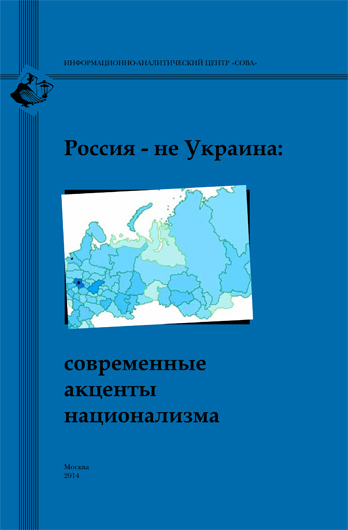 © Information and analytical center "Owl"
I suggest those who wish to get acquainted with the table of contents ; I will not dwell in detail on each article.
So, taking off the cream, I want to draw the attention of readers to the following articles of the collection.
Here about Navalny
Political scientist Emil Pain in the article “Modern Russian Nationalism in the Runet Mirror” concludes that the ideological demarcation has recently aggravated not only between conditional left, liberals, nationalists and pro -government traditionalists, but also within each of these groups. One of the examples of intra -group demarcation, of course, is the case of Navalny, whose nationalism caused very hot disputes within the liberal camp. Pain finally did what would help to bring at least some numbers to these disputes for the time being. Analysis of 1315 posts of Navalny in LiveJournal for the period from June 2010 to June 2013 shows that his nationalism is sporadical, plus exists only within the framework of his dislike for corruption. According to the researcher, the ugly statements of Navalny to the Georgians, which he allowed in 2008, so sunk into the soul precisely because they are unique. The peak of his nationalist statements falls on events on Manezhnaya Square in 2010 and at the beginning of 2011. After the elections to the Coordinating Council of the opposition (October 2012), the share of nationalist discourse is greatly reduced in favor of a general -degree theme.
The author contrasts Navalny's case of Vladimir Milov. If the first, by reducing the intensity of nationalist statements by 2013, goes, according to Pain, to meet the nationalist discourse to liberals, then Milov in the same period actively increases the share of nationalist statements in comparison with general political and illustrates “a very typical transition from the pragmatic use of ethnic nationalism to infection with them as a disease”.
Here about violence and about what awaits us
It is impossible to ignore the article by Alexander Verkhovsky "The dynamics of violence in Russian nationalism." She will not seem excitingly interesting to a wide reader. Hate violence on the basis of hatred is one of those from which an ordinary person rather wants to somehow psychologically defend himself. Nevertheless, there is a large circle of people-specialists on related topics, journalists, politicians-to which this article will be very useful both as analytical material and as reference, because it covers a long period of time-from the late 80s to our days and because it wrote it, the Verkhovsky, The Expert on this topic. In addition, the author makes a cautious, but therefore no less pessimistic forecast: in the near future we can expect an increase in political violence with the participation of radical, but loyal nationalists. Attacks will be subjected to both their direct opponents and simply oppositional citizens.
Here about how exactly the media lies to us
Ethnologist Viktor Schnirelman in the article “Media, the fight against“ ethnic crime ”and cultural racism” with examples, in detail, with the numbers shows what tricks the journalists create and impose a negative image of migrants to society. This article can be inserted into the textbook of the Faculty of Journalism. Here are the ways of creating Migrantophobic sentiments that Schnirelman lists: naming the ethnicity of the criminal (except for the case when Russian is Russian), manipulation of criminal statistics (using unverified numbers, direct distortion of numbers), double standards (“strangers” do not forgive the impudence that they easily not notice from “their own”), Alarmic headlines of the articles (The heading is written about the displacement of indigenous citizens by Muslims, and in the article - that the number of Muslims in the city grew from 3 to 4 percent), attracting radical nationalists as commentators on the migration problem. The author also mentions the responsibility of those from whom journalists often take an example: status officials and politicians - both mainstream and opposition (and again did not do without mentioning Navalny).
Analysis of 1315 posts of Navalny in LiveJournal for the period from June 2010 to June 2013 shows that his nationalism is sporadical, plus exists only within the framework of his dislike for corruption.
Here about Dugin, not about Bonheadov
The article by Professor University George Washington Marlene Laryuel “Russian nationalists and extremely right -wing and their Western ties: ideological borrowings and personal interaction”, unfortunately, is not devoted to subcultural relations . It is about notable people: about Alexander Dugin, Alena de Benois, Alexander Sevastyanov, David Duke, about the leadership of the Russian Orthodox Church. Regret is caused by the fact that the study of lower and cultural contacts has long been in demand, but has not been undertaken at a serious level. Naturally, this reproach does not apply to the author, and not to the compiler. Rather, this is a wish aloud that some carriers of such knowledge (primarily this applies to Antif) finally design it in a used form.
The article Laruel not only gives an excursion into the history of relations between Russian Eurasians and science racists with the new right -wing people in Europe and America, but also shows how a change in the domestic policy vector in Russia led to the demarginalization of figures such as Dugin, and their subsequent influence on the country's foreign policy. As the author notes, “The Ukrainian crisis of 2014 allowed the indicated groups to explicitly offer the Kremlin its Western European ties”, a vivid example of which is the fact that most of the European observers who came to the referendum in the Crimea turned out to be from extreme right organizations.
Here about entertaining conspiracyology and about what it is poured into
The historian and expert of the Owl Center Elena Strukova in the article “Smoke of the Fatherland: The Stories of Russian History in the Texts and Statements of Modern Russian Nationalists” considers historical publications, more reminiscent, according to the author’s expression, “entertaining conspiracy”. The works of several ultra -right figures are considered: Alexander Dugin (where without him), who sang neo -recovery; members of the party "Homeland"; Nikolai Starikova - the ideologist of the "party of the Great Fatherland"; Evgenia Fedorova-State Duma deputy from United Russia and the creator of the organization National Liberation Movement; Vladimir Zhirinovsky. All these figures are somehow loyal in relation to existing power. All of them in their writings make a systematic substitution of the usual question for historians "Why did this happen?" To the question "Who is to blame?" The fault of external and internal enemies, inevitably exposed on the pages of the books in question, consists in obstructing the independent historical development of Russia. Most of the authors propose to correct the existing state of affairs by creating organizations of active supporters of the authorities. At this place you can startle and, as Elena writes in the final of the article, look at the Duginsky nostalgia for the oprichnin in a new way.
Cherry on the cake and must-sead
The title article of the “Ukrainian” block “Right Sector” and others: National radicals and Ukrainian political crisis of the end of 2013-early 2014 ”( “ Right Sector ”-an organization banned in the Russian Federation ) for the authorship of Vyacheslav Likhachev-the head of the monitoring group of national minorities in Ukraine-was published on the Owl website and Polit.ru . This, of course, is a cherry on the cake and a real must-sead for everyone who wants to reinforce (or possibly, to adjust) their emotional attitude to the events in Ukraine more rational arguments. Given the availability of the text on the network, it makes no sense to retell even the main conclusions here, but the main one must still give: in the sense of nationalism the political phenomenon in the sense of nationalism, Likhachev considers the popularity of the populist Oleg Lyashko, capable of bringing the National Radines to the new Rada. Moreover, the main factor in the growth of its popularity is a military threat from Russia; Thus, it turns out that Russia, accusing the new Ukrainian authorities of commitment to radical nationalism, itself catalyzes its rise in Ukrainian society.
The other two articles from the Ukrainian section are devoted to more private issues: Anton Shekhovtsov - the researcher of the extreme right - writes about the take -off and fall of the Freedom party (the article “All -Ukrainian Association“ Freedom ”: from success in the elections to failure in the revolution”), and the expert of the Center for “owl” Vera Alperovich in the article “Ideological battles of Russian nationalists on Ukrainian fronts” She traced exactly how the Russian nationalists affected the split that we are now observing in all areas of society, and sometimes in our own families.
***
“And yet why, why should I delve into all this? - Probably asks the reader who has reached this place of review. “Well, what about the details of the existence of crazy fanatics?”
The fact is that the topic of nationalism has long been not marginal. We leave the brackets that the scope of violence has reached such a level when this should be interested in all “decent people”. The problem is both wider and at the same time easier: all the layers of our society are so saturated with nationalism and racism that people who avoided this already make up a minority even among “decent” ones. In such a situation, it is not enough just to be against: one must be actively and qualified against, possess the facts - and just work on yourself, so that, God forbid, do not succumb to the general clouding of the mind. Then, perhaps, the question (not) of the identity of Russia and Ukraine will cease to appear in such a frightening reality as war.
Russia is not Ukraine: modern accents of nationalism. Sat. articles. Comp. A. Verkhovsky. -M.: Inform.-analysis. Center "Owl", 2014. 308 p.