
Translated material
Who the printer is furious
The State Duma has established the production of anti -democratic laws, the initial motive of which is to restrict the political capabilities of specific persons and organizations
The State Duma has established the production of anti -democratic laws, the initial motive of which is to restrict the political capabilities of specific persons and organizations
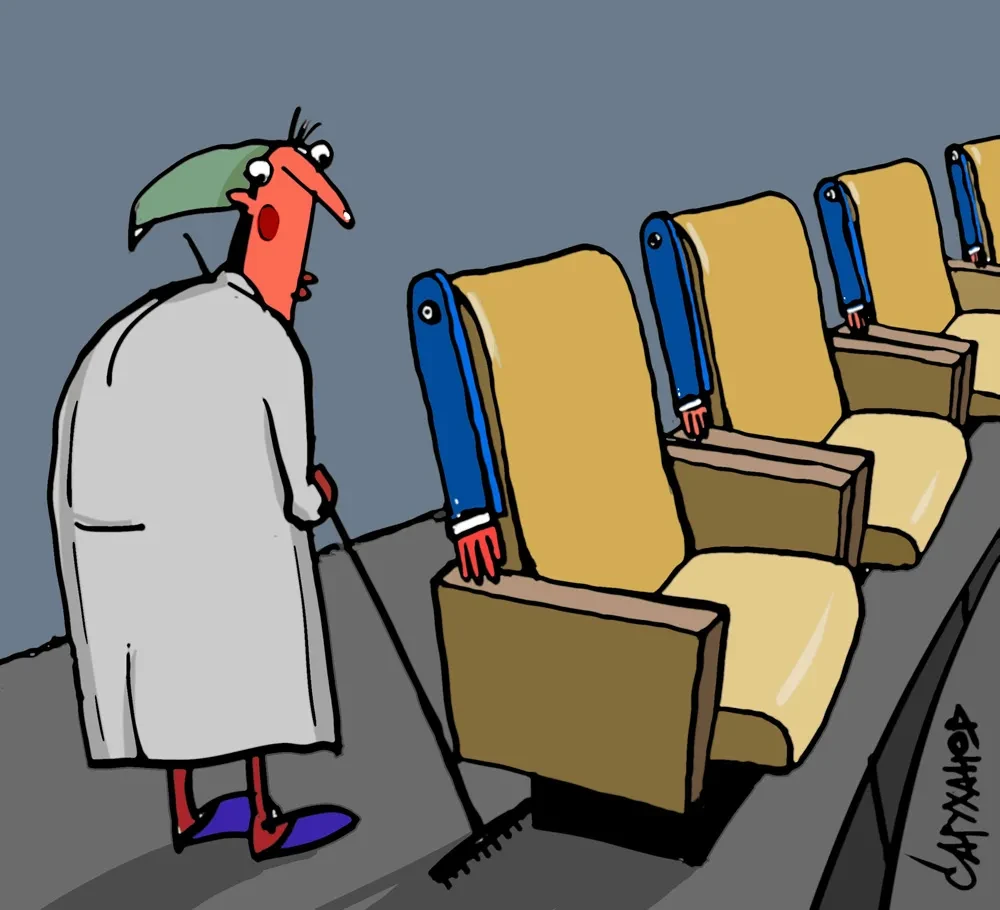
Many laws that the State Duma adopted in recent years amaze the enemy with high accuracy. The motive for their development and adoption - despite the lengthy justifications of the “public benefits” and the protection of the “interests of the state” - are the point manifestations of dangerous dissent and control of the authorities.
The course on “prohibition” was taken by lawmakers back in 2011. However, from year to year, a product that was published by a “enraged printer” acquired more and more personal features, having as the main goal of very specific individuals. One of the first such kinds is the law on “foreign agents” in non -profit organizations. Over the past two years, the Ministry of Justice has introduced fourteen NGOs into a special register. However, it is no secret that the reason for the prohibitive inspiration of deputies was the growing authority of the “vote” - an organization that, during the development and adoption of the document, created the authorities the greatest problems in a very sensitive field - monitoring the election and opening of fraud and falsification during monitoring the electoral process.
As a rule, the most dragon initiatives are accepted as soon as possible - from nine days to a month and a half. A group of deputies-developers puts their signature under the document. Although often these are only adjacent executors, and real customers are the presidential administration or government. If two years ago the most “dirty” work was carried out mainly by the so -called “legislative special forces” - the already lit up young and non -disgusting deputies of the generation of “nurses” (it was they who took an active part in the development of scandalous initiatives aimed at combating the opposition), today today their energy to tighten the electoral rules and “protect” citizens from the filth of foreign influence is directed as influential as influential as influential as influential Old deputies, and those whose names are generally known to anyone. Everyone wants to contribute to a further narrowing of the space of freedom.
At the end of the last month, legislators from the party of the authorities decided to legislatively “cover up” their own. The “Law on the Villas of Rotenberg” (or as it is also called the “law in defense of the victims of the Western sanctions”), adopted so far only in the first reading, caused a rather rare outrage in the Duma’s colleagues and independent experts precisely because of his “personalist” nature-however, in this case they do not repress the person, but, on the contrary, they defend legislatively. And at the same time all the like.
In this regard, we decided to recall the most resonant legislative initiatives of the State Duma, in which specific persons and organizations became not objects of protection, but the main planned victims.
Foreign Agents Law
In July 2012, the State Duma adopted in two weeks the law obliging NPOs, which are engaged in political activities and at the same time receive funding from abroad, register as “foreign agents”. Initially, the authors of the bill were six United Russia - Alexander Sidyakin, Irina Yarovaya, Vyacheslav Nikonov, Andrei Krasov, Adalbi Shkhagoshev and Mikhail Starshinov. But subsequently, when the human rights activist Lyudmila Alekseeva invited the Western authorities to introduce the “six” to the “Magnitsky List”, the rest of the party’s colleagues in solidarity put their signatures under the document.
According to numerous experts, and the activists of this organization themselves, the law was adopted precisely under the “voice”. At the same time, everyone else got it, including completely harmless from the point of view of maintaining the current authority of its control over society. After conducting unscheduled prosecutorial inspections, the association, which showed itself in 2011, was forced to launch the process of self -destruction in the field of public surveillance of elections. Problems with the authorities at the Voice, which registered again, but already as a movement, are still available to this day.
Law named after Navalny and Khodorkovsky
"Navalny will not be allowed to elections-2024." Reasoning on this topic appeared on blogs and the media immediately after the three United Russia - Vladimir Pligin, Dmitry Vyatkin and Vladimir Ponezhezh (all of them are members of the Committee on Constitutional Legislation) - in October 2013 they introduced a bill to the State Duma that limits the right to be elected candidates for committing a grave or especially serious crime. So, as conceived by the authors, the ex-owner of Yukos Mikhail Khodorkovsky will be able to use his passive suffrage only in 2032, and the opposition politician Alexei Navalny -not earlier than the spring of 2026.
It should be noted that this was not the first attempt by the deputy “Trinity” to distinguish between “high -precision” laws. In May 2012, they initiated a ban on life -long participation in the elections of candidates with the criminal past. And a year later, before the elections to the mayors of Moscow, the contours of the first and main opposition candidate, not passing the criminal filter, began to clear up. If the verdict on Kirovles entered into force before the voting day, then the registration of Navalny’s candidate would be canceled.
However, in October 2013, the Constitutional Court, in which six citizens who previously convicted of serious and especially serious crimes appealed from different regions, recognized the lifelong defeat in passive electoral law unacceptable. A few months after the decision of this decision, the deputies revised the approach to the criminal filter and replaced the lifelong ban on terms (10 and 15 years), which, according to experts, "in fact, mean the same."
Lugovoi law
In July 2012, a law was adopted on the creation of a black list of sites that promote child pornography, drugs and suicide. Experts expressed fears that the adoption of such a document may mean the introduction of Internet censorship in Russia. I did not have to wait a long time. After a year and a half, a group of deputies (Member of the LDPR Andrei Lugovoi, Unicorn Sergey Chindyaskin, Communists Nikolai Ivanov and Sergey Gavrilov) proposed expanding the list of the risk of getting into a single register of prohibited Internet resources. The law on blocking sites for extremism, also known as the Lugovoi Law, was submitted to the State Duma in December 2013 "In order to improve the mechanisms of protecting the company from unlawful information distributed in information and telecommunication networks, including the Internet."
A number of opposition Internet media were quite quickly affected by the legislative initiative. This spring, Roskomnadzor included on the list of prohibited sites “ Grani.ru”, “Kasparov.ru”, “Daily Journal”, which, according to the Prosecutor General’s Office, distributed “calls for illegal activities and participation in mass events conducted in violation of the established procedure”. The heads of blocked sites see a political connotation in the decision of the official authorities: the Internet publications were persecuted due to an attempt to analyze and report objective information about the events in Ukraine and in Crimea. By the way, the Blog of Podolny in the LiveJournal was blocked for the same reasons. It was entered in the register of prohibited sites because of two records-about the attitude of the opposition policy towards events in Ukraine and on the trial in the “swamp case”. At the end of both posts, Navalny urged his readers to come to the court building, where the process was held.
Law on limiting the share of foreign capital in the media
Two weeks ago, the State Duma adopted a law on the restriction of foreign capital in the media up to 20% (“the state is more important than security than business”). The initiator of the amendments adopted in a record compressive deadlines (9 days) were three deputies: Vadim Denin (LDPR), Vladimir Parakhin (Fair Russia) and Denis Voronenkov (Communist Party). The document applies to all types of media, including printed and online publications, while still the current establishes 50% restrictions only for television and radio.
Media market participants expressed concerns that the innovation would strike a serious blow to the media in a number with an independent editorial policy . For example, the Sanoma INDEPENDENT MEDIA media holding portfolio includes Vedomosti newspaper (33% of its shares are controlled by the Finns), and the Forbes magazine, which is published by Axel Springer Rash, belongs to a German company by 95%. Rumors from the upper floors of power have already reached us that they were especially dissatisfied with the excessive free -thinking of the newspaper Vedomosti. It is she who is the main stimulus that caused a response edition in the power corridors. However, it is obvious that other “guilty” media, such as glossy magazines, will fall under the law “without guilt”.
Bloggers Law
Amendments to the law “On Information”, developed as part of the “anti -terrorist package”, were adopted in April of this year. They equate bloggers whose pages are visited by more than three thousand people, to the media. Now Runet users along with journalists will be responsible for the dissemination of information.
Representatives of all four factions took part in the development of the document: Irina Yarovaya (United Russia), Andrei Lugova (LDPR), Leonid Levin (Fair Russia) and Oleg Denisenko (Communist Party).
So far, no one has suffered from the law. However, based on the experience of law enforcement of previous laws, it can be assumed that on the sight of Roskomnadzor, primarily the top oppositionists. They, in the conditions of continuing pressure on printed and audiovisual media, are increasingly forced to go to the network. Then they will squeeze them.