
Translated material
Pepopol in the history of arts
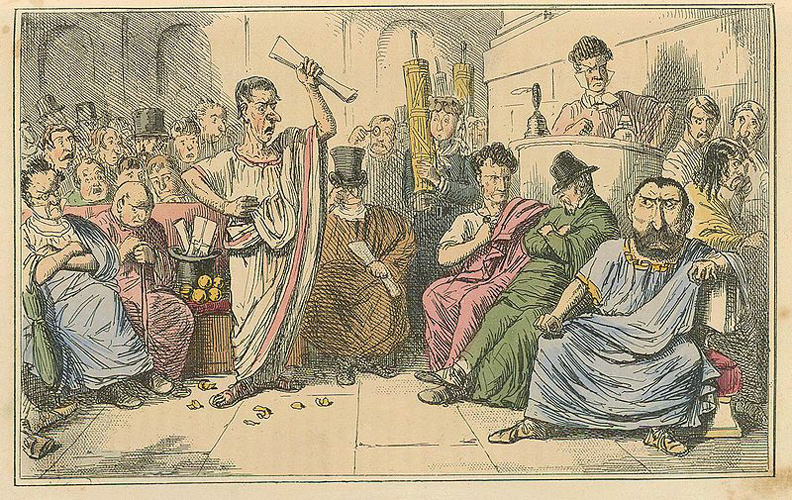
A woman in a yellow jacket loudly shouts something to a student who receives a second higher education, her neighbor, a heavy gray-haired lady, also says something indignantly. It is impossible to make out the words from the back row, because the hall of the Institute Museum is filled with noisily proving something to each other by students and teachers. The sight, in general, is not pleasant. This is not the plot of a film or a performance. Unfortunately, this was the meeting of the Department of the Universal History of the Arts of the Russian State University , which is divided into two parts: one will engage in the art of new and modern times, the other - the ancient world and the Middle Ages.
At first glance, the separation of almost technical and certainly should not cause so many disputes, and even more so numerous petitions (for example, this ) and the dismissal of teachers, which the former head of the department of Ksolir Lukichev and other opponents of the division. By the way, there were a lot of them: in the Facebook group “We will save the Department of Art History of the RSUGU” are now almost two and a half hundred participants. However, the dean of the Faculty of History of Art Vladimir Kolotaev considers the division “structural”: “no changes in existing educational programs are happening, and structural transformations affect only the management system and the future opening of new directions of training, new sets in the undergraduate and graduate, while maintaining all existing ones, which will also be recruited, as before.” In addition, according to the dean, students will receive the same diploma, and for scientific papers they will “attach” to the department at which the supervisor they have chosen work.
Lukichev does not agree with him: “Firstly, that I do not consider it rational and necessary to change-this is the structure of the department with the current circle of professional competencies, with the prevailing scientific and educational“ field ”. And precisely because it seems to me adequately corresponds to the tradition of systematic, holistic, fundamental education in the history of art formed in Russia. This tradition is fixed in the latest, just approved by the Federal State Educational Standard. ” Also in numerous posts on Facebook, she wrote that the Department of Theory and History of Art of New and Contemporary Time would duplicate the Department of Cinema and Contemporary Art , headed by the dean, and claimed that the art of the Renaissance would fall out of the problems that the departments will be considered, because it would not be clear where it is to be attributed.
The department had problems for a long time. Last year, by order of the Minister of Education as part of the faculty of art history, which also includes the Department of Cinema and Modern Art, the Department of Museology, the Center for Egyptology named after Golenishchev and several more units, she lost her budget places. This happened after as a result of monitoring the Ministry of Education and Science in 2012 of the RSUSU was recognized as a “university with signs of inefficiency” . This year, however, the word "inefficiency" disappeared from state monitoring. Now, university founders were recommended to “reorganize” them, among those who received such a recommendation, the RSUS was also.
However, in addition to external problems, the department had plenty of internal. According to the deputy dean for the scientific work of Alexander Markov, low scientific indicators (some employees did not publish anything for years) were combined with unacceptable organizational inertia. Thus, the preparation of curators was folded simply because of the insufficient quickness of the employees of the department, and the opening of the program “Theory and Practice of Modern Art” was met with hostility by a number of employees of the department. The dean himself speaks out in the already familiar conflict for the format of post on Facebook . Here are a few of his complaints to the department : “In fact, the department has one of the lowest indicators of scientific activity in the Russian State Humanitarian University. All the scientific achievements that the department is proud of is in the distant past. Many employees of the department - N.V. Prokazina, Yu.V. Ratomskaya, M.N. Butyrsky, E.V. Long - for many years work without defending candidate dissertations. By the way, it is they who express the greatest indignation of changes. The heavmira itself has only three articles in the last five years, low indicators of publication activity among her deputy A.V. Pozdaeva. <...> Not a single textbook, not a single collective monograph has been created and is planned in recent years, and the authors of individual monographs and textbooks did not receive any support from the head of the department. In other words, the head of the department does not encourage any forms of research work, and there is no organization of scientific research at the department. ”
The teacher Anna Pozhidaeva, one of the most active opponents of the separation of the department: “The need for science and our low scientific potential, extremely verbose, answered the accusations. To begin with, in our consolidated report prepared for accreditation, the level of scientific activity of the department turned out to be very high. Yes, listening to a real acting scientist is often excitingly interesting. But not every real scientist is a good teacher. I believe that the current teacher should be aware of the news in his subject, to write something from time to time, but the number of publications is not a criterion for the quality of teaching. Some “non -oriented” teachers are brilliant lecturers and teachers, experts in their field, and the lack of degree and rare scripture of scientific articles do not interfere with this. And the load at 900 hours a year does not really contribute to science.
The discovery of new magistrates to which we supposedly resist is a very subtle question. It seems to me that our main goal is to ensure that already prepared art historians-bachelors come to our magistrates (the ideal option is an “integrated” magistracy, as in Moscow State University), and not people from the outside, often incapable of perceiving the disciplines of magistrates without a sufficient knowledge base. Here, the “wide fan” of the magistrates who wants to spread Kolotaev is not quite appropriate - they will not work in a situation where unprepared people with a non -consistency education (which has proved the extremely low level of master's thesis, protected in the last school year in the magistracy headed by Kolotayev himself (the department of cinema and contemporary art)). I did not notice the opposition of K.L. Lukicheva (which Kolotaev talks about) to the opening of a magistracy on foreign art of the XV -XX centuries that opened this year - on the contrary, I remember well that K.L., like us all, in every possible way contributed to its discovery. The prepared opening of a magistracy on Russian art, and the idea that arose before our crisis, about the possibility of organizing a magistracy in the art of antiquity and the Middle Ages arose before our crisis, seems appropriate.
True, changes at the department are not carried out by the most successful methods. There is absolutely no way to understand the third -party person at intrigues at the faculty of art history - if only because supporters of opposite points of view sometimes say mutually exclusive things. For example, Kozhmiri Lukichev claims that the reorganization of the department was preparing without its knowledge, while her opponents say that the conversation was about this for a long time. And so, for example, on Facebook the consequences of the reorganization of the department Anna Pozhidaeva: “Old posts, according to information from the personnel department, have not yet been abolished (and at least two months will be abolished), therefore, while our jobs are also preserved. However, not all bosses agree to tolerate until the official representation of subordinates. The tragedy is repeated in the form of a farce: with the persistence of the revolutionary sailor, the new (and the latest) is in a hurry to equip the long -awaited nest - orders a new sign on the door, puts things in order in the cabinets ... Only, the trouble, he finds there, for years, strangers (ours and our already fired colleagues), books, shoes, sweaters ... and contacts us, and contacts us, and contacts us The continuing to sit in their old places and try to do their job, with an urgent request to remove their things, throw away the old trash of those who have been here for a long time, examines the table and the computer on it in a friendly way-she should not be transferred to her, she will no longer be needed ... Everything is to the house, everything is in the family. This happens in our (including K.L.) presence, we, apparently, should immediately connect to violent economic activity, move the tables, endure belongings ... Somewhere we have already seen it. ”
In any case, the recessing of such a conflict in the public field seems not to be the best idea. In addition to reputation losses, which can easily become financial for the faculty, where most places are paid, the question asked by the student at a meeting with the dean: "Who will teach?"