
Translated material
Not a watchman to my brother
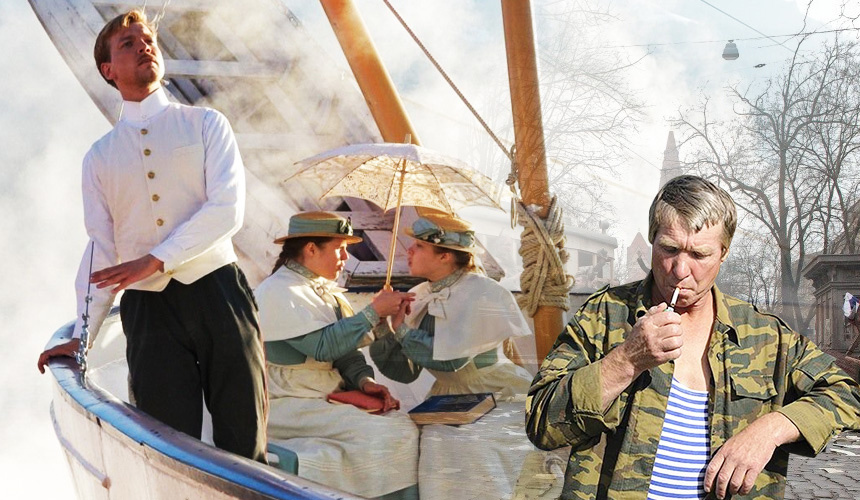
In the theater box office, Nikita Mikhalkov has been going on for a week for a week. And on Sunday, October 19, at the first, the Russian premiere of “White Nights of the Postman Alexei Tryapitsyn” Andrei Konchalovsky will be held. Vasily Koretsky - about what one cinema is bad and what another is good.
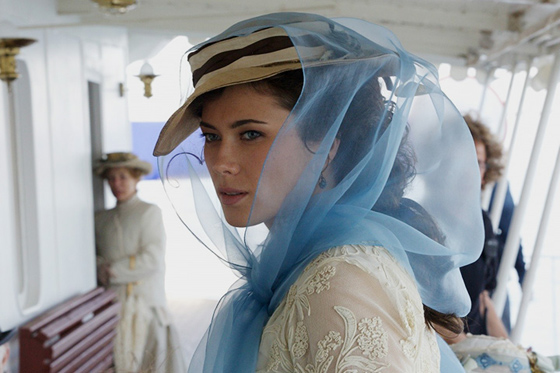
The scarf turns blue. It flies out into the window of a white steamer, under the groaning of passengers it takes off to the mast, under the silver chime of the synthesizer soars next to the drawn seagulls. And behind the scarf, the good well done in a white tunic jumps on the decks, almost grows, makes stupid faces, awkwardly looks around, touches passengers and rigging: oh, ah, oh, here is embarrassment!
No, this is not a slapstick of the beginning of the last century. However, Nikita Mikhalkov’s new film “Sunny Blow” is full of so rainbow, deanery and pimony longing for pastoral past, which itself looks like a postcard from this yearnch. Well, what were the nine -hundredth postcards: children with cigarettes, languid ladies in hats - or maneuster gentlemen with girls Neilly, romantic ties of Arkady. Greetings from Yalta. Hello from Kyiv. The mass culture of the beginning of the century is not an Hermitage with the Tretyakov Gallery. And Bunin ... Well, yes, the Nobel Prize - but, in fact, that it can be more anachronous and boring more than the story (and Mikhalkov fanes the Bunin story to epic proportions - the heroes, for example, fit exactly two hours after the start of the film), entirely dedicated to the subtle psychological experiences of random communications in the road. Also me, a big story.
However, for Mikhalkov, this is exactly this-a comedy of attractions, funny, light music, nonsense, jumping, farting a boy and a seagull, black currants in champagne and rubber in the pants of a provincial official posing in a golden strap-and there is a Russian story, interrupted by the embarrassment of the 1917th. The glossy, as they would say now, the idea of the “old order” as a large cool veranda, with the windows overlooking the Volga scope, on which it is so good to poison stale jokes, in principle, has some cultural and historical foundations. It to nausea resembles the inner world of many Chekhov’s heroes - and it is precisely this widespread “ringing vulgarity (in its own expression of Nikita Sergeyevich) that is the main problem of the“ sun blow ”. Not timing, not vague-reactive replicas, not the caricature of some scenes (the same act with pistons)-but a small directorial giggle. Stupid running around, shallowem, the narrowness of scope ... about the "solar blow", unlike the Rabelazian "Us-2", and there is nothing special to say. After the belated recognition of Mikhalkov as an unbridled visionary (and I admit, I also highly appreciate the reckless wildness of the “Siberian barber” and “citadel” with “upcoming”), the temptation to continue the sensational-conformist praise of the villainous genius is clear. But, alas, the Mikhalkov “Sunny Shock” is no longer Faust, but an ordinary user. Yes, the NS works well with the extras (although not as virtuoso as Ken Russell did, whose “music lovers” are devoted to Mikhalkov on his own field of Kitch a la Rüss), yes, he is quite good at the scenes of the apocalypse (it is because this is precisely reality, given to us, and he is in the sensations, unlike the groundless fantasies about infinite I am the Lord). But the directorial statement is so amorphous, so badly articulated that it is impossible to distinguish where the author’s speech is, and where - just nonsense and poor jokes, foolishly abandoned by characters (like a played “button accordion” about Darwinism and monkeys). It is not Mikhalkov who says - through Mikhalkova, the imperial it says, and as any patriarchal way is built on the nudity of the drunken Noah, and in the heart of this monarchist idyll lies vulgar obscenities - horse -drawn uda, tea lamp and humid senile erotica. Without them, no way. Without them, without these small weaknesses - the mortal seriousness of red terror.
 © Studio Trith
But maybe this is not a laughter - but the convulsions of a sentimental cry of the old Russian culture of lieutenant, Yesauls and beautiful young ladies? Alas - judging by the film, she would have been enough only on a bad joke. And when it comes to a serious tears, Mikhalkov turns to the instrumentation of the enemy, the Bolshevik avant -garde: he steals a children's stroller from Sergey Mikhailovich Eisenstein and again lowers it from the Odessa staircase - already making it a symbol not Nikolaev, but of the Leninsky terror. Well, well.
However, this seemingly shameless travesty has its own undoubted logic: inversion in general is the main technique of ultra -conservative ideology. And the NS is very consistent here: after all, he not only turns back the time, contrasts the theories of evolution in the involution, but even puts upside down all modern ideas about what is good and what is bad in art. The toilet comedy turns into a lyrics, and what serves in the film the artistic design of the tragedy has long been passing through the comedy or even farce department. As, for example, the famous Cossack song, where the dawn distributed in Gorky-2 or the Bogomolovsky Lyra than on the final credits of the "Sunny Shock".
Similar, fatalist, the idea of history - with Andrei Konchalovsky. Similar, but different. To begin with the “White Nights of the Postman Alexei Tryapitsyn” is a kind of continuation of “History of Asi Klyachina”, but made at another time, in another place and, most importantly, in another cultural context. Konchalovsky, while maintaining his author’s gestures and, possibly, idefixes, very far in “white nights” from self -reproach. Here he shows at the same time loyalty to himself and vitality, naturally adapts to the changing world, peering with interest - and not abandoning it.
Here, probably, it is worth mentioning right away - I do not share enthusiasm for "white nights." Still, they are interesting precisely as the film of Konchalovsky, and not as a film in general. Torn from the context of the directorial filmography, “nights” seem to be a strong, modern post -house (if Konchalovsky himself had not come up with his post -jet half a century ago, mixing professional actors, peasants, workers and employees in “ace Klyachina”). There are all those techniques that we see at festivals-long hypnotic shots of landscapes, a clash of fixation and reality, pantheism characteristic of directors of Southeast Asia ... Yes, a lot of things. The Russian missile soaring on the final shooting tires behind the backs of the fellow villagers obviously rhymes today with a flying saucer descended on a Landscape rummaged in the Chinese “still life” Jia Zhanke. But for Konchalovsky, unlike Zhanke, this spacecraft is not an alien invasion. The rocket, taking off from the Plesetsk cosmodrome, is its own, dear, just as the tanks were native, which constantly rumbled behind the fields in the “ace of Klyachina”. The “Russian European” Konchalovsky believes in progress, believes in the symbiosis of the Lake surface and the military -industrial complex - even if this symbiosis consists in illegal general fishing. And its digital chambers, which catch light so well and do not create the image textures at all, are organic in relation to the colorful, but the superficial existence of the inhabitants of Kenoseria (at some point, Konchalovsky directly likes his silly hero in a thin water film of the water model).
 © Producer Center Andrei Konchalovsky
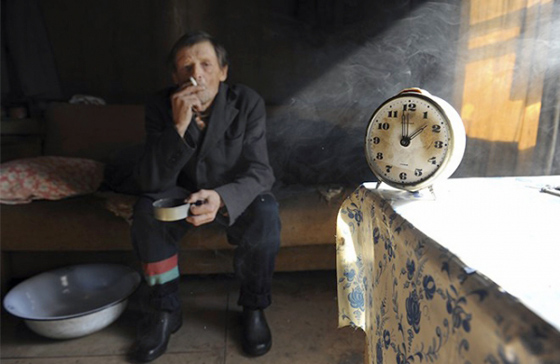
Armed by the latest achievements of culture and technology - the “number” and a nyastic cat, Konchalovsky is landing on the shore of Kenozer not in order to “understand” or “comprehend” the natives. No, Konchalovsky comes as a colonialist to give them his meaning, to make part of his script. Their own being has not been manifested for him, which means that it has no value. Kenozers live in every sense without history: at the very beginning of the film, decomposing a photo album on a psychedelic oilcloth, Tryapitsyn hardly recalls his biography - he got married, divorced, tried the household (in the photo - a sad cow), fought with vodka; Won, damned. Compare this with a similar episode from “Asi Klyachina” when the walls of the peasant hut turn into the annals of generations. The meaning in the existence of the village appears along with the directorial narrative. This is a narrative - a matrix taken from the past, Soviet life, which the director imposes on reality to find ten differences. It is not difficult to look for them: the dwarf - the chairman of the collective farm from Asi Klyachina for half a century was reborn into a village drunkard named Kolobok. Rural work disappeared. The school closed. Soviet songs are forgotten. There were only missiles, space, night silence and a feeling of endless remoteness from the world, in which Vietnam and NATO's machinations used to be rattled, and now the “fashionable sentence” is rattling with Alexander Vasiliev (for some reason, rags is stumbles on this program all the time).
But there is something else-that which could not be shown in 1967. Firstly, a clear, clear, honestly articulated existential horror. “And the pain is constantly in the soul ... all life went like some kind of patience ... You can get to death like this,” a dangerous neighbor will confess to a rag. Secondly-eschatology, vague expectation of the end. Unknown people cut off the engine from the ragpitsyn boat (an emergency for a village in which no one locks the doors), every night he is a gray ghost cat, and then new rules were launched from Rybnadzor. The world is embarrassed, excited, and this is not the world, possibly, but only visibility. “You think it is so. And it turns out strangely. Who says that he knows, does not know anything, ”the village Caliban Kolobok retells (obviously from the words of the director) Lao Tzu.
What will happen to them when all the signs that Konchalovsky did to do will come true? Nothing. The frozen now in amazement in front of the big world, stupidly giggling, drunken, aged, these people will endure everything and survive everyone. After all, it was they-and not the caricature of the Popovichi and Jewish girls who were not invented by Mikhalkov-and got up from the stove in the 17-18th, won civil, fell under collectivization and industrialization, again won the second worldwide and battle for the crop, and then again flooded onto the stove, bumping their eyes with their eyes. Now they are indifferent to take -off rockets - and will also be indifferent to its fall.