
Translated material
"Religion is an attempt to gain hope"
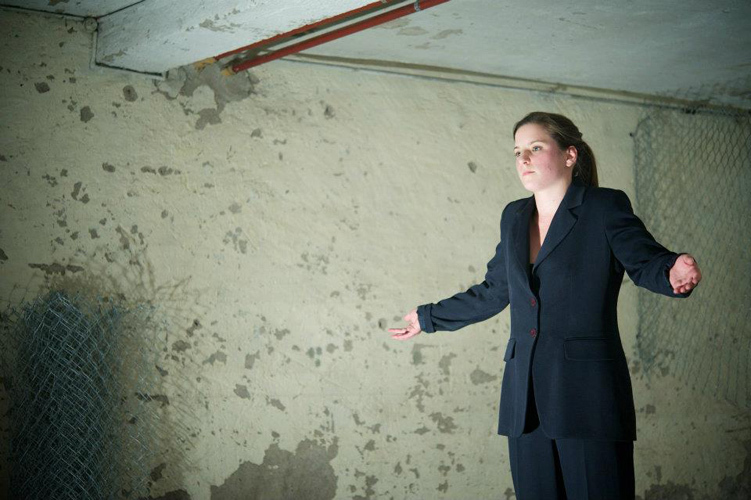
On October 18, Perm will host the premiere of the performance of the Swiss director Miriam Walter based on the play of her compatriot Lucas Berfus “Bus”.
- How did it happen that you got to the Perm project? I would like to make mistakes, but, I am afraid, neither in New York, nor in Zurich where you worked before, most people do not know that such a city exists.
- This is really so, despite the fact that Perm is a very big city. And this is the first stop at the Trans -Siberian Railway, as I was told. For the first time I came here in the summer to participate in the Theater Laboratory. I did not know anything about Russia, but I heard a lot about your country, so I took the opportunity to come as ...
- Adventure?
- No, before that I worked in unfamiliar countries - Israel, for example. In addition, I am half a Brazilian, my family lives in Brazil, and I studied in the USA and traveled a lot around Europe, so there are no news for me. Rather, I perceive this project as a political action.
The fact is that before arriving here I lived in a state of dilemma. On the one hand, the Russians that I met turned out to be very close to me. That is, unofficially, relations with Russia were well developed. At the same time, the media spoke about Russia nightmares. And for me as a theater director it was important to get my own idea of the country, from the inside. I believe that we must exist outside political structures, to establish communication with the effort of our own will, not relying on the media, ideology and other abstractions. I believe in the political theater. Getting to together, working together, not afraid of what the media says - I think this is very important.
At the same time, this visit to me is a very personal gesture. My grandfather lived in Ukraine even before the Holocaust.
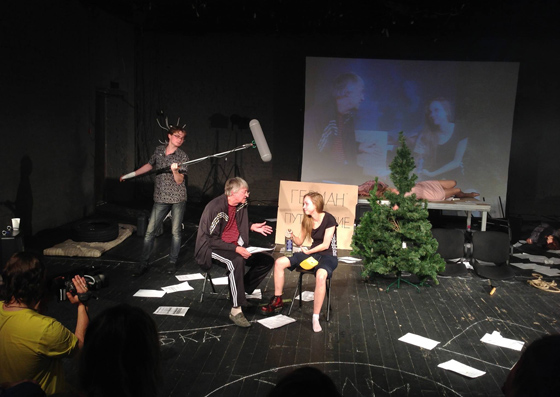 © Pro Helvetia Scene from the play "Bus"
- Do you know that under Perm there is the only Gulag museum in Russia? Did you manage to go there?
- No, unfortunately. I spend almost all the time in the theater. The Perm Theater is my main, one might say, impression of Russia today. How large it is and what important place it occupies in Perm's life! After all, the theater is in the very center of the city!
People come here for thought, for discussion - this is not just a beautiful decoration where you can go before dinner. The creative class experiences powerful pressure in Russia, because the authorities are afraid of it and are trying to control it. But this makes you act, fight. In Europe, after the Second World War, artists became a completely independent “class”, their freedom is strictly guarded, so that everything can be done. But due to this permissiveness, art ceased to be effective. You put on your work the brand "Art" - and everyone says: "O'Kay, art is so art." This is also censorship, but only turned inside out - you can do what you want, but no one will take you seriously.
- The play “Bus” of Lucas Berfus, which you took for the production, does not seem painfully political ...
- I would say that it is very political - it all depends on how you understand the policy.
It is not open political, as, for example, Richard III, where the problem of tyranny lies on the surface. This play talks about the consequences of political actions - about how immoral society becomes, how it decomposes, when pressure experiences for a long time. In such a society, you begin to speak differently, hear differently, otherwise interact with people. This happens on the bus - in a closed space, people broadcast a distorted reality brought from the outside world. Those principles that organize this distorted society begin to be intensively discussed.
We must exist outside political structures, establish communication with the effort of our own will.
I took this play not because I wanted to expose some purely Russian situation. It seems to me relevant for Europe, and in general for people of the 21st century. This is a story about how we have lost the ability to move forward, to be pilgrims.
There is another political aspect for me in this text: how to interact with politics and religion, which I call it “and then they had sex” - ceased to be divided. There is an artificial substitution of one to the other, thereby religion is depreciated. People become Christians or Muslims, not even really understanding what is behind this culture, this system of worldview. Religion turns out to be an attempt to gain hope, to join at least some kind of community, even if it is even a Syrian army.
- Berfus said that for him the main theme of this play was a doubt ...
“I think Lucas and I are in solidarity in this.” Behind all the topics, pain points that I spoke about and which I strive to intensify in my performance, ultimately there is doubt.
The characters are constantly striving to find a solution to a particular problem. They argue very aggressively and even deliberately. They stay in place or go, they are simple tourists or they have some kind of mission. They constantly rush. Each character is this - these are people who ultimately know nothing for sure. And the main character, Erica, becomes a catalyst, awakening this doubt. It forces other passengers of the bus to return to their reflection, which is very painful. Therefore, their hatred falls upon her. It’s like a stranger come to a closed community, and its appearance makes the company rebuild; The mechanisms that have worked for the idle, each community member begins to manifest itself in relation to the newcomer, begin to operate.
- As a key to the production, you use the technique of “cinema in the theater”. That is, your heroes are making a film about this story on the bus. Why did you choose just such a decision?
- There are several reasons. Firstly, after reading the text, I immediately thought that it was a movie scene. Very movie generation images, language, scenes. The basis of this story is a sketch, but at the same time the composition of the play is fractional, episodic - for me it is also more likely a form of film review than a theatrical one.
In Europe, due to permissiveness, art has ceased to be effective.
Secondly, a way of stage existence. I walked from the artist, tried to carry out the casting so that the guys had to show less, “build up” in themselves if possible. So that they can speak as much as possible from their own face. This gives cinematic expressiveness.
And one more important point: the reception of shooting allows the director to be on stage - more precisely, two. These are my alter ego. It is important for me to show not only the problem of social pressure, but also the technology of creative production, which is also under tremendous pressure. An artistic product is the same object of consumption as everything else. You want to catch the nerve of time, but capitalism gives you very tough terms: work now, quickly, while there is money. We must do, do, do.
- Your dance experience helped you in this production?
- Yes, from the point of view of the body language. Usually I put it, working much more with the language of the body than with a literary source ... You see, Lucas in this play demonstrates a very expressive language. I mean - there is practically no air in this text, the characters are constantly talking. This is not the dramaturgy of the situation - the heroes act little, here the action is minimal, the gesture is almost invisible. In working with this text, it should be very clear, expressive choreography. And the experience of dance really helped me - in working with artists, their interaction, building a picture of a picture, within the framework of which there is a discussion.
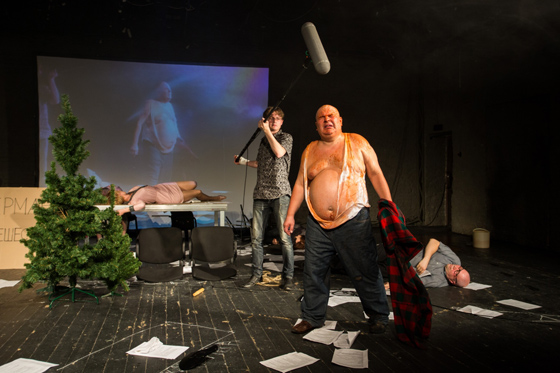 © Pro Helvetia Scene from the play "Bus"
- Did you feel that very “Stanislavsky system” when working with Russian artists? You have a lot of experience in productions with European artists and with American ones.
- Yes, I felt the difference, but this was primarily concerned not to school, not the technique of working with the role, for example, but a personal background of artists. In Europe, they also work according to Stanislavsky, and even more so in the USA, this is not the point. Not a way of playing another, but people themselves are completely different. Their way of perceiving the text, discussing it, conditions of acceptance/rejection of some circumstances. The only thing I note is internally Russian artists work very intensively. In Europe, artists work much more outside.
I have very sensitive and diligent artists, but by the end of the day they become people who have got everything in this life. This is what I need, because just such characters are shown in the play-they got everything, they are on the verge.
- Are you satisfied with work at this stage?
- So far, everything is fine, but the day after tomorrow we are going on stage for the first day, the performance begins. I had time to work out the details, and now I have come when I need to step back and look around the whole.
People become Christians or Muslims, not even really understanding what is behind this culture.
- Did you choose the play yourself?
- We received a list of plays, and my friend said that I should make a “bus”, because this text seems to be written for me. And she was right. But I would not do the production of the play imposed on me.
I was told that I, being a European man, made an absolutely Russian production. But there was no such task. In general, it is quite stupid to come from Switzerland with a statement that you want to make a play for Russia, teach everyone a mind. Although Russian colleagues now say that I should put Bulgakov, "Masters and Margarita."
-Is it necessary, in your opinion, to plunge into the history of the country, its culture, when you come to the production? Read books, go to museums ...
- This is exactly what I did first of all: I re -read all the available communist manifestos, bought books about Russia. But I learn much more from the people with whom I work. I also walk a lot - I go to the city without a translator. I try in this way to imbue the atmosphere of Perm. I do not want my perception to distort any institutions. Even museums. In museums, I can find out the facts, but I need the truth about people, their everyday life. So I prefer to drink beer with colleagues, smoke a cigarette. The theater is people, this is not a theory.
-Specific people ... The cultural public after all.
- Yes, it's true. Therefore, long walks around the city are so important for me. And I also try to talk more with others. Finding out from personal conversations what problems they have and what they are doing to solve them, you understand very well how society works ...