
Translated material
"Within competence"
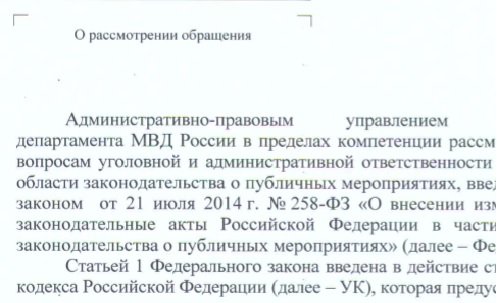
In July 2014, trying to understand the essence of the next amendments to the Law on rallies, the OTD-info discovered in their text many controversial, contradictory and intriguing moments, ready to endure even professional lawyers. We sent a list of naive questions to the agreement and legal department of the Ministry of Internal Affairs, which made up a positive review of this law, and now we publish its official answer (PDF).
New criminal article
Legislators introduced a criminal article for “repeated” (that is, “earlier ... more than two times within 180 days ” ) holding to justice of 20.2 Administrative Code. So how many times the court must find a person guilty of violating at the rally so that a criminal case is opened on him?
The Ministry of Internal Affairs : the crime has a formal composition, is considered completed from the moment of violation of the established procedure for the organization or holding of the meeting, rally, demonstration, march or picket or violation by the participant of the public event of the established procedure for organizing or conducting the meeting, rally, demonstration, procession or picket, provided that the person was previously held administratively responsible for the offenses provided for in Article 20.2 Administrative Code. Administrative arrest and criminal article: how it was done in the USSR
In other words: a criminal case can be started after the fourth time. It is curious that the Ministry of Internal Affairs shares the holding and participation in the event: there is no this division in the text of the law, and not a word is said about possible criminal liability for participation.
Should all accusatory decisions be made after the law entered into force (July 22, 2014)? Or is it only the last, fourth, times?
The Ministry of Internal Affairs : According to Article 9 of the Criminal Code, the crime and punishability of the act is determined by the criminal law acting during the commission of this act. The criminal law establishes the crime of an act that enhances the punishment or otherwise a worsening position of a person has no reverse force (10 Criminal Code).
In other words: the Ministry of Internal Affairs agreed that the law has no retroactive force, but decided not to answer the question of whether this, in fact, concerns the last, fourth sentence or them all and whether the accusation could appeal to the fact that if a person received three decisions of 20.2 before entering the law, then he has the opportunity not to commit the fourth.
Comments
Natalya Zvyagina , expert on the freedom of meetings of the Moscow Helsinsky group:
For all the repressiveness of this norm, which was created precisely in order to scare primarily activists, there is such a thing as criminal justice. It is very different from the administrative, because there are other terms, another punishment, and another process, and it seems to me that judges and investigation should refrain from such things. It seems to me that a similar incident [the initiation of a criminal case for the fourth offense, if the three previous court decisions were issued before the law of the OVD-Info], which was possible at the level of administrative legislation, at the criminal level will not pass so easily. Here you will come and say: “But my citizen did not think that he would commit a criminal offense in this way, because it was not a criminal offense.” And it seems to me that the case will crumble, because a intent that is binding in a criminal offense will be scattered. In the administrative, he is not needed, but in the criminal is obligatory, therefore, it seems to me that such cases in any court will be scattered, they are impossible on legal grounds. Even if someone is overdue and such a thing will try to initiate, according to the norms that are currently available, the case should fall apart. I understand everything about political will, but technically it is not as easy for excesses as in the situation with administrative norms and rules. Another question-and this is the most important thing that I want to say about all this-you understand that we are talking about legislation, which makes it so difficult to realize the freedom of assembly in general, that to look for these legal positions, to discuss some minimum possible disagreements in the assessment of one or another paragraph-this is like a dead pumping. On the way to perfection, we are dealing with such a rigidly spaced space, so at the moment already with unfulfilled legislation that it is easier for any person, simple, with a street encountered with such a problem, to get around this legislation in some corruption route, or to use other possible forms of expression of their position than a meeting, a rally, picket or a walk. The purpose of this legislation was initially limited to make the minimum pleasant, minimally in demand precisely this sphere of public activity. What we are arguing about now is, of course, great, this is such a narrow -minded party, such a pleasant conversation.
Tatyana Glushkova , lawyer of the non -profit organization "Lawyers for constitutional rights and freedoms" ("Yuriks"):
The Ministry of Internal Affairs sees the prospect of applying this law loyal to the protesters. If you interpret this answer literally, then criminal prosecution is possible only after four -time bringing to administrative responsibility and only for offenses committed after the amendments entered into force. That is, all offenses that are committed before that moment, regardless of when the court ruling is made on them, will not be taken into account when bringing it to criminal liability. This is already good compared to the options that we were afraid of. As good as possible with the legislation and the practice of its application that we exist.
Repeated violations according to 19.3 and 20.2 Administrative Code
Amendments to the Law on Meetings introduce a new, eighth, part of Article 20.2 of the Code of Administrative Offenses, which provides for the punishment for " repeated " violations in parts 1–6.1. Is the violation of “ repeated ” if the previous violation was committed according to another part of this article?
Ministry of Internal Affairs: There is no answer
Comments
Natalia Zvyagina : From a formal point of view, this is logical. I will not say that this is right, that it is fair, but it can be regarded. It is not necessary to violate two times in 20.2 of part 5 and only then will it work.
Tatyana Glushkova : It seems to me that if a person once was held accountable for any part of Article 20.2, then the second time he will be brought already in part of the eighth, regardless of whether the acts committed by him are homogeneous or not. The wording of the law involves just such a scenario. In principle, in court it will be possible to argue with such an interpretation and demand retraining if, for example, the situation arises, that for the first time a person was held accountable as a participant in the event, and for the second time the organization was charged with him. But I would not count on success. True, the question is still whether such situations will arise in principle, because in my memory no part of the updated article 20.2, except the fifth, was used.
In the case of a “ repeated ” violation under part 3 20.2, does the Code of Administrative Offenses bears liability in part 3 and part 8 of Article 20.2 of the Code of Administrative Offenses or only one of them?
The Ministry of Internal Affairs : subparagraph “E” of paragraph 4 of Article 3 of the Federal Law of the Code of Administrative Offenses is supplemented by part 8 of Article 20.2 of the Code of Administrative Offenses, which establishes liability for a repeated commission of an administrative offense provided for in parts 1–6.1 of Article 20.2 of the Code of Administrative Offenses, if this action does not contain a criminal act. The literal interpretation of part 8 of Article 20.2 of the Code of Administrative Offenses allows us to believe that the “repetition” of administrative offenses, the list of which is specified in the disposition of the article, is not a circumstance that aggravating administrative liability, but an obligatory qualifying feature of a special composition of an administrative offense.
Comments
Tatyana Glushkova : What the Ministry of Internal Affairs is talking about is issues that relate to the general theory of criminal and administrative law. A circumstance that aggravating responsibility is a circumstance that does not translate the act into another part of the article or another article. This is just a sign that should be taken into account when sentencing. And the qualifying sign of a special composition is the sign, in the presence of which the same act, but with this additional sign, will be qualified according to another article or part of the article. This is the difference. That is, for example, we have one of the circumstances aggravating administrative responsibility is the commission of an administrative offense by a group of persons. This means that if the act is committed by a group of persons, then this fact should be taken into account when choosing a punishment. But the execution of the acts by a group of persons does not lead to the re -qualification of the act. And the repeated commission of the offense provided for any of the parts of Article 20.2, on the contrary, entails the retraining of this act with, for example, part 5 to part 8 of this article. But, of course, part 8 will be imposed by itself, and not in addition to any other part.
Natalya Zvyagina : I look at the practice that is in the courts, and I see that the judges have already become confused in these parts and the law enforcement officers themselves are confused in all parts. I see the processes when they give qualifications according to 20.2 parts 5: they come to court, and the judge says to them “you have all the wrongly qualified, there should be 20.2 part 2, take your protocols, close the case behind the lack of a violation” or “re -qualify there at 20.2 part 2, but since the position of the suspect’s face worsens”. “Brake protest”: Detention at public events from January 2013 to April 2014 I see that the system itself begins to get confused in this number of subparagraphs. Tricky legislators tried to overlap from all sides, and law enforcement officers can not cope with this. This is such a regulation that it just stops working. I have not seen the application of the 20.2 parts of the 8th, I have never used it, as far as I know, and, frankly, I doubt that it can be somehow adequately applied.
Is the violation of “ repeated ” if the previous indictment of 20.2 was made before the law entered into force?
The Ministry of Internal Affairs : A person who committed an administrative offense is subject to liability on the basis of a law acting during an administrative offense (part 1 of Article 1.7 of the Code of Administrative Offenses). The law that establishes or aggravating administrative responsibility for an administrative offense or otherwise worsening the position of a person has no return force (part 2 of Article 1.7 of the Code of Administrative Offenses).
In the case of " repeated " violations under Article 20.2 of the Code of Administrative Offenses, does a citizen bears both administrative and criminal liability for the last violation?
Ministry of Internal Affairs: There is no answer.
New sanctions for violations on public actions
Yellow is highlighted changes that have entered into force with the new law. Put part of any article to the heading to see its textual formulation. (*) - The textual formulation is changed.
<! [Cdata [/*> <! [Cdata [/*> <!-*/ .Newkoap {background-color:#fff00; } TD {Padding-LEFT: 5PX; PADding -Right: 5px; } .Newtextkoap .tooltip {color:#fff00! Important; } <p>/*-> <!]]>*/