
Translated material
"Grisha loves a pear." "Stress"

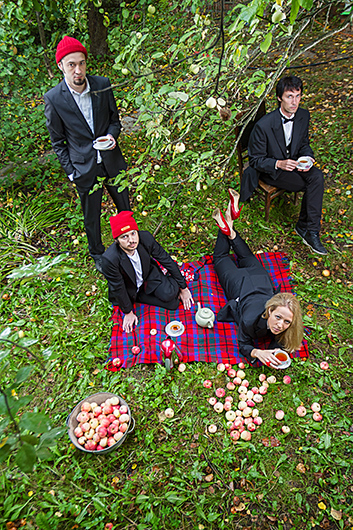
The Moscow group “Grisha loves a pear” not only composes songs in Russian, but also tries to embed them with markers of the era and joke about the consumer society. This is a difficult task, for most Russian indie musicians-overwhelming and even for some reason considered ashamed. But the leader of the “GLG” Zhenya Bely, who works as a marketing manager, and this does not stop her guys. On November 2, the group presents the second album “Stress” with a concert at the Powerhouse club , and before that they told COLTA . Ru , which distinguishes them from Slepakov’s seeds, how they were on “our radio” and why they are not called corporate parties.
- Who plays in the Grisha group group? Where do the group members work on iPhones?
- I am a white wife, I sing, I write songs, I work as a marketing manager. Mitya Repin plays the bass, in the world an interfaces designer and works in the Afisha, he is also the creator of the GLG logo and all our graphic materials. Eugene Obukhov, drummer, in the evenings plays and teaches drums, and serves in the office during the day. Pasha Uher is a professional guitarist. In addition to “GLG” plays in several projects, but he still does not have enough on the iPhone. And everyone else has.
- Why in general in 2014 to sing about Auchan, iPhones and traffic jams in Moscow? It does not seem to you that this agenda is from the zero, but now the crisis in the yard and some other request from the public-although Auchan and iPhones have not gone anywhere?
- In terms of zero you are right. The whole album is just a post-crisis, after 2009. But here is the issue of the length of the “production cycle” of the song - from idea to release. We spend a lot of time on this-and the point is not only in the record, but to notice, evaluate, think over, arrange, live with it for some time. Everything around it seems to change very quickly - but some phenomena are eaten and become so familiar that they stop noticing. This is just the most interesting to write about this. If you try to “keep up” - from the thought to the recording should take no more than three months. And we will now write a song about the crisis, and when we release it-there will already be a continuous jappy-bloomry, people will go to Ikeua, and we will have to wait for the next crisis. It is encouraging that not for long. And it also encourages that there are songs that are 30-40 years old, they all contain markers of particular time - and still they are relevant, people admire and sing, not even understanding what it is about: apparently, the matter is not in specific words, but in the sensation that this song carries.
They don’t take us to the corps - because, they say, the people will be offended. Socialist.
- In general, what social layer do you belong to - not office plankton, it is clear, but who: young professionals, creatures, bohemia, middle class?
- And we, rather, unite by the ideological vertical than horizontally. And each has its own layer. “Bohemia”, of course, sounds sexually - but that would be true if we all with music earned a livelihood. The guitarist Pasha is like Bohemia, Mitya-Hipster and Creacle Hercules, Zhenya is a rebel and informal, and I am still a clerk.
- What is the GLG group distinguish from the Grisha Urgant project and Slepakov’s seeds?
- Let's add a snapped, for triple completeness. Probably we are similar - like funny. But our girl sings.
Seriously, the difference is that we are trying to make music, not entertainment. Not the author’s humorous song of the KVN format or “Humor FM ” wrapped in a pop phonogram. These guys play more in a chansonnier or street singers, probably. We are complex, they are simple. They simply sell them to the corporate party, because everyone will laugh and dance. And they don’t take us to the corps - because, they say, the people will be offended. Socialist.
- Tell us about the sound of the group - what is it and why exactly?
- To begin with, on the first album of the sound as such, there was no - there was a certain musical shell for stories. In the course of the case, it became clear that it could not be - non -standard content with a standard sound was given too much dissonance. Another thing is important: in fact, the already finished song is an unprofitable food, which in the end can turn out well, or maybe tasteless. Here you won’t get off with one arrangement: not everyone is ready and can listen to music - it is the atmosphere often perceived, especially when the music sounds a background, it should read and hook, otherwise the music for elevators is turned out, the task is to remain unnoticed. As a result, the reduction of the second album dragged on for four months of night experiments with the sound, it was important to highlight the handwriting of the group, but at the same time not to make game at all. Within the framework of the album, everything turned out, in the future, I think we will move towards minimalism and electronic sound - now it seems that one note sounds and reads better than sixteen.
- You had four rotations on our Radio - how did you get there and what did these rotations bring to you? Will you carry the songs again on the radio?
- We sounded in the program of Andrei Bukharin “Native Speech” - I really liked what he did at first at the “maximum”, then at “ours”. He wanted and the air of unknown Russian -speaking musicians. Of course, I immediately sent him the first album, and the song sounded from him both in his program and in the “chart dozen”. I would like to believe that four rotations brought us a certain number of new loyal fans. Many people wrote to me personally and added to the VKontakte group, but you can’t count exactly. Of course, we’ll carry it. Although at the same “ours” they had been told to me for a long time that they appreciate us “as part of the current counter -cultural underground”, but they will definitely not put on the air.
- Tell us a fun story how Grisha loves a pear performed at a corporate party.
- “GLG” really played a couple of times on a corporate party, and there was nothing funny in this - they were only surprised that people know the words “shawarma” and “jaguar” and sing along. But in fact, it was fun when this summer we were called to speak for a real festival for the Druids. In a reserve where you can’t burn bonfires and drink alcohol. We went there all day - first on the SUV, and then on the boat. It was romantic and drivers - of course, they sang about Martini, and about the “jaguar”, and then pulled out of the glory, and in the midst of the height they ran into two pumped -haired fair -haired young people - members of local sobriety. They were convicted of the use and propaganda of alcohol, obeyed, listened to an explanatory conversation and received memos on how alcohol destroys the brain and heart.
-Finally-favorite questions: what is the main problem of indie musicians in Russia? And which of the colleagues is close and pretty to you?
-The problem of indie musicians is that if they really play indie, this turns into a problem for them. We (indie musicians) are not trendseters, but followers. Therefore, it is extremely difficult for us to do something original. And even more complicated, having made it original, to find a listener who will understand and appreciate. For by “indie”, contrary to the vocabulary definition, everyone clearly understands the hipster music of the “Western model” (see the song of the “hostel” group “Indi-Huindi”). Nobody ever called us “indie” precisely because we do not fit into this format. Take the conditional mohito, the same in all establishments, and it will be more popular than the author’s cocktail, since everyone is familiar and understandable. We like everyone who, contrary to everything, does in their own way, and in completely different formats. Alina Orlova (although it was a long time), “mare and corpse toads”, “Nesmeyana”, “Polyvo”, “hostel”. And so - everyone who is trying in Russia to do independent music, well done and ascetics.