
Translated material
Scientists have established the age of Ebola
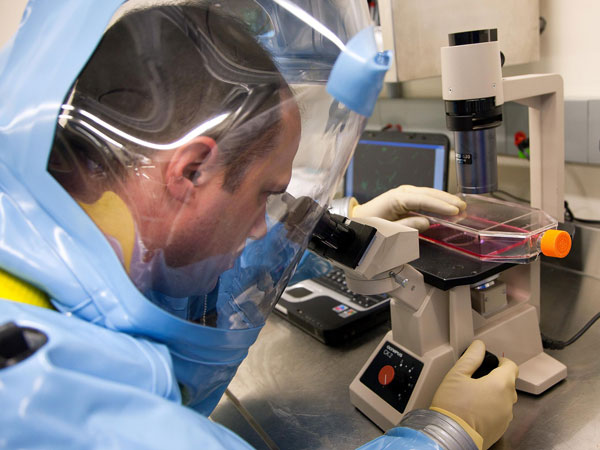
American scientists have established, Ebola virus is much ancient than before. He, like the Marburg virus, refers to the filoviruses that arose in the Miocene era, from 16 to 23 million years ago. This was reported in the journal Peerj, as well as in a press release from the University of New York in Buffalo.
American scientists found that in time the evolutionary lines of the Marburg virus and Ebola dispersed. Previously, scientists believed that Filoviruses arose about 10 thousand years ago about the same time when agriculture appeared. However, the results of the last study pushing the emergence of the Filovirus family many millions of years ago to the appearance on the planet of anthropoid monkeys. “Filoviruses are much ancient than it was supposed earlier,” says the scientist Derek Taylor, a doctor of biological sciences of the University of Buffalo. “They interacted with mammals for a long time, for several million years,” adds Taylor. The expansion of knowledge about the origin of these viruses can affect the composition of vaccines and programs identifying new pathogens.
 Ebola virus
It is noted that the discovery does not belong to the modern Ebola virus. Researchers, biologists Derek Taylor and his colleague Jeremy Brunn, worked with “fossil genes”, that is, with fragments of genetic material that fell into mammalian DNA during a viral infection. One such gene Filovirus (VP35) was found in the same place in the genome of two types of hamsters and two types of fields. Scientists came to the conclusion that this virus came to animals even before the rodents became separate species, and this was just about 16-23 million years ago. Simply put, according to scientists, the filoviruses are as ancient as the common ancestor of the hamster and fields. “These rodents have billions of pairs of bases in genomes. The probability that the virus gene will insert itself into the same place in different species at different times are negligible. It is much more likely that this inclusion occurred at the common ancestor of rodents, ”Taylor explains. The VP35 gene nevertheless turned out to be more closely connected with the Ebola fever virus than Marburg, which finally convinced scientists in the version that these two viruses began to diverge in the era.
The first famous outbreak of Ebola fever among people occurred in 1976, and scientists still have too little information about the history of the virus. The same shortage of information in scientists in relation to Marburg fever, which for the first time struck a person in 1967, then it caused the infection of 31 medical workers who worked with the fabrics of monkeys imported from Uganda, seven of the infected ones could not be saved. Understanding the antiquity of the virus can help in the prevention of the disease, Taylor believes. In his opinion, to create a common vaccine against the Marburg virus and Ebola's fever, it would be important to take into account that these two viruses diverged so long ago. New knowledge about filoviruses could expand the ideas about which carriers can be sources that hide unexplored pathogens. “When the scientists first took up the search for the Ebola source, they rushed through the jungle, moving to everything - from mammals to insects and other organisms,” Taylor says. “The more we know about the evolution of the introduction of filoviruses and their carriers, the more we can find out about who can be participants in this system,” the biologist adds.
Ebola and Marburg viruses cause viral hemorrhagic fever, which is characterized by abundant bleeding and impaired blood coagulation, as a result of which in most cases a person dies. This group of viruses also belongs to the recently discovered lobby virus, but it is supposedly harmless to a person.
The number of Ebola infected with the Ebola virus exceeded 10 thousand people, 4922 of them died, the World Health Organization reports . WHO also officially states that Nigeria was currently freed from the transfer of the Ebola virus. “This brilliant success indicates that Ebola can be stopped,” the organization’s website says. The current outbreak of Ebola in West Africa, the first cases of which were recorded in March of this year, is the largest and most complex outbreak of Ebola’s fever since the detection of this virus in 1976. She appeared in Guinea, then spread across the land borders to Sierra Leone and Liberia, and later transmitted by air transport to Nigeria and the ground-to Senegal.
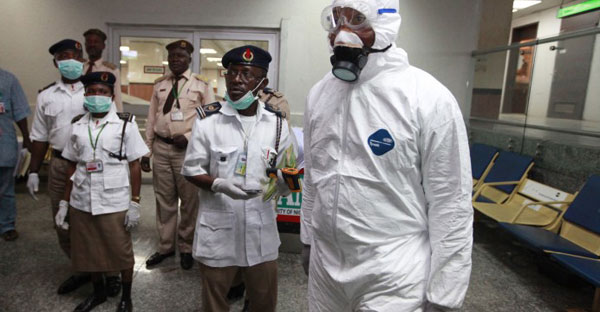 Ebola control at the airport. Photo: Ecns.cn
Many countries fear the introduction of the virus to their territory and are engaged in the development of preventive measures for emergency cases, as well as the search for a vaccine from Ebola. There is still no licensed medicine, but in WHOs the most promising drugs from Ebola are considered VSV-EBOV and CHAD-EBO vaccines, the latter was developed by the British company, both of them were based on the vesicular stomatitis virus, into which the Ebola and adenovirus chimpanzees was introduced. The Russian vaccine from Ebola’s fever is developed by the Novosibirsk State Scientific Center for virology and biotechnology “Vector”. Currently, tests of several vaccine options are already underway.
However, judging by the discussions on social networks, in Russia there is neither panic nor even fears about the threat of Ebola fever. Some are very skeptical of the news about the epidemic and believe that the excitement around the fever is a business enterprise in order to then earn on preventive drugs. Others believe that this is a US way to distract the whole world from more important problems. Spelling punctuation saved:
“Ebola is a disease that spread a thousand times faster on the Internet than in Africa,” Internet users joke .
“Ebola is inherently terrible only by dehydration, and a person will never die from Ebola if he receives proper care and basic medical assistance ... But in Africa it is difficult, that’s why they die from Ebola,” Denis Nikitin believes .
“The flu kills more faster, no one hysteria, Ebola, like the IG is spinning for benefit,” says Dmitry Kobert.