
Translated material
Overcoming non -existence
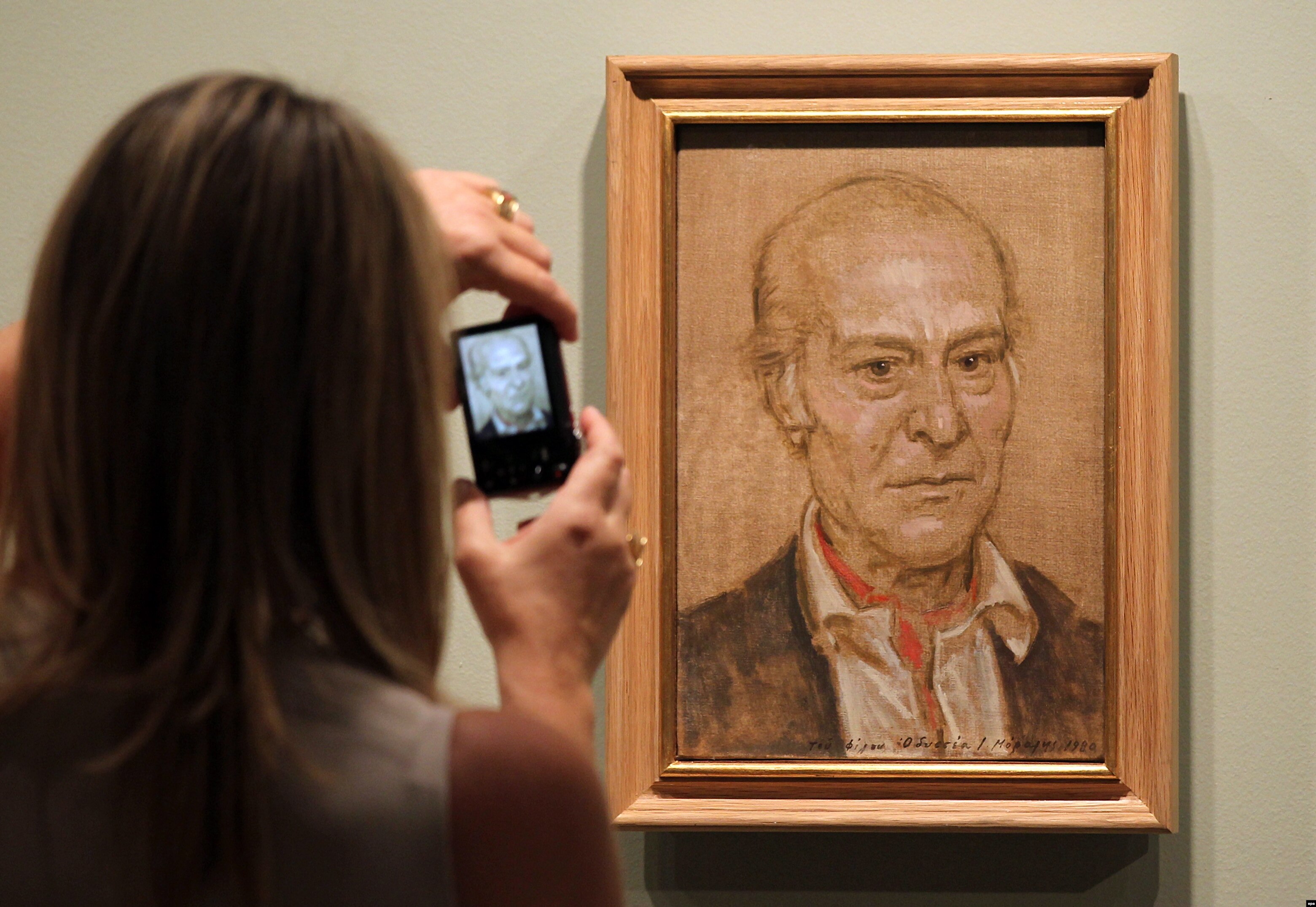
Odysses Elitis in Russian context
Alexander Markov. Odysses Elitis. - St. Petersburg: Aletheya, 2014. - 276 p.
For the first time, presenting the Russian reader the intellectual biography of Odysses Elitis (by the way, in general, the world's first statement about Elitis in this genre - the author managed to get ahead of this even the Greeks themselves, who were honored in Elitis of one of his greatest poets), philologist, historian of literature and philology, philosopher Alexander Markov does something substantially out of the framework His hero - although this in itself would already be a discovery for the Russian reader.
Yes, of course, involuntarily you have to do educational work - almost from the basics.
Elitis is the figure as significant as it is brightly characteristic of European modernism, which is noticeably better known to us in its Western European principles. “As an art theorist, the original interpreter of the European intellectual heritage, the creator of experimental forms of poetry,” writes Markov, “he stands on a par with Rilke, Pound, Valerie, Eliot.” Naturally, the cultural work that Elitis's associates performed in modernism had both a kind of Greek version and a kind of Greek tasks (and Markov shows that these, local, seemingly circumstances and their literary, intellectual results are interesting to be interesting outside Greece). These Greek features of all European intellectual care can be considered in the best way on the example of Odysses Elitis, since among his contemporaries-poets he is really one of the largest. It should be read as part of the European text.
With all this where Elitis definitely is not, it is in the Russian reader consciousness. Well, even if not in mass, from mass consciousness in relation to deep and complex poets there is nothing to expect - but in a general enlightened consciousness, in the system of his connections. There is no it there, although it was even translated with us, and not even so few. In 2008, the translations of Irina Kovaleva and Sofia Ilyinskaya with a fairly detailed introductory article were the first of the translators in 2008. “To translate it,” Kovaleva wrote, “is incredibly difficult, because his poetry lives inside the tongue. True, those highly professional translators who took up this were on top - S. Ilyinskaya, Yu. Moritz, L. Yakushev. However, literally unit poems were translated. Not a single collection of elitis - with the exception of“ heroic and mourning songs about the younger leutenant, who died about the younger leutenant, who died. In Albania " - to this day has not been translated into Russian as a whole. The most representative publications today - in the anthology" Hercules and we "(1983) and in the book" Poets - Nobel Prize laureates "(1997), largely duplicating each other." In the same 2008, in the Greek Library of the Publishing House O.G.I. The only, not very large - in a hundred pages - a collection of Russian Elitis, the "Hyacinth concert", in the translations of the same Kovaleva, Ilyinskaya and Milena Harutyunova, came out. Two years ago, a small example of Elitis’s prose was published on the Gefter.ru website - a “special path” - a text characterized in a short preface as “rhythmized thoughts of individual experience”. For some reason they were published without indicating the name of the translator, but something stubbornly makes me think that it was Alexander Markov himself, who has been engaged in Elitis for several years.
In any case, Markov accurately leads his hero from the Russian linguistic of being (before) of being - both in large volumes: all the texts of Elitis in the book - both poems and excerpts from essays - are given exclusively in the author’s own translation. Again, in order to be done by a great work, one thing would be enough. It would be quite possible, for example, to publish a collection of translations with comments - it would already be significant. But the author is clearly not enough.
Markov is engaged in elitis not just as a poet, but as an intellectual phenomenon, he considers him as a point of converging many and different semantic lines. The biography of the poet as such is given only to the first part of the book; The second considers his relationship with different areas and modern culture to him and the previous culture.
And, finally, Markov makes the figure of Russian cultural consciousness and Russian reflection from Elitis. Here, of course, you can’t do without a monograph - moreover, one that attracts the vast layers of Greek and European culture - and the one, which, perhaps, could only write Alexander Markov with its individual mental structure.
Markov would not be himself when it would have been in the Greek poet, even for a long time to be comprehended, did not find a reason for the encyclopedicity in general, Markov is a person of such a property that under his arms, like the king of Midas, into gold, completely everything that he speaks about. Elitis, "the brightest of the poets of the" hymnic "warehouse", according to him, inherits "simultaneously classical ancient imagery, the sophistication of Byzantine poetry and European modernism." Thus, the poet gives his biographer the opportunity to think over a much more widely posed question: what poetic results can give these three completely multi -built traditions, having come down in one person - in interaction with each other, and even with the author’s personality? What are the principles that form from this diverse unity and holding it?
Essentially, Markov presents us with an analysis of a whole cultural state - or even several such states that have come in the years of the active creative life of Elitis. And he lived for a long time, from 1911 to 1996, self -propelled in almost the entire XX century and surviving (out of growing?), Essentially the very modernism that in the first half of the century caused him to life as a cultural phenomenon. Not to mention the fact that throughout the book they are scattered - able to grow together in a separate study - excursions in the uniqueness of the Greek, Mediterranean way of experiencing and understanding of topics and problems characteristic of the modern elitis of Europe. (In general, the author (not) once again confirms the long-standing of my suspicion that it is possible to truly write the history of culture or some of its fragments only by missing all this through a description of some, piece and single, which combined it in itself.)
So, we will find out - briefly, at the level of mention, almost in passing - “the most important difference between the Greek version of psychoanalysis” - with one of the adherents of which, the poet Andreas Embiricos, the leader of Greek surrealism and the “first Greek psychoanalyst,” to communicate with the young Elity - “from the main European versions”. "Greek psychoanalysis is frankly masculine: the main attention in it is paid not to the" attraction to the mother ", but" the search for the father, "and the Greek Oedipus is primarily a wanderer, not a tyrant." And the other ally of the embryicos for surrealism, the poet, painter and essayist Nikos Engonopulos "tried to summarize the psychoanalytic experience of the split" I "by performing a moral polarization in it: he began to distinguish between" good libido "and" bad libido ". We also learn how the Greek literary life was built in the thirties: after that, after that, after that, after that, after that, after that, after that, after As "in 1922, the Maloisian catastrophe put an end to the" great idea ", and the revolution of the military general N. Plarace and the king’s flight destroyed the previous trust in democratic mechanisms," "literature began to get involved with circles and magazines than with the public activity of poets-politicians and poets-poets" in what kind of difficult relations were, what values were then loaded then, what were the values of the then. variant of the new Greek language - demotics and kafarevus ...
All this applies to plots that are not like the periphery of the Russian picture of the world, but essentially beyond its borders. And certainly it is not involved in an active comprehension - despite the fact that Greek culture is much less, if we think about it, we are alien to us and far from us than, for example, French or German (at least by virtue of Byzantine roots and the Orthodox foundation). Greek brands, as if "outskirts" cultural plots in our picture of the world.
Markov reads Elitis as part of the environment - and as a full -fledged chapter of the European text, looking from the inside of which the reader gets the opportunity to a certain extent to see its other chapters differently. He not only says that Elitis is a major poet, he explores the anatomy and genealogy of this size.
As a result of all that has been said, in the book about the Greek poet-nobeliat, I’ll risk saying, almost equally, albeit in different respects, both its hero and his interlocutor-author: his principles of vision of his material, work with him, the tasks that he sets himself.
Speaking about the European culture in which he acted, with which his hero led the dialogue, Markov understands the culture of not only verbal, but different levels and forms of human reality. (The word, however, occupies in this reality, how much it can be felt on the basis of what has been said - a kind of privileged position: it focuses on everything that is happening in it, gives it to be revealed.) So, we will find in the book of the chapter about the elitism and the Greek revolution, about Elitis and artists, about elitism and science; Reflections on the relationship of Elitis with the modern Greek Theater; About the relationship of his theological interests with his own radical political views ... And this is fundamentally for the author: he is ready to consider almost everything that influences the poetically implemented word - and educates the conceptual tools for discussing these objects in their unity. Markov patiently extends the framework of philology-without violating their structure and not ceasing to be a non-incounded philologist.
Its book itself, according to the author’s recognition in the first lines of the preface, "arose from the deep conviction that in addition to the direct influence that historical and philological disciplines study, there is an indirect influence that needs special methods of study." It is these methods of brands slowly on domestic grounds that cultivates.
“Indirect influence,” he explains further, “passes through the boundaries of the arts: we can talk about the influence of the moon or rivers on the poet of the 19th century (why, however, only the 20th?!- O.B.-G.) no less than the influence of Baudelaire or Rilke.” Markov is generally a bit to how the word and non -western exchange mutual influences - and the elitis is very interesting to him among other things and therefore: forming poetic statements, he worked not only with the word. “Compilation of collections itself,” the author writes, “was an iconological experiment for Elitis: Elitis not only invented the design himself, making a sketch of the cover and attracting familiar artists to the design, but also followed the printing - he selected paper, fonts, placed the text on the page. You can immediately recall the experiments of the avant -garde, but the difference between the elitis consists in the fact that the elite is that it consists in the fact that the elite is that the elite is that Avangardists turned the book into a semblance of plastic arts, while Elitis sought to put classical arts in the service of a completely traditional, cultural book form. "
Markov looks closely at the underground currents of ideas and images, leading to the fact that the same elitis - a person without a doubt of the book - "influenced not so much Lorc and Eliot as the spirit of Byzantine hymnography and folk mythology." He is no less ready to be attentive to the fact that the poet knows only “firsthand” - “But this influence is nevertheless deep and soulful.”
Well, I don’t know how it is possible to immediately and categorically not to fall in love intellectually in the author who knows how to understand this; capable of seeing with lateral vision no less clear and tenacious than direct. The connections of this level are noticed and, moreover, extremely few are able to work with this, because, in addition to literacy, such work also requires great sensitivity and, which is equally important, the lack of snobbery.
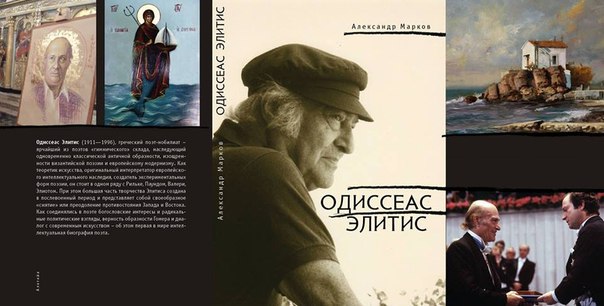
That's what is desperately sorry - this is that there are no illustrations in the book. Not a single one - with the exception of the portrait of her hero on the cover. And how important it would be to see photographs of it at different stages of life; handwriting samples; Reproductions of the covers of his collections - which he meticulously designed - his drawings, paintings by those artists who were especially significant for Elitis! With the understanding of the mutual influence and penetration of the word and the non -western, their needs for each other, which both Alexander Markov and his hero are characteristic of how few people - is felt simply necessary. I even want to - although the book barely came out - to dream about its reprints, with illustrations and a separate, large poetic application. What if it turns out?