
Translated material
"Our Crimea", street art-no
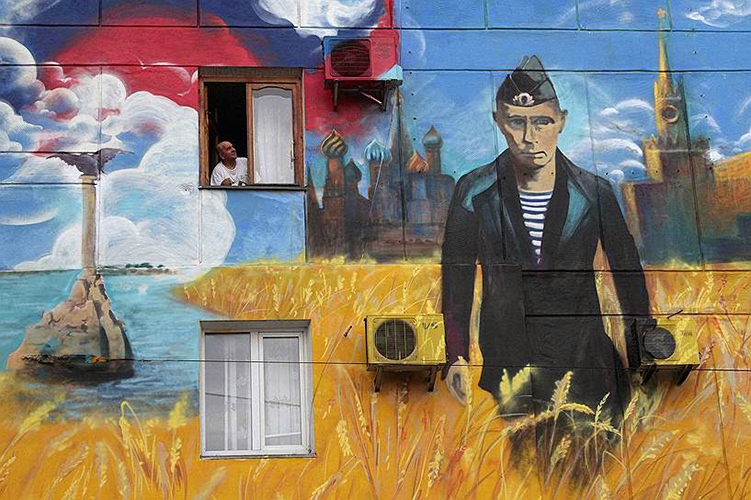
In just a few years, hastily legalized street art has acquired the features of an urban epidemic. Designer sneakers "Adidas" the size of a middle warhead are scattered around the city. Here and here there are agics facades reporting the latest “achievements” of Russia, the giant faces of Mikhail Bulgakov, Sergey Rachmaninov, Vsevolod Meyerhold ...
From the side it seems that this is a history of heroic conquests of public space. In July, in St. Petersburg, the Street Art Museum opened on the territory of the existing plant of layered plastics. The firstBiennale of street art “Artmens”, with the support of the Moscow Department of Culture, was held in the capital in September. The world stars of legal street art, massively climbing the capital every day, multiply samples of monumental painting in the city: the number of painted walls is already calculated by several hundred. In fact, legalized street art was cleaned of a raid of provocation and placed in the sterile environment of updated Moscow-the space of extremely pleasant visual sensations. Once upon a time, a subculture has turned into an industry, divided between the city authorities, pro-Kremlin movements and large businesses, sick with street marketing.
"The decorated facades do not tag"
Street art became part of the festival "Best City of the Earth" ("LGZ") in the fall of 2012. The general director of Novatek Art LLC , which is engaged in the “organization and conduct of artistic painting and design of city infrastructure facilities”, Ivan Panteleev assures that the roots of the graffiti program of the Department of Culture are leaving for the Festival of Street Art “Most” , which his company first spent a few months before. “Even before the festival“ Best City of Earth ”, we made 21 objects in Moscow - facades, bridges, booths,” he says. “Artists, fortunately, even then discarded unnecessary provocationism and began to do the work of the city level.”
Having decided to make friends of city officials and street artists, Panteleev suggested using street art for decorative purposes at a meeting with Moscow Mayor Sergei Sobyanin. “I said that in this way we help utility services to fight vandalism - the decorated facades do not bother,” he says. “The image of the city is rebooted, an emotion appears between the dull gray walls.”
Sobyanin gave good. To realize the will of the mayor, according to tradition, rushed with a zeal brought to absurdity. The following was followed by a rapid change of pictures: a meeting with Sergey Kapkov , who was instructed to implement the program of “street creativity within the law”, and the first standards - 150 objects. They were divided among themselves by Novatek Art and curator Sabina Chagina, who owns a store and the Streetkit gallery. The tram depot on the soon, reminiscent of Roy Liechtenstein and the average newspaper caricature at the same time (the art group “310” worked on it), the facades, once again the facades, the current plants, very small booths ... Very soon, the adepts of the new direction began to operate with the terms “functionality”, “usefulness”, “social work” and “payment of labor of street artists”.
Soviet illustrations from fairy tales on booths near playgrounds began to make Sabina Chagina. At some point, the LGZ website was earned by the graffiti-help function: everyone could leave an application with the address and photography of the object where he would like to see graffiti. “True, we could not cope with the hellish stream of applications,” admits Vladislav Stefansky, who worked as an assistant to Sergey Kapkov from 2012 to 2013 and was engaged in the graffiti program from the Department of Culture.
Now the Street art program “LGZ” combines three blocks: copyright work “on a free topic”, dedication to the Bulgakov characters, who are scratched in raw plaster and imitate the technique of sgraffito (they are made by Pavel Shugurov, a popularizer of legal street art in Vladivostok), and giant faces of the creators of the early twentieth century. Not so long ago, for example, in Bolshoi Vatin Lane appeared three -story Sergei Eisenstein. On the way - Anna Akhmatova, Konstantin Stanislavsky and Igor Stravinsky.
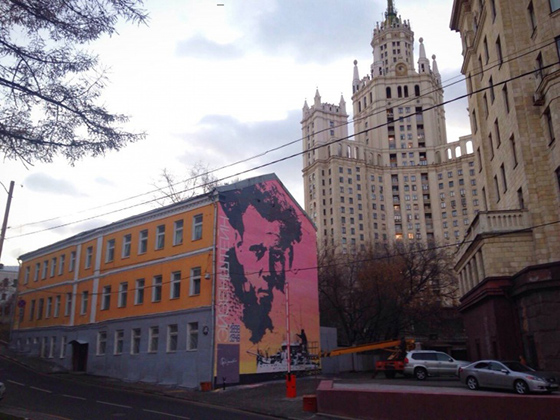 © Department of Culture of Moscow
“Of course, you can argue about whether the city needs such oversaturation with street art,” says Vladislav Stefansky. - But before this program, graffiti was not associated with art in the minds of the layman, and no one tried, for example, to convince the artists that there was nothing shameful in working with the city, that this is not a backwater. As a result, even anonyms that paint the electric trains at nights and tags on the streets worked with us. They also know how to draw. ”
Eisenstein is, of course, not Crimea. However, this vague-abstract content is kept on tossing strictly defined images into the cultural field. “Why do we need Western brands and symbols? - Asks Ivan Panteleev from Novatek art. “Why do we need Marilyn Monroe, if there is, for example, Love Orlov?” I would not want to slide into kvass patriotism, but we have a great culture, and we broadcast it through street art. ” As a result of such a policy, instead of Charlie Chaplin, who was originally intended to draw, the Brazilian Eduardo Cobra, Maya Plisetskaya appeared on Bolshaya Dmitrovka. Instead of branded strangers who were inadvertently falling into the frame of Colombian Stinkfisha, is Rodchenko's red -heeled Pioneer. “He wanted to make some kind of Indian woman, but people will not understand! - explains the general director of Novatek Arta. “We must learn to promote Russian culture to compete with world brands.”
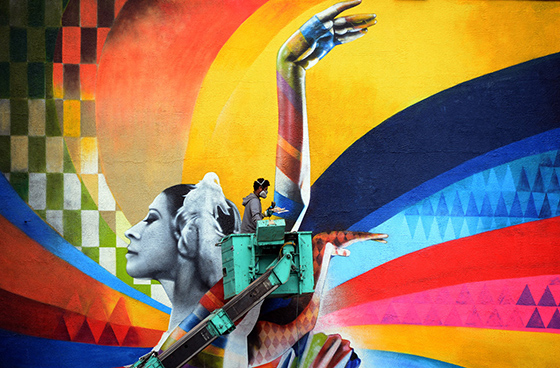 © AFP / East News
Not without Crimea
However, the festival “Best City of Earth” had a single political work. Nevertheless, in the spring of 2013, the so-called Crimean graffiti began to appear under the LGZ brand. The frantic patriotic impulse found a way out through street art almost by accident.
“Suddenly people began to come to us from one-day company of a wide profile: they and graffiti wanted to draw, and then some kind of musical festival were plunged to us,” says Vladislav Stefansky. -They brought me presentations in which the names of my friends-artists were listed, and they, of course, never painted any facades in Sochi. So the works that were done in the framework of LGZ for some reason ended up in foreign portfolio. ”
Soon the legendary drawing “Russia and Crimea Together Forever” appeared on Taganka, its initiator is Alexander Diaghilev, the former commissar of “ours” and a dozen more horse-patriotic social movements. He registered the brand “The Best City of the Earth-Art”, allegedly uniting all the artists who painted as part of the festival of the Department of Culture, and also bypassed several television channels, generously distributing the interview. Multiplying myths, Diaghilev trumpeted about the preparing two thousand houses and prices for painted facades: one wall - 1 million rubles. However, as it turned out soon, in reality, Diaghilev’s activity limited herself to Taganka, and the artist painted this wall for a spray cylinder.
The expected drawing was inconsistent. “The day after he appeared, they called us, in my opinion, with the question:“ Do you know who did it?! Crookedly, askance, ”says Ivan Panteleev. This wall, reminiscent of the guitar’s stamp, “Novatek Art” tried to get the “LGZ” graffiti program-was planned to portray dedication to Vladimir Vysotsky. However, nothing came of it. “Patriotic graffiti in terms of performance is, of course, a shame,” says Panteleev. - It is not very clear what he thinks, for example, a customer of such a project when he travels around the city and sees a job that does not correspond to the level of Moscow as one of the international cultural capitals. This is anti -advertising and complete profanity of the idea. ”
Names and names, of course, are not disclosed
The-agriculture wall with Putin-chockey player, the facade with Gagarin (“Yura, we corrected!” On Nakhimovsky Prospekt), the Graffiti-collage “Thank you”, assembled from the letters painted in different cities for the President’s birthday, belong to the Prochrevsky movement “Network” . It appeared a year ago and absorbed mainly former “ours” activists.
The movement calls itself a national producer center and claims that it has nothing to do with any non -profit organizations. The “network” works, in fact, as the “vaccination” of the right, full of love for Vladimir Putin, a view of culture. In addition to graffiti, they organized a fashion show in Sevastopol, on which they showed sweatshirts with the Russian ruble, and the “12 spiritual bastard” film festival led by Emir Kusturitsa.
Patriotic graffiti in terms of performance of execution is, of course, a shame.
“We support Vladimir Putin and want to grow people like him,” says Anastasia Melnik, spokesman for network. “Our task is to bring media persons who will be responsible for Russia and represent it into the world stage in 10 years.”
True, Alexandra Diaghilev is not complained here: they say, they say, they used to work together, and now he ascribes to himself the projects of the “network”. Melnik claims that they do not pay artists (“He wants the public to see his work!”), And “private individuals and commercial organizations” give money to their projects, the names and names of which, of course, cannot be disclosed.
No one thinks about an aggressive invasion of urban space with frankly propaganda encodings in the “network”. “How much can you? - The artist asks, introduced as Eugene Mars. -Yes, opposition views were accepted in the Street-ART-test, and we chose a different position. For us, graffiti is a platform for communicating with an audience, a new media. Moreover, the topic of our drawings is relevant, all artists with education, everyone understands what they are doing. Why is some eye and two squares drawn on the third transport ring-this is an art, but Minin and Pozharsky against the background of the Kremlin-no? ”
In the mid-1980s, in the United States, the head of the New York subway, David Gann, who looked at the graffiti “Symbol of the collapse of the system”, declared war on street art. In today's Moscow, they were transformed into a symbol of Quasitrium of this system.
The “Network” insists that all their graffiti are agreed with the owners of the buildings. Anastasia Melnik rests on the fact that “not so big changes” are introduced into the appearance of the house: “We affect less than 30% of the building, and besides, these houses are not architectural monuments.”
We support Vladimir Putin and want to grow people like him.
However, Activist of the Archnadzor movement Andrei Novichkov calls a story with 30% nonsense: “For example, residents of the house on Pokrovka called us and asked if it was possible to draw Crimea or something else without coordination with them.” According to him, any drawing on the building - whether it is a historical monument or a typical high -rise building - should be agreed with the Muscovitecture, the prefecture of the district and residents. “Each house has its own colorful passport, that is, made in a certain color,” explains Novichkov. - You always need to remember that the appearance of the structure is already completed by the architect. It doesn’t matter if it has the official status of a cultural heritage object or not. ”
As explained in Archnadzor, graffiti can be drawn on a deaf wall of the house without coordination with the owners in case the permission has given the Muscovitecture. But there are windows on the wall of the house on Pokrovka, which is now decorating an idyllic view of the “Lastochkin's Nest” in the Crimea, which means that coordination with the inhabitants was mandatory. “Therefore, in the case of cover, of course, there was a violation,” says Novichkov.
Street art that we have squeezed out
However, it cannot be said that the very existence of the “Crimean” graffiti determined the agenda. The most painful was the question of whether the gloomy wall-mounted patriotism or joyful-abstract urban design is generally with street art. The street artist Stas Good, for example, is sure that "walls are a crooked mirror that shows what is happening very well." “Let the“ Crimean ”facades and“ thank you ”Putin,” he says. “Let our children and grandchildren see how wretched the regime was.”
Ivan Panteleev, on the contrary, believes that this is a pretty "Oldsky view of things." “Let the meaningful, provocative, illegal street art will also be,” he says, “but Tagging, stuffing initials-this is not interesting today. We create a great contemporary art of urban scale. It's just that this story is no longer about underground. ”
Let our children and grandchildren see how miserable the regime was.
Nevertheless, the constant repetition, the legalized seriality of the once radical gesture, still led to its meaninglessness. A brand appeared on the site of Tag. Anonymous with a spray can in the pocket of wide pants were replaced by refined street painters with an academic education. And at this point there are the opinions of most street artists, bypassing official festivals.
The artist and activist of the Partizaning project Igor Ponosov, for example, is convinced that we have long lost graffiti and street art as outsider art practices. “Graffiti and Street art today are supermainstream directions,” he believes, “and commercial brands, developers and power use this. It is annoying that with all these trends, the environment of street art in Russia has not formed. In this area there is not a single curator, criticism or art critic. What is happening today is practically not discussed inside the street art community. His adherents are rather glad that finally there are megaps, festival programs and can be earned by cooperation with commercial brands. In the next few years, probably, this situation has been eliminating grain from the chaff, but this can no longer be called street art-we have been squeezed out now. ”