
Translated material
Have you climbed the lighthouse of the cross?
Within the framework of the Krasnoyarsk Fair of Book Culture, the Swiss artist Florian Count will present two large -scale installations - the “game field” and “concrete volume”. They can be seen in the Krasnoyarsk Museum Center. In an interview with COLTA . Ru The artist spoke about the New Testament as a source of inspiration, an architectural view of art and the absence of borders.
- Why did you bring a chessboard to Krasnoyarsk? This is clearly some kind of hint.
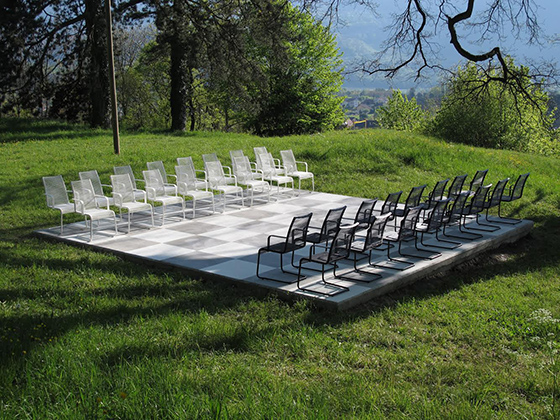
-Yes, yes, all for a reason. The name of my installation from French literally translates as a “game field”, there is a link to the conceptual artist Marseille Dyushan, who played chess throughout his life. This is curtsy in his direction. The installation is a large -scale chessboard with chairs instead of chess figures. On the one hand, this sculptural composition is an object of contemplation, which works as a platform, where visitors can walk or sit down. But this is also a kind of scene that anyone can get to. Everyone should determine the rules and their role - it does not matter, the king or pawns - or just take a chair and take a step from the playground. This activates the psychology of the group organization. Chess is very popular in Russia, so I brought this work here. By the way, the competitions of two chess teams from Krasnoyarsk will be held here. Let's see what will come of it.
- In the Krasnoyarsk Museum Center, your other work will be shown - “concrete volume”. Is this curtsy towards the Krasnoyarsk rocks?
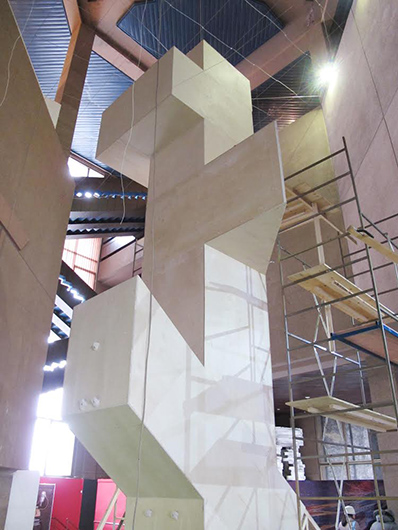
- Yes, this is a sculptural replica on the Krasnoyarsk cliffs, or, as they are called here, “pillars”. The concrete structure enters into dialogue with the landscape and with the architecture of the museum itself, which was originally built as the 13th (and last) Lenin Museum in Russia. At the opening of my monument, a professional climber performed various risky tricks on it, and on the rest of the days all visitors to the museum will be able to climb him like a tower or a lighthouse.
 © Florian Graf
- After all, there is also a reference to Suprematism?
- Upon more detailed examination, it becomes clear that this is not just an abstract sculpture, really reminiscent of the Suprematic architect Malevich, but also the image of the cross (if you look diagonally) - the main symbol of Christianity. This is a horizontal-inventive penetration, where the horizontal symbolizes the earth, and the vertical-the sky. These stories can be found in the same Malevich and, for example, Pi Mondrian. This is an object and my interest. For me, the New Testament is one of the most complex utopias that cause constant conflict with everyday life. The tradition of pillars comes from this complex of problems. My “concrete volume” is made so that the audience touches it, penetrated the most distant corners, expressing at the same time spiritual and sensual interest.
- Will these works be exhibited for the first time?
- I created the installation of the “concrete volume” specifically for Krasnoyarsk, so the first show, yes. As for the “Game Field” project, in Russia I show it in a somewhat updated version, because it will exist in a fundamentally different space. For the first time, this work was presented at the sculptural Biennale in Switzerland this year (I made it for the English landscape garden in the Swiss Alps).
All visitors to the museum will be able to rise to my work, like a tower or a lighthouse.
- But this is not the first time you work with space and monumental forms. Where does such a love of scale come from?
- You correctly noticed, I like to work with large forms. I have several works where I try to give them some new meaning. So, for example, two years ago, on the shore of Lake Bodensky, I built a lighthouse, which, like a boat, could push off the shore and circle aimlessly through the water. The meaning of this lighthouse is not to serve as a guide, but to, floating along the lake, violate the boundaries between Germany, Switzerland and Austria. The object was called Ghost Light Light House . I even lived in it for some time. And I also lived in the former Bellelay monastery, which I turned into my studio for a while. Maybe the fact is that I am an architect by education (I studied at the Higher Technical School of Zurich) and I, like any architect, have special relations with space. It’s scary to understand what place we all occupy in life - both in the psychological sense, and, no less important, in the spatial. Can this place change? And how to do it? The way we build our cities, what environment we form around ourselves, all this affects our daily life, psyche.
- Is it possible to comprehend the space using other genres and means of expressiveness - for example, performance? Or is it possible only through static forms?
- I think yes, it's pretty interesting. Performance sometimes helps to find a certain “poetic density”, which I also try to create in my videos.
 © Florian Graf
- How is that?
- When time, action, energy are connected, peculiar impulses are created. I was born into a family of musicians, so it is easiest for me to compare this with music, which is also a dense stream of sounds. And I use different other matters to create my works. Although, of course, I understand the most understanding sculpture and generally any large forms, scale. This, in my opinion, is ideal tools to try to look at the world philosophically. I would like to unite, like the artists of the Renaissance, Vita Activa and Vita Contemplativa , that is, the artist’s active intervention in nature, the environment, on the one hand, and contemplative thinking on the other. I think that this balance creates real art.
- You were born in Switzerland, but spent a lot of time in America and Great Britain. Is it important for you to identify yourself as a Swiss artist?
- I will not say that this is a fundamental question for me. I was born in Basel and spent most of my childhood there. But for the past ten years I have lived in a variety of places-in New York, Edinburgh, London, Chicago, Berlin and Rome-and made exhibitions around the world, from Moscow to Afghanistan and East Africa. So it’s hard for me to call myself a Swiss artist or even European. Too many experiences received in different parts of the world under different circumstances influenced me, formed an artistic flair. For me, art is not a matter of nationality. It is rather about an individual person and his relationship with the world.