
Translated material
Schoolchildren in orbit
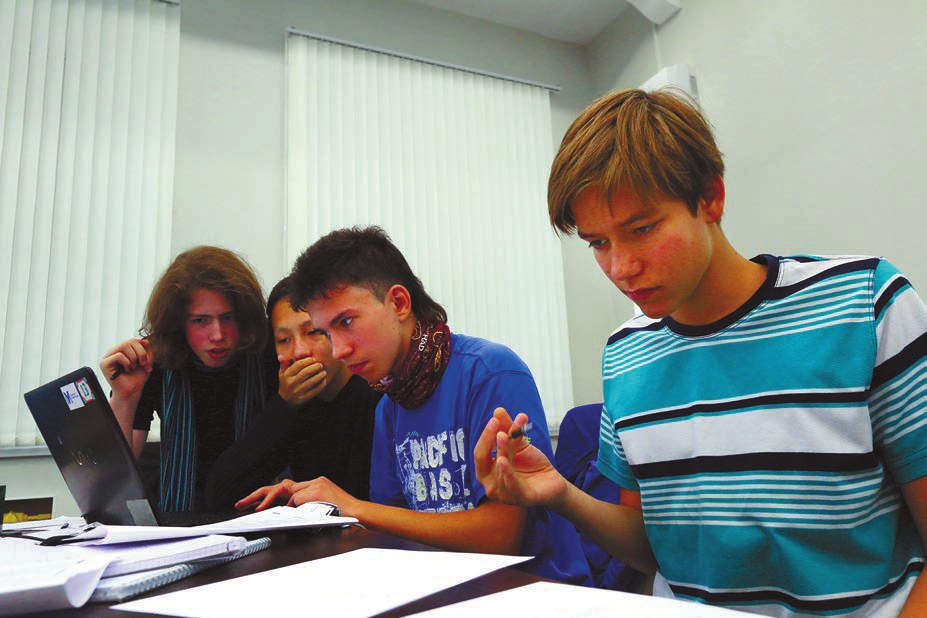
 From September 15 to October 12, 2014, the All -Russian Tournament for Modeling of the Orbit spacecraft was held as part of the science festival. The game "Orbit" [1] was attended by almost 650 schoolchildren of 8-11 grades from 30 regions of Russia (in total 146 teams).
All participants began with the qualifying stage: it lasted three weeks in an online mode. Every Monday to the teams who managed to go through the previous stages opened a new task. In the first mission, lunar, the task was simple: the participants needed to put the finished ship on the surface of the Earth’s satellite, for which it was enough to carefully read the methodological instructions and calculate the meaning of the only parameter.
Those who managed to put the ship on the moon were supposed to adjust the braking and prevent the critical value of the overload on Mars. The Red Planet required more calculations, so its hypotheses could be checked on a ballistic model - instead of a rocket, launched a body with a fixed mass and use experimentally obtained data. In the last of the online tour, the teams needed not only to put the ship on Mars, but also to pre-design it, and after landing, to transfer as much scientific information as possible from the surface of the planet to Earth.
The work of children in the qualifying round took place using an online sympturator, in which sharp overloads were modeled at the entrance to the dense layers of the atmosphere, heating the device due to friction about the atmosphere, the danger of a collision with the surface and other realities of the planting of the spacecraft.
But, unlike other cosmic simulators, such as Orbiter [2] , Spaceengine [3] or Kerbal Space Program [4] , in “Orbit” it was necessary to deal with formulas, to deal with the physical sense, to solve practical problems without beautiful visualization. The online symbol only calculated the result, showing how true the students analyzed the source data and made their own calculations. After each landing on the surface of the planet, the participants received telemetry from their spacecraft and could see their mistakes or, on the contrary, make sure of the correctness of the selected solutions. It was impossible to win this tournament by trial and error.
On October 12, in the final, 15 best teams from all over Russia met in the walls of the University of Mechanical Engineering (Mami). They had to conquer Venus, which was a serious challenge: the device had to overcome the dense layers of the atmosphere, and then work out on the hot surface of the planet as long as possible.
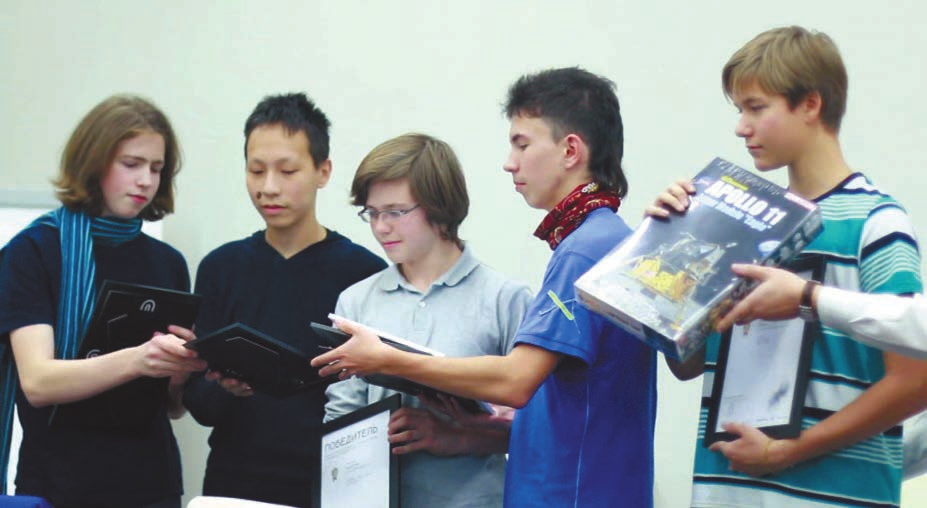
During the six -hour struggle, the leader changed several times. In the last minutes of the tournament, the national team of Moscow tenth graders called “Vyodra Russell”, consisting of the former and current students of the intellectual school (Daniil Gafni, Evgeny Koylyak, Daniil Konovalenko, Nikitinko Nikitin, Kirill Shumilov), pulled out the victory.
The second place was taken by the Kermana team from the Center for Education No. 1 of the city of Tula (Alexander Anchishkin, Dmitry Rustsarinni, Daniil Kostusaev). This team retained the leadership for a very long time and had every chance of victory. The third step of the pedestal was occupied by the team “KB named after E. Schrödinger ”from Lyceum No. 14 of Zhukovsky Moscow Region (Danila Voznyuk, Boris Bilich, Alexey Shepelev, Ivan Shandybin, Mikhail Sysak).
 Alexander Khokhlov
Photos provided by the organizers of the tournament
2. Http://orbit.Medphys.ucl.ac.uk .
4. Https://kerbalspaceprogram.com .
PS The editorial office congratulates A. Khokhlov on the birth of Olesya's daughter!