
Translated material
College in the mountains
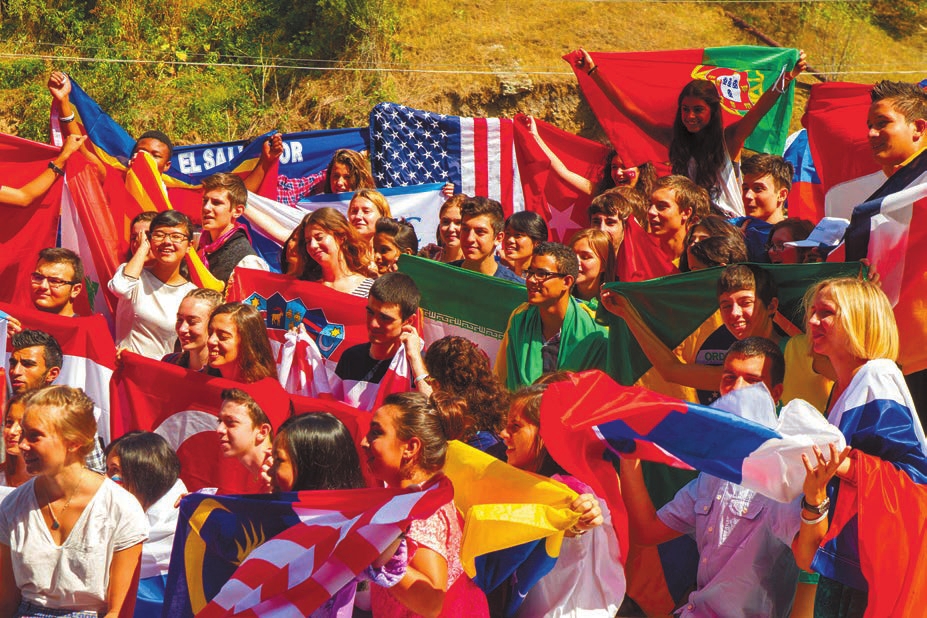 In the Armenian city of Dilijan, this academic year has opened the International School of the United World Colleges. Who and what will be taught there , Karina Nazarevyan found out .
Sixteen -year -old Nariyda Zeino (Obaida Zeino) from the Syrian city of Aleppo literally with a battle broke his way to foreign education. There is a war in his country, the city has problems with electricity and the Internet, and you need to apply and interview online. By hook or by crook, Obayde tried to get at least temporary access to his mail and skype - and eventually passed a competitive selection.
Teenagers who want to study in one of the colleges of the United World Colleges (UWC) are selected by national qualifying committees. They are about 150 countries of the world, and they include graduates and teachers of UWC schools and other local specialists. The UWC colleges themselves are only 14: they are in Canada, Hong Kong, India, Italy, Holland, the USA, Great Britain, Norway, Singapore, Swaziland, Costa Rica, Bosnia and Herzegovina, and from this year in Germany and Armenia.
Obayda did not know that he would be sent to Armenia. “But it is very happy to be here,” he adds diplomatically. According to the teenager, he did not pass the exams well enough to choose a specific college. As the organizers say, the decision on which country will go to each of the children, make national qualifying committees. At the same time, they try to take into account the preferences of the applicants themselves as possible.
And their preferences are quite unexpected. The sixteen -year -old Tourchanka, Sila Karabiber) wanted to study precisely in diligas, because she is very upset by bad relations between Turkey and Armenia. “We are neighbors, but so far from each other and do not know each other at all,” she complains. - I would really like to really restore bridges between our cultures! I want to change something. " All friends were very surprised at her choice, but her parents supported her.
In addition to the force, three more students from Turkey arrived in the UWC Dilijan this year. In total, the college in September accepted 96 students from almost 50 countries from Europe, Asia, North and South America and even Australia.
 The world is without borders
The United World Collegages movement originated in 1962 in the UK. It was then that the German teacher of Jewish origin Kurt Hahn founded the first UWC school in Wales, which was called Atlantic College. The khan was already in seventy, and he saw a lot in his lifetime: two world wars, imprisonment and persecution in Hitler Germany, forced emigration to the UK and difficulties of the post -war period. The idea of the UWC was to collect adolescents from different countries in college, many of which are divided by political and historical contradictions. With personal communication, interethnic prejudices should have disappeared.
This strategy turned out to be quite viable. Erasing the borders, the struggle against misunderstanding between different cultures and now, 52 years later, remains one of the main missions of the UWC movement. As can be seen in the example of the history of the power of Karabiber, this mission is still relevant.
To unite people, you need a universal language of communication. Naturally, they became English: on it, children study and communicate with each other. It is striking that schoolchildren speak English very well. To the question: "Where did you learn the language?" - Obayda Zeyno modestly replies that he was doing it. “Unfortunately, in Syrian schools, English is taught quite weakly,” he says. “I read books and watched many films.”
In UWC colleges, children are taught according to the International Baccaraite program (International Baccalaureate, or IB). Despite the name that can be misleading, this is not a university program, but a program of pre -university training. It was developed by the Non -Profit International International Baccalaureate Foundation, which was founded in 1968 and was based in Geneva. According to information from his official site, today there are four IB programs for children from 3 to 19 years old and more than a million people in 3934 schools of 147 countries study on them.
The IB diploma is recognized by leading universities in the world: with it you can enter Cambridge, and Oxford, and MIT. In Russia, IB is also recognized as secondary education. Accordingly, the Russian schoolchildren who came to the dilizhins open up the widest opportunities.
Blocks to choose from
Seventeen -year -old Lena Vasilieva graduated from school in Murmansk. But instead of entering the university, she decided to learn for two more years under the program of the international undergraduate. What she will do after the end of the Dilizhansky College, she does not yet know: during this time a lot can change. In total, Uwc Dilijan this year received eight students from Russia.
Now the school in dilizhines is gaining adolescents aged 16-18 years for a two -year pre -law program. In the future, the capabilities of the college plan to expand. Already in 1917, a set of students of 13-14 years will begin on the IGCSE program - a Cambridge program for preparing for high school. And if 96 teenagers study at the college now and 25 teachers are teaching, it is expected that by 2023 there will be 650 students and teachers will be 60.
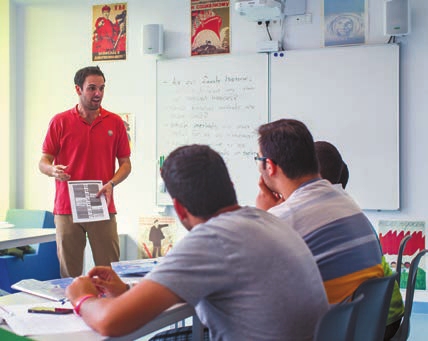 International, according to the plan of the UWC movement, should be the composition of not only students, but also teachers. Teachers from the UK, Germany, Bulgaria, the United States and, of course, Armenia came to work in UWC Dilijan. Moreover, some of them themselves are impressed by the cultural variety. “Previously, I already worked in international schools, but there I had students from two or three different countries,” says the teacher from the UK. “And here - half the world: Salvador, China, South Africa! .. Now we have children from 50 countries, and next year, when we recruit new students for the first year of study, we may study people from 80 countries.”
The director of the college was John Paddifut, who previously headed various educational institutions in India and at Sri Lanka and was the deputy director for the educational part of the Iton College in the UK.
IB implies a kind of curriculum. All disciplines are organized in six blocks: “Language and literature”, “Foreign language”, “People and society” (that is, humanitarian disciplines), “Experimental Sciences”, “Mathematics” and “Art”. Each student must choose one subject from each block, while he must study three subjects at a standard level, and three at an advanced level. If desired, a person can take two objects from the same block (for example, physics and chemistry from the “Experimental Sciences” block), but for this he will have to abandon, for example, from the “arts”.
As stated on the official website of UWC Russia ( www.ru.uwc.org ), they plan to organize courses for preparation for the exam for Russian students on the basis of a college, and even a regional center for passing the exam. It is understood that ideal children, having studied abroad, will return to their native country and use the acquired knowledge and competencies there.
Football for everyone
Dilizhan is a mountainous city with a 18 thousandth population. About a hundred kilometers are separated from Yerevan, and a little more than an hour to go from the capital along a winding road. Located in the valley, he opens the beautiful landscape with his gaze and evokes pastoral calm.
Turning such a city into an international educational center is an ambitious and, of course, a very costly task. The project is fully implemented with the money of philanthropists. According to the president of the school and the chief movement of the project of the Russian businessman Ruben Vardanyan, he discussed plans for the restoration of Armenia with his friends and colleagues in the early 2000s. The idea to create a school, according to the opening ceremony of the UWC Dilijan, came to Vardanyan and his wife Veronika Zonabend in 2006, when they were looking for training options for their children.
According to official figures, at the time of the opening of the school, the cost of its construction amounted to 115 million dollars. In addition to the training and residential buildings in the territory, there is a medical center, a sports center with a pool and all possible playgrounds, a football field and much more. Ahead of the second stage of construction, on which another $ 75 million will be spent.
The UWC Dilijan project should benefit not only to students, but also to local residents. The idea is that the entire infrastructure is a football field, a pool, etc. -Residents of Dolizhan will be able to use. The educational complex created new jobs for diliges and new jobs. The philanthropists who invested their money are mostly wealthy Armenians: entrepreneurs Gagik Adibekyan, Nubar Afyan and dozens of other people. The school budget in the next five years, as the organizers say, will be equal to an average of 8 million dollars per year.
Education at UWC Dilijan costs 35 thousand dollars a year, but most students received a scholarship. The scholarships are complete and partial, and partial, in turn, can cover from 20 to 90% of the cost of training - depending on the income of the family. According to college heads, when selecting, the financial capabilities of applicants are not taken into account: the main thing is to choose those who are ready to study and share the values of the UWC.
In harmony with the environment
The values of the UWC are not only in multiculturalism, but also in what the organizers call the service to society. Each UWC college has its own specifics. In the Indian College called UWC Mahindra, students are engaged in the preservation of local biodiversity. In Bosnia and Herzegovina (UWC in Mostar), adolescents help restore relationships in a divided society. In the UWC Atlantic College in the UK, students can monitor the level of pollution of sea water.
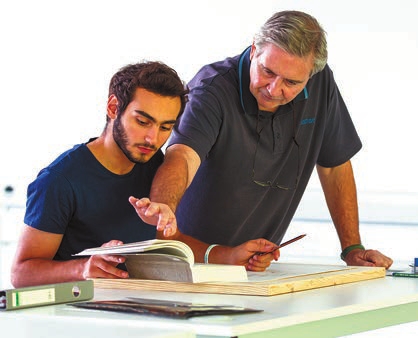 In dilizhins, students should also come up with their own socially useful program. Most likely, they will help in one way or another the development of the city: to give English lessons or swimming to local children, to participate in a discussion club with local schools and contribute to other initiatives.
Another value of the UWC, as you can understand, is attention to the environment. The architectural complex of the Dilizhansky College is conceived in such a way that the bends of the mountains are imitated as much as possible to the landscapes as much as possible, greens are planted on the walls and roofs. They say that if you look at the ground from above, then the buildings can not be noticed. In addition, according to Victoria Rozhok, spokesman for the RD Group, the RD Group, the buildings are now undergoing a procedure for obtaining the BREEAM International Ecological Certificate.
The college in Diligan became the first college of the UWC network in the CIS. The presidents of Armenia, Nagorno -Karabakh and Serbia came to the opening ceremony, which took place on October 11, 2014 and spoke a lot of high -half words. But the main ones at the holiday, of course, were not them, but children with burning eyes that overcame the war, misunderstanding of others and competition, in order to forever change their view of the world.
Photo press - the opening ceremony of the UWC dilijan