
Translated material
Sociology Grid

In June-July 2014, the next GRID 2014 conference was held in Dubna. The report of not quite ordinary topics was presented to the section of the Grid systems of personal computers and voluntary calculations. Representatives of the Center for Distributed Computing IPPI RAS talked about the first results of a sociological study conducted among Russian -speaking participants in voluntary distributed calculations (the so -called Cranchisian community).
There are not very many examples of such studies in the world, only two are known to us - the survey that the creators of the BOINC platform (California University) themselves in 2006 (more than 30 thousand respondents, of which are about 500 from Russia and Ukraine), and the IBM survey among the World Community Grid (WCG) project, which received more than 15 thousand. answers [1] (about 300 Russian -speaking respondents).
In the described study, more than 600 participants managed to interview, which can be considered a very good result.
It is worth noting that in Russia voluntary distributed calculations (hereinafter - DRV) are not written very often and mainly describe the purely technical moments of this technology. One (perhaps the only one) of attempts by a philosophical view of the problem of volunteering in science can be considered the work “Voluntary distributed calculations: problems and prospects” in the collection of scientific works of the Russian Academy of Sciences of 2013 [2] .
But DRV is not only and not so much projects and computers; These are primarily people who create these projects and participate in them. People with their motivation, their own interests, desires and problems. This is a self -organizing and developing communicative community that has existed for more than 10 years. Some features of this community were described at the National Supercomputer forum in December 2013 [3] .
The history of this sociological study began in September 2013 at the first Boinc: Fast [4] conference, about which the Trv-Feature talked in No. 19 (138) [5] . The idea was expressed by one of the representatives of the innings (from the English. Cruncher , this is the name of the participants in the calculations) and interested the employees of the Center for the Distributed Computing of the IPPI RAS. It was they that the task of the initial organizational stage fell: to interest the new idea of sociologists, develop questions of the questionnaire [6] and technically prepare for the processing of the received answers.
The second difficult task was the need to ensure a sufficient representative of the survey and get a serious coverage of the interviewed audience. At this stage, the work was carried out by the forces of the volunteer-cranks. The main part of the information support and attracting volunteers to the survey was taken by Boinc.ru. To this end, almost all existing Russian-speaking Internet resources dedicated to DRV were involved. To present the scale of this work, I will briefly list our actions:
- Announcement on the site and the topic on the forum boinc.ru [7] ;
- postal mailing among registered forum participants (about 800 addresses);
- Placing information in thematic forums on sites: Astronomy.ru, Overclockers.ru, Distributed.ru, Distributed.org.ua, in the VKontakte social network group;
- Postal mailing on the list of addresses of participants in large Russian teams Russia Team and Crystal Dream (more than 3,000 addresses);
- announcements of voluntary assistants in various blogs and forums.
The dynamics of filling the questionnaires for the first month of testing quite clearly demonstrates the following schedule, in which the first two peaks just correspond to the active reaction to information messages on Internet sites and mailings.
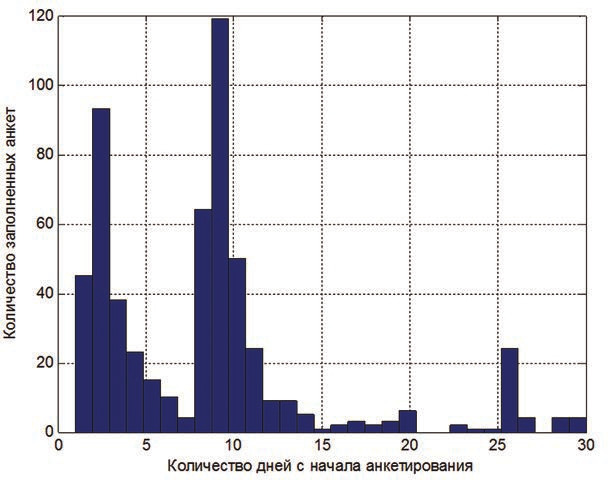 It is worth noting that volunteers quite positively took the very idea of such a survey and took an active part in it, although there were several negative statements. If we take into account that about 4,000 Russian tremors are actively involved in the calculations, and 650 profiles were received during the survey, then the coverage amounted to more than 16%. Moreover, among those who answered, there were both ordinary participants and many of the founders (captains) of Russian teams (3% who answered) and all the organizers of the currently existing Russian projects (1%).
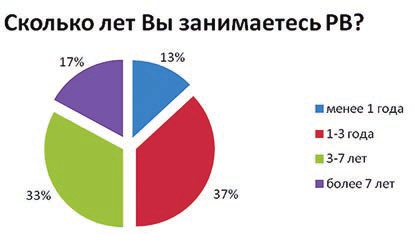
In addition, it is very significant that the majority of those who responded turned out to be “with experience”, having behind their backs for more than one year of participation in various RV projects, the opinions of which therefore can be taken into account as an expert. On the other hand, the answers of the “youth” can be seen as a fresh look at the problems of scientific volunteering, to which the “old men” may have long been accustomed to. Accounting for beginners is a very important topic, since the satisfaction of their wishes can increase interest in participation in projects and contribute to a longer active case life.
Cranchic age of the survey
 Here, perhaps, it should be noted that the main purpose of the study was to find out which audience to interact the organizers during the creation and work on the draft voluntary calculations. What components of the project do the participants consider it significant, and which are secondary? What to pay attention to first of all so that the project is successful?
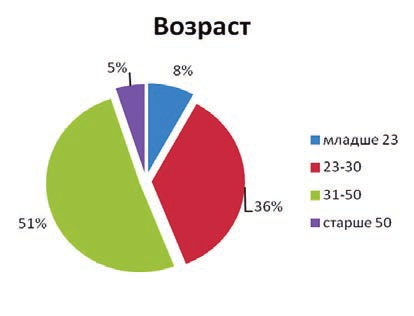
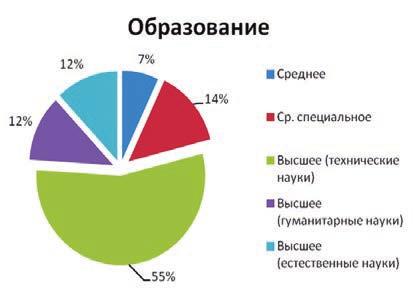
The main result at the moment can be considered the final sociological portrait of the “middle crane” (i.e. participant in the draft voluntary calculations). As it turned out, the Russian narcher is a man (97%) aged 23 to 50 years (87%), having a higher (80%) technical (55%) education. The vast majority of participants use 1-2 of their own computer in projects (76%). The main motivating factor for them is the desire to help in scientific research (93%).
The results of the age and educational distribution of the questionnaires
 However, the processing of the survey results continues, and sociologists from Isa RAS joined it. So you can expect new results (I hope interesting).
The survey also showed that the participants are seriously and consciously related to the choice of projects for participation, and present quite high requirements for their organizers. From the answers it follows that volunteers really want to help effective research.
It turned out to be interesting that 65% of participants would not participate in a project in which the goals and objectives of the study were not formulated, and 45% did not have a desire to participate in commercial projects. And in addition, participants want to actively interact with the organizers of projects, keep abreast of plans and intentions, see preliminary and final research results, i.e. Feel like accomplices on the conducted scientific activity.
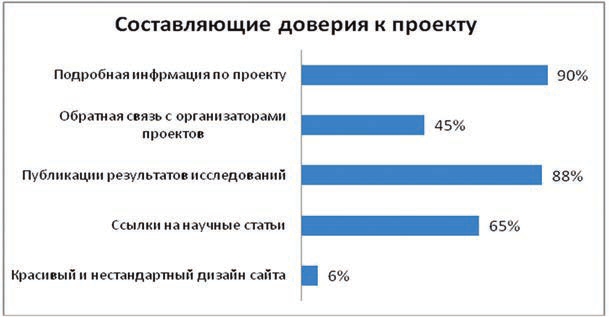
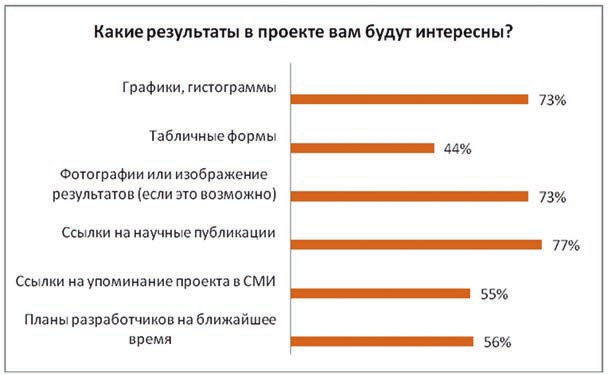 In general, according to the results of the survey, we can draw the following conclusions:
- Participants are the allies of the project organizers;
- Participants are fully formed people, with a fairly high level of education and qualifications (in various fields);
- Participants are quite consciously approached by the choice of the project itself and the issues of interaction with its organizers, and also want to feel themselves accomplices in research, to be aware of the problems and successes of the project that they joined.
There was a provocative question in the questionnaire: "Are you ready to participate in the national project?" And if 34% are certainly ready to support such a project, then 54% of the participants would like to previously familiarize themselves with the goals and objectives of such a project. That is, people want to see their Russian projects. But at the same time, they want such a project to be potentially important and useful, and expect real results from it.
Probably, one cannot fail to mention another interesting event related to the topic, namely, the preliminary discussion of the prepared report on the eve of the conference in Dubna. Actually, it was an informal meeting of several representatives of volunteers and employees of the IPPI RAS who prepared a report. Just at this meeting, the first attempts were made to understand and explain - for themselves, first of all, the resulting results; Some were quite predictable, while others were very interesting and unexpected. In general, this (one of the first) attempt to understand the psychology of voluntary assistants of scientific research has shown that society is not indifferent to the problems of scientific activity. There are people who are not only interested in news from the “scientific fronts”, but also ready to help to help and even take part in the scientific process. However, as a report on a scientific project from representatives of science, in contrast to the state (with its financial reports, plans for 10 years in advance and the percent of young scientists), they require scientific results, without any husk.
1. Worldcommunitygrid.org/about_us/ViewNewsarticle.do?articleid=323&utm_source=Emel&utm_Medium=email&utm_campaign=user_study_20130815
2. Http://inion.ru/files/file/ sournetworks_and_online_communites_2013.pdf p. 328.
3. Http://2013.nscf.ru/tesisall/section%209/04_1490_andreeval_s9.pdf
5. Http://trv-science.ru/2013/09/24/konferenciya-boinc-fast/
6. Https://docs.google.com/forms/d/1qhnfhgla1uhkspoo4_8t3b1pwmsa1csdo4yxkg1cxsq/viewform
7. Http://forum.boinc.ru/default.aspx?g=posts&t=1587#post65639