
Translated material
Ruble on the way to freedom
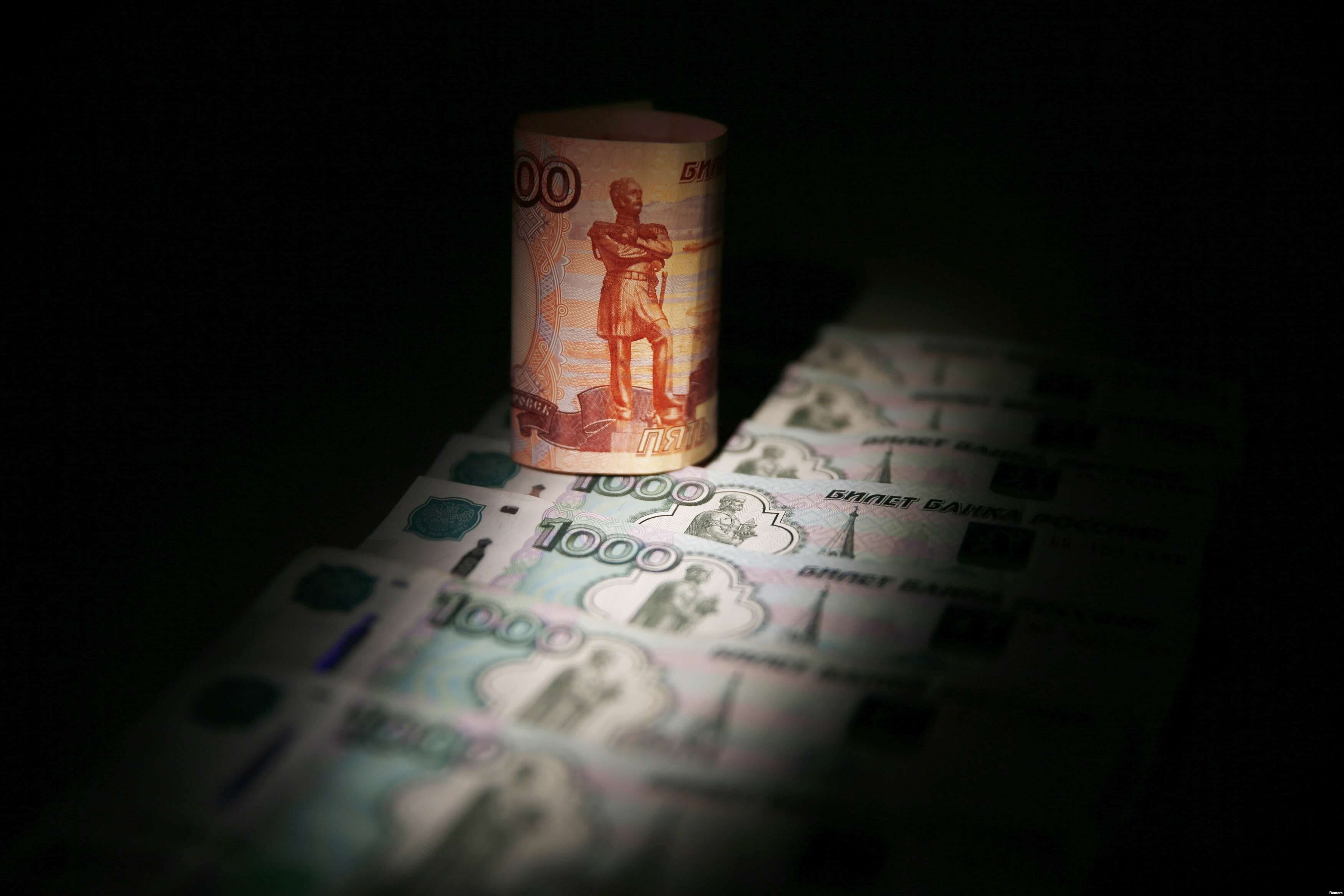
The Central Bank of Russia actually refuses to support the ruble, whose course accelerated the fall
On Wednesday, the Central Bank of Russia announced the restriction of its interventions in the domestic foreign exchange market to maintain the ruble exchange rate. This statement, made against the backdrop of the ongoing economic problems and geopolitical instability, discarded the Russian currency to new historical minimums.
The official US dollar exchange rate on Thursday rose at once by 5.5 percent - about 44 rubles 40 kopecks, the euro rose by 5.2 percent, amounting to 55 rubles 62 kopecks. However, when opening trading on Wednesday, the fall of the Russian currency was much more significant: the dollar came close to 45 rubles, and the cost of the European currency exceeded 56 rubles.
Experts are convinced that the main causes of pressure on the Russian currency are the ongoing decline in world oil prices , as well as geopolitical factors, primarily the events in the east of Ukraine and the involvement of the Russian authorities to them. In their opinion, the latest decisions of the Central Bank gave additional acceleration to the falling ruble. On Wednesday, he stated that he limits his foreign exchange interventions in the domestic market. Says the chief economist of Alfa Bank Natalia Orlova :
The market is already in the conditions of a floating course, there is simply a very small daily presence of the Central Bank
- I believe that today the Central Bank has actually took a key step towards the floating rate. If earlier he followed the principle of unlimited interventions in the foreign exchange market (from the moment when the course went to the Central Bank’s intervention zone, they were unlimited if necessary), today the Central Bank said that he would spend no more than $ 350 million a day. This actually means that the market is already in the conditions of a floating course, there is simply a very small daily presence of the Central Bank. By and large, this is what the market expected in the previous two weeks. Obviously, the Central Bank is now preoccupied with the big expenses of its reserves, wants to save them, and therefore he accelerated the transition to the floating course.
- Last Friday , the central bank sharply raised its base rate at once by 150 basic points - from 8 to 9.5 percent. Why did this decision almost could not support the ruble, although there were such hopes?
- It seems to me that there is still a question of context. From the commentary of the Central Bank, it followed that this increase in the rate was made with a margin for the next many months, I read so that the supply somewhere on the horizon is six months. But in principle, to expect that this increase is enough for six months is very optimistic. That is, as a one -time increase in the bet is impressive. But as an increase in the rate to the maximum with the possibility of its further decrease, 150 basic points are far from the limit.
-In your opinion, does the Central Bank have any additional levers of influence on the domestic currency market now?
Elections have been held in the southeast of Ukraine, and now the question of some new round of geopolitical tension is also on the agenda
- Only the interest rate. And, of course, the market is still looking from the point of view of offers of currency refinancing tools. The Central Bank slightly reduced the rate on the currency part on the reverse currency swap. I think that such measures, as well as the proposals of some new tools ( announced the return currency repo for 12 months ) psychologically stabilize the market. Although these tools are quite expensive, and I'm not sure that the market will use them to use them.
-Nevertheless, despite any decisions of the Central Bank, the main reasons for the weakening of the ruble today remain the same?
- In principle, yes. In fact, the outer background is quite complicated, it was aggravated by the fact that oil for previous holidays fell to $ 82 per barrel, elections have passed in the southeast of Ukraine , and now the question of some new round of geopolitical tension is also on the agenda. Therefore, there is no improvement in the external situation for Russia. Of course, if oil grew over the previous days, the actions of the Central Bank could be different. But in fact, the situation for the Central Bank is quite difficult, and he is forced to reckon with these realities.
Now the players do not exclude the new round of sanctions in the market. Of course, this is not one hundred percent probability
-But is the geopolitical factor really remain so important? The elections in the east of Ukraine have ended, and the reaction of the international community to them is still quite weak. Or is the market still awaiting new sanctions against Russia?
- I think that, of course, it will be very important how Russia will respond to them. But I will say that now the players do not exclude the new round of sanctions on the market. Of course, this is not one hundred percent probability, but so far, in any case, a way out of the complex geopolitical situation that arose. And, of course, the longer the situation remains so difficult, the stronger it affects the negative mood of the market.
- Given all these factors, what will happen next to the ruble?
- The fact that the Central Bank released the course reduces the speculative component, and, unlike what was happening in the previous month, now the market will not buy money from the Central Bank. Therefore, in the near future we can see, perhaps, the course of the course at the level of 45 or even 47 rubles to the dollar, but I think it will be extremely short -term. The market will look for a fundamental balance, and it, according to my estimates, is closer to 40 rubles to the dollar.
- And in what period can this balance come?
- At the end of the year, we expect that the currency exchange rate will be 41 rubles to the dollar, and the next year - 42 rubles. Therefore, I think that next year, for the next 15 months, the rate will remain in the range from 40 to 45 rubles per dollar.