
Translated material
How to be afraid of ebola
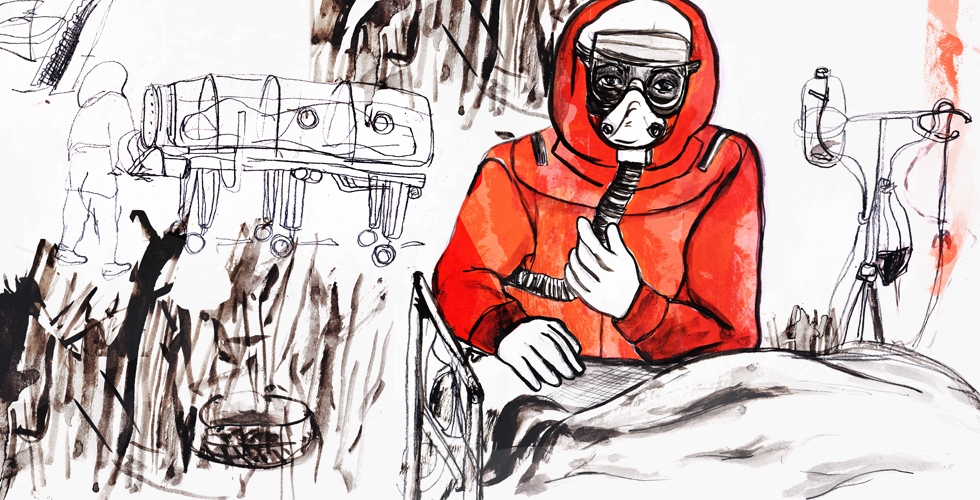
The world masters the quarantine regime. On October 27, Australia closed the entrance to citizens of African countries affected by Ebola epidemic: she canceled all valid visas and refused to issue new ones. On October 31, Canada also acted. On November 3, the visa regime with Guinea, Liberia and Sierra Leon was introduced by Singapore, who used to let the Africans simply by passports (unlike, by the way, from Russians, Ukrainians or Belarusians who were required for a long time).
In Russia, they reacted to the trend in his own way: Zhirinovsky suggested that the quarantine and even stop the Duma meetings, the St. Petersburg deputy Milonov-not to let Tim Cook in the Russian Federation (because he is gay-and therefore, he has HIV and Ebola). The Government of the Russian Federation, it seems, thinks in a similar style: on Thursday, the head of Rospotrebnadzor, the chief sanitary doctor of Russia Anna Popova said that Russians should not go abroad for the New Year holidays so as not to pick up and bring Ebola to Russia.
Who is right and what to expect from this outbreak? The epidemic in Africa claimed almost five thousand lives. There is a forecast for the Center for Control and Prevention of US diseases: 550 thousand new cases by January . Or all 1.4 million, if we take into account that one and a half unregistered for one officially registered case of the disease.
To follow her with a smart look, it is worth finding out what expectations and fears of scientists and doctors should be checked in practice - and how to read the news correctly.
How the epidemic works
A little fundamental facts. Ebola’s fever is attributed to zoone infections - this is when new viruses pass to a person from animals. So, new flu strains are always from birds (occasionally through intermediate hosts: pigs, goats). When changing the owner, falling into a “alien” organism, the virus can give a greater severity of the course of the disease and fatality: figuratively speaking, the virus is not adapted to life in another organism, which means that it can poorly fulfill the main task of any parasite - give the host body a proportionate load in order not to kill it, but to provide multiple transmission.
The primary owner of Ebola is bats, intermediate - monkeys and people. Freezes of infection usually occur when an epidemic begins among animals (more correctly to say “epizootics”) - and people who are in contact with the beasts become ill. In West Africa, bats and monkeys are not just eaten by rare marginals: Bushmith is the main source of meat for the majority. On average, 25 tons of game run on the savannah per square kilometer, and the flies of the Tseces interfere with the dilution of cows or pigs - it is clear in favor of which meat everyone makes the choice. Bushmit is even served in restaurants for wealthy Africans - this is something like stuffed fish for an intelligent Moscow family. A way to demonstrate to yourself and others that you have not lost contact with the roots. By the way, it is not as dangerous to eat an infected monkey as to be sprayed with blood when cutting - which is considered the main mechanism of infection.
The virus is not adapted to life in another organism, which means that it can poorly fulfill the main task of any parasite - to give the host body a proportionate load in order not to kill it, but to provide multiple transmission.
Since no one has stopped with the advent of Ebola (this is the same as turning all over Europe into vegetarians during the pork flu), the transfer of the virus from animals could easily occur again and again. “With large flashes among animals, epizootics cover large territories, many animals are ill, often of different species, and accordingly there is the possibility of infecting many people,” says Professor Mikhail Favorov, an international expert in the field of epidemiology of infectious diseases.
In this situation, all the forecasts would have to be abandoned. Bat with monkeys do not go to complain about the well -being of doctors, and no one leads the statistics of their incidence.
Fortunately, in September 2014, a team of geneticists from Harvard and MIT studied the genomes of virus samples taken from 78 patients from different places in Africa, and excluded such a scenario. The virus picked up someone alone from the animal, and since then it is transmitted exclusively from humans to a person, so that it will not be possible to blame the guilt of the monkeys.
An indicative case is how Ebola’s fever penetrated into Sierra Leone. The local Ministry of Health surrounded the investigation and found out: the first victim of the disease in May 2014 at the funeral of a respected sorcerer in Guinea, which had previously treated Ebola with traditional methods. Among the patients, 12 more visitors of these funerals were soon discovered. Six months later, at the end of October, the US Diseases Control and Prevention Center counted 4759 sick and 1070 deaths in the country.
The quarantine, perhaps, would help, but it is clear that the Guinean leadership in such a situation had a lot of other opportunities to properly dispose of their power.
As for the prohibitions on crossing borders, even the Secretary General of the UN Pan Hi Moon managed to criticize this measure. First of all, because the prohibitions on the entrance and quarantines can greatly brake the fight against the epidemic. If anyone who returns from Africa to the west is quarantined, doctors and volunteers will stop going there, and virologists will not be able to quickly analyze samples in the same Harvard or MIT . And, of course, doctors from Africa will lose the opportunity to come to teach various effective methods to universities and the first world hospitals.
Influence against fatality: race for the survival of people and viruses
At first hits into the human body, viruses are poorly conveyed further: the point is not only that they kill the owner too quickly, but also that their “master keys” are not adapted to the penetration of a person’s respiratory tract or digestive organs. A textbook example of such a new virus is bird flu. This virus is not transmitted between people at all and at the same time gives very high fatigue (but all cases of infection - from contacts with the bird).
Further, as follows from classical epidemiology, two things are happening in parallel. The virus mutates in sick (and the analysis of the current flash shows that this happens very quickly and “corrects” both of its “disadvantages”: instigrant and infection should fall. The whole question is how these two changes - a drop in fertility and an increase in contagiousness - will be combined.
Bushmit is even served in restaurants for wealthy Africans - this is something like stuffed fish for an intelligent Moscow family.
The most bad example from the story is the Spanish, the 1918 pandemic , which killed about 50 million people around the world. The flu, which was only a little more fatal than the usual seasonal one, but the most contagious in history. In total, 500 million people were ill with Spanka, and therefore even several percent of the letters gave such terrible figures in an absolute dimension.
The current strain of Ebola, unfortunately, is not zero. The virus is transmitted in contact with liquids and discharge of patients and corpses; However, this method of transmission is an order of magnitude less effective than that of influenza - Ebola does not know how to fly through the air.
Treatment: will not help in Africa, the rest will not go
There is no antiviral treatment (as from HIV, herpes, hepatitis or influenza), but there is an experimental ZMApp serum , an injection with antibodies to the virus. In addition to the high cost and slow production, this approach has a large minus: even if a specific person saves a specific person and makes it non -neural, in a situation of the epidemic, he will become even more vulnerable to illness. “The fact is that as a result of the introduction of serum, the patient’s immunity will begin to produce antibodies to serum antibodies,” says Professor Favorov. This means that with repeated infection, the patient will be in greater danger, because immunity will, with the help of such new antibodies, kill his own antibodies to Ebola. The only real help to patients is the cheapest type of care: this is the replenishment of fluid loss, rehydration, a dropper with saline.
Conclusion: experimental treatment will not be used in the hearth, which means that it will not fundamentally affect the development of events. If treatment is required for us, then we will get it even in the conditions of very unusable medicine - it will be just a dropper with saline.
Vaccine: Not tomorrow
Now in the world there are clinical trials of several vaccines. The most promising of them is CHAD 3 : Ebola virus segments are built into the “monkey cold” virus (a third type of adenovirus) to stimulate the production of antibodies in a healthy person. There is a big problem of production rate - in any case, until the end of the year they will make no more than a few tens of thousands of doses. According to Mikhail Favorov (in the past - the deputy director for science of the International Institute of Vaccines in Seoul), the World Health Organization will completely take the distribution of these vaccines under control, and they will all go to countries where the outbreak is raging.
If anyone who returns from Africa to the west is quarantine, doctors and volunteers will stop going there, and virologists will not be able to quickly analyze samples.
The State Scientific Center for Virology and Biotechnology "Vector" operates in Russia; Its representatives report the start of testing their own vaccine. In the past, it was a respected and known organization in the world; For example, this is the second place in the world where one of the two existing strains of the smallpox is still stored (the virus was defeated in 1979, but decided to preserve the WHO strains). The Vector has a subsidiary of Vector-Farm, which, in particular, produces recombinant interferons, rather complex antiviral drugs. So there are chances, but here the creation of millions of doses for all of Africa is likely to drag on.
General conclusions are the following:
- Follow the news: how a flash in Africa decreases and - a separate item - how immigrants decrease;
- Do not rely on quarantines and similar measures: at first they are not needed, and then ineffective;
- do not panic and not limit yourself to a disproportionate measure;
- Do not rely on vaccines: working vaccines in sufficient quantities will still appear soon;
- Do not count on high -tech treatment: if there is a trash, it will not help, but while there is no trash, the chances of getting infection are insignificant, and it is not necessary.