
Translated material
Colta.ru opens the section "Science"
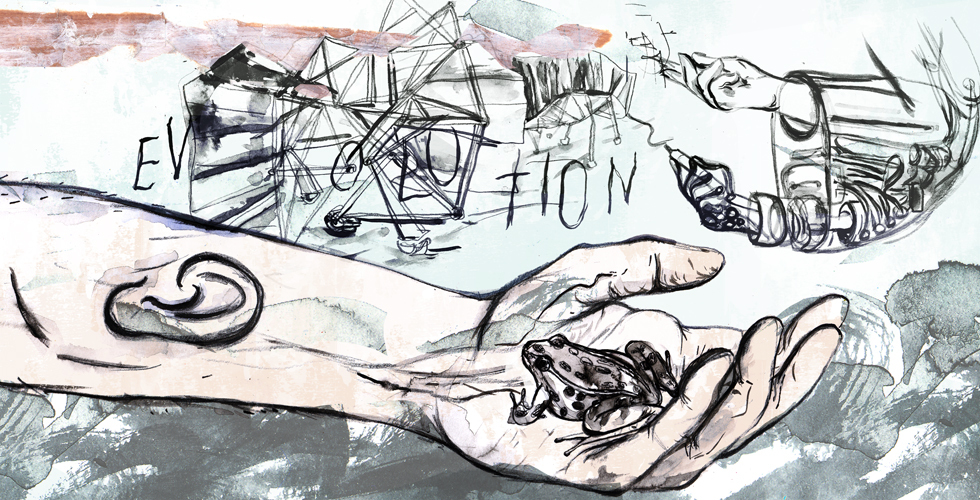
Scientific news is taught to live the day after tomorrow, which is in no hurry to come. Telomerase will win old age. Cryonika will allow an inconspicuously patient to wait. Flexible displays promise to turn over.
The natural reaction to this pioneer picture of the future is panic, like Ilf's in notebooks: “In fantastic novels, the main thing was the radio. With him, the happiness of mankind was expected. There is a radio, but there is no happiness. ”
Therefore, the science that clarifies and interprets ours today is more interesting to us: what to do with the radio that is already available. How does the assortment of the district pharmacy react to changes in culture? How are the liberals differ from conservatives-say, is a tomograph capable of registering any differences in the brain? Is there any logic in the arguments of the Ministry of Health about the risk of “creating genetically ethnic weapons”, under which Russians still prohibit analyzing their DNA using the American service 23 andme ?
All this is the subject of a new natural science that can no longer be confidently called biology or physics. The methods of accurate sciences have learned to apply to nonsense, litter, life and routine.
In fantastic novels, the main thing was the radio. With him, the happiness of mankind was expected. There is a radio, but there is no happiness.
Galileo did not invent the telescope. But he was the first to guessed to look at the heavenly bodies through the device of the Dutchman Hans Lippersgei, invented for “looking at distant objects” on land and at sea. According to a similar principle - the old technique, a new subject of attention - a whole family of disciplines without established names and clear boundaries acts. They study that part of life that is considered to be the territory of classical humanitarian knowledge or, worse, common sense. Why should a professor of computer linguistics from Stanford delve into the dictaphone records of “quick dates”? Or in angry online recovery to a cafe (one out of five stars), where a waiter for too long for the client for too long? We will definitely tell.
In science, there are no clear boundaries between important and unimportant, serious and frivolous. First, Andrei Game is given a comic ignition award for a frog leviting in a magnetic field, then he receives Nobel for an experiment, where a sticky tape was a decisive tool. In scientific journalism, it is in the same way that you have to turn over the usual hierarchy: the missing footnote is often more important than the news of the news itself. This is especially true for the plots that the agenda imposes on us: if Ebola kills the 4818th in a person, context is more useful than accurate statistics. For example, what does the words “successfully tested medicine” mean in practice: tested in public or on monkeys? How many doses are able to produce all the pharmaceutical companies of the world in a month? And in six months? How many people need to make an injection if at this moment we still do not know who is infected and who is not? And are they suitable for the role of medical volunteers who can go to the foci of infection without risk to life, those who have already been ill with Ebola and survived?
In addition to the fact that science finds out for us about viruses, language and genes, it itself is a worthy attention of the object. So the science of the internal mechanisms of science is going to devote a separate cycle of texts.
Why should a professor of computer linguistics from Stanford delve into the dictaphone records of “quick dates”?
Firstly, scientists are a special class with their own rules, values and hierarchies. Not a creative class and not clerks. Bruno Latur, the classic of the sociology of science, once tried to look at the laboratory life as anthropologists look at the tribe of hunters and collectors, whose rituals and language are incomprehensible to them. It turned out that these observations tell a lot of things about the life of society as a whole (as, by the way, the expedition to primitive tribes).
The Russian Academy of Sciences and Universities in such a coordinate system is something like the Amazon tribes that did not allow themselves to explore for too long. All the more interesting it will be to talk about them.
Secondly, it is interesting to see science as at a factory for the production of knowledge with strict accounting and control. Highly specialized works about hemorrhagic fever, stem cells or graphene make it clear how, in principle, the cycle of knowledge in the world is arranged. In particular, for each scientific article it is known who, where and when he referred to it. It is easy to find out, for example, how transparent to know the state borders (not to the end, but Chuchha on the territory of science is much more difficult than in the big world) and the boundaries of disciplines (say, linguists often refer to physicists and vice versa).
Finally, culture so often reflects on science that this cannot be ignored. Nick Cave writes Higgs Boson Blues ” , Michael Naiman puts the opera based on the book of the neurophysiologist Sax“ The man who took his wife for a hat, ”Bjork writes the album “ Biophilia ” with the composition “ Dark Matter ” (“ Dark Matter ”). Such contact points are the plots of our section. Like the fate of the scientific oddities that became artifacts of culture: from the Shukhov tower and airship hangar NASA to kinetic sculptures, Theo Janssen and a real ear, implanted in the hand of the Australian artist of the staler.
(Curtain rises.)