
Translated material
Left bend
In society
 Left bend
November 6, 2014 Alexander Bondarev
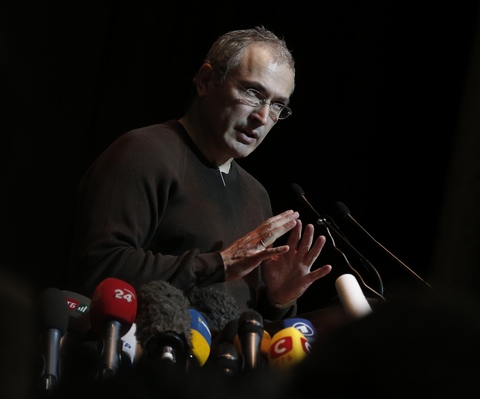
On October 29, 2014, Mikhail Khodorkovsky spoke in the Paris Higher School of Political Sciences. Of the other famous figures, a prominent economist Sergei Guriev was present on the stage (also, by the way, an exile).
The audience was filled with several hundred students, several dozen journalists and one representative of the Russian embassy who failed to go unnoticed.
The theme of the lecture: "The political, social and economic future of Russia."
Since I followed the economic views of the applicant for the post of presidential candidate since 2009, and he almost did not formulate them during this time, I was extremely interested in whether they changed in 5 years and if so, in which direction.
In the end, suddenly I will live until the time when I have to vote for him.
In order to avoid misunderstandings, I immediately declare: only those excerpts from the lecture are given below that relate to the views of the respected Mikhail Khodorkovsky to the economy and the role of the state in future Russia. Quotes are practically literal. Under the recording.
M.B. Khodorkovsky (2014):
1. We will remain [after Putin] an archaic model of public administration. Hierarchical and bureaucratic. This model does not work.
2. According to my (with colleagues) recent estimates, the “minimum management” in Russia is about 100 thousand people. It can be a city or economy sector. What does “minimal” mean? This means that the managers are “not visible” by the lower, smaller levels, and they are not controlled or controlled ineffectively.
3. The state must be a manager, not to rule subjects.
4. Way: municipalization and transfer of maximum powers down. There should be regions in the middle - where the federal government cannot manage effectively, and the municipal does not have enough financial resources.
5. In the 90s, managerial mistakes were made.
Redistribution of power is necessary.
It is necessary to change the 1993 constitution.
All oil revenues should go to the Pension Fund.
The country should not live on raw materials rent, but on the results of the labor of citizens.
Money should have the one who has it, and not flow to the center.
6. Democracy is the current management system. Russia has no alternative to this system. I, as a management specialist, can say that the authoritarian system is limited by the number of controlled objects.
And if we want to have a controlled system, then it should have various independent sources of legitimacy [at different levels].
Various branches of the authorities should also have their own, independent sources of legitimacy.
Then some managerial “mesh” is formed [ usually it is called a “lattice” - A.B. ].
This resembles a matrix business management model. (Although in this model there is only one source of legitimacy that delegates its powers.)
The authoritarian manager weakens feedback from management objects, which leads to managerial errors.
7. To increase management efficiency, you can “blind” small sectors together. For example: about 2 million people are employed in the oil industry, and it is quite controlled.
But already in IT technologies-hundreds of thousands of small and medium-sized enterprises (someone is engaged in social networks, and someone makes software for chips). And these are already uncontrollable objects. Indeed, conflicts inevitably arise between them, and there is no one to resolve these conflicts, because the power simply “does not see” these objects.
8. Political reforms must be carried out before economic.
For the overall picture of these theses is not enough, but it can be supplemented by taking advantage of the correspondence between Khodorkovsky and Ulitskaya (2009). It seems that Khodorkovsky’s economic views have not changed since then (in any case, he had never rejected his previous statements publicly).
However, judge for yourself.
I will also give below some fragments of our discussions of this correspondence (she describes this: “I was your self -proclaimed representative, and [my friend] was terribly attacked by me”). Then they were not published for obvious reasons: you cannot criticize a person, courageously “shaking the term” in the zone.
And now Mikhail Borisovich was not only freed, but also declared himself as a public politician with far -reaching ambitions. Which in itself is wonderful. And thanks to the lecture in Paris, the “Information Age” also appeared.
So, M.B. Khodorkovsky (2009):
“The share of GDP (i.e. social wealth), redistributed through the state, in the immunity of developed countries. And this is the main, generalizing indicator that finds its practical reflection in a weak pension system, healthcare system, transport and communal infrastructures, etc. But even if you take the topic of industry, then here the role of the state is unreasonably small. ”
Thus, Khodorkovsky, who is considered a “liberal marketer”, still believes that the state can and should be a manager, i.e. Manage the economy. In his Parisian lecture, he never even mentioned the word “market”. But he mentioned the Trans -Siberian Railway, which, in his opinion, can be governed only by the state. Although in the USA (with the largest railway network in the world), England, Canada, etc., in general, all the railways are private. Why? Because it is cheaper and more effective.
Khodorkovsky also regrets that authoritarian management does not allow us to go down below the level of 100 thousand people. And I would like - so that the management would be more effective. It seems that he simply does not believe in the possibilities of the market. And really:
“The structure of industry and transport is bad. Especially after the collapse of the USSR. You can wait until the market is recreating the missing, you can for a very long time. It is necessary [first] to compensate for the key problems of structural industrial policy.
The powers of the state can (and it is necessary) decrease (there are excessively many of them, and they are unbalanced), but the role of the state, its actual participation in the economic and social life of society, at this stage - to increase. ”
Let me remind you that they see in Khodorkovsky a person who can get the country out of the crisis. Crisis manager. I will not explain in detail here what the “matrix management system” is. This structure is complex and confusing, having its own advantages and disadvantages. The main complexity in its implementation is the adherence of the combination of several flows of teams, which, in principle, can lead to constant conflicts between performers. It is used in some large corporations (by the way, a entrustally integrated yukos, as far as I know, it was not there), but on the scale of the whole country it has never been used anywhere.
But all its critics converge in one thing: this structure is considered absolutely ineffective in crisis periods .
Here you have a crisis manager.
However, we were distracted from the main thing: how does Khodorkovsky see a properly functioning economic model? Here's what he offers:
“I (and in this sense, I am a statesman) believe that in the current conditions, there should be a significant part of industrial production for industrial policy.
Probably 60%.
What do I mean by “industrial policy”?
Where, when and how much oil, gas, forest, diamonds and, possibly, several more strategic types of raw materials should be extracted.
How? Business business.
Where and in what form this raw materials can be delivered.
Like a specific choice, within the allocated options - business business.
Where, how much and how the electricity should be produced, where it should be delivered (we are talking about strategic capacities - about 70% of production).
Where to build roads, where to develop cities, universities.
Etc. Questions are on a hundred pages, and a mobile, flexible plan (five -year -old, no matter how disgusting) - on hundreds of thousands of pages (if you include the regional aspect). ”
It is easy to see that this “industrial policy” is nothing more than centralized planning. And all objections of classic liberals are applicable to it. For example, how does the state without a market know how much oil, gas, forest, diamonds < ... > , where and in what form this raw material can be delivered < ... > , where, how much and how should electricity should be produced, where should it be delivered ”? And who will solve it personally? What mechanism can be forced to carry out a business order (already tried) in the amount of 60%(by the way, why exactly 60%, and for electricity - already 70%?) At what prices the state intends to pay off the business for the goods and services it? Finally, already quite roughly speaking, how, in principle, this project differs from the Stalinist “industrialization” or “labor armies” of Trotsky? Only a percentage?
But the most remarkable is the proposal to return to the " mobile, flexible plan on hundreds of thousands of pages." Starting with von Hayek, it was repeatedly demonstrated theoretically (and in the USSR and practically) that centralized planning does not work for a number of reasons.
And the point is not at all that " the authoritarian leader is weakened by feedback with management objects, which leads to managerial errors ."
The point is in principle. The Nobel laureate Leonid Kantorovich worked on the task of optimal planning, who managed to prove that with a sufficiently large (in mathematical sense) number of parameters, the task of centralized planning and management becomes fundamentally impossible.
Not to mention the fact that this task is also impossible for the reason that centralized planning is organically incapable of keeping up with continuously taking place in the system-firstly, due to the time factor (while the information reaches the center, the situation on the ground has already changed), and secondly, because in the conditions of the centralized system, the information sources are usually not interested in sending complete and reliable data.
And yet. Khodorkovsky simultaneously declared himself a supporter of globalization, but immediately wrote about some “ strategic capacities ” and “ strategic types of raw materials ”. Really, 5 years ago, he foresaw a cardinal turn in Russian foreign policy? Otherwise, why then huge numbers of “ strategic capacities ” and “ strategic reserves ”, if the country is not preparing for some global clash, or even for war?
Such utopian ideas were expressed at the lecture that it was somehow embarrassed to discuss them. For example, “all oil revenues should go to the Pension Fund” or “Money should be with the one who has it and not flow to the center” (and what do you order to do to the subsidized regions?).
But the 7th thesis sounds most beautiful-especially in the lips of Khodorkovsky.
“Hundreds of thousands of small and medium -sized enterprises are already uncontrollable objects. Conflicts inevitably arise between them, and there is no one to resolve these conflicts, because the power of these objects simply sees' ''. "
And the arbitration courts for what?
At least in his homeland, at least in the Hague. And they work quite without any state.
But the most dangerous is in another.
The device of the economy in Khodorkovsky has already been implemented.
In fascist Italy and Nazi Germany.
And do not be scared: from an economic point of view in Russia today - real fascism.
Classical liberalism says: there is no freedom without property rights. And such a right means that "the owner of the ownership, use and disposal of their property will be precin one." This is not even a classic formulated, but Article 209 of the Civil Code of the Russian Federation.
Under socialism, all these three rights are taken by the state. Like in the USSR.
Fascism acts more cunning: it retains the right to own, limits the right to use and completely deprives the owner of the right to order.
Examples? The same Yukos. Recently - Yevtushenkov. Or Deripaska: "If the state will say that we must abandon the company, we will refuse."
And do not be offended by the terrible word "fascism." There is also "liberal fascism." This is the name of the voluminous bestseller of Ion Goldberg (2008, 2009). It is worth reading.
And Churchill himself at one time called Mussolini "the largest European legislator."
The system worked for the time being!
And Herbert Wells in 1932 expressed the hope that "liberalism will be reborn, like Phoenix, in the form of enlightened Nazism." But Wells is excusable: he saw Lenin.
And today, for example, in France, Marin Le Pen, Putin's great friend, in the program of the National Front party proposes to strengthen the role of the state and to establish the central body of “Strategic planning of reindustrialization [ all with the title letters - A.B. ], directly subordinate to the Prime Minister. " Surely there will also be a " flexible plan for hundreds of thousands of pages ."
There is another analogy. The analogy is historical and personally to the respected Mikhail Borisovich in no way applies.
But let's try to think.
As you know, Stalin accused Trotsky of Levine, of the effort to absolute dictatorship and thereby (against the background of Trotsky) looked like a moderate “centrist”. But then, to implement his mobilization plan of industrialization, he took advantage of all the cruel methods proposed by the Trotsky Arsenal.
It is embarrassed to even write this, but in matters of economic policy, Khodorkovsky takes the position of Putin's “left”. And who knows, maybe the latter is even beneficial for the “leader of the opposition” (in prison or free) to proclaim the ideas of centralized planning and strategic industries. Indeed, this can remind people of the most gloomy times of our history.
Let's think: what would Russia look like if one day Khodorkovsky managed to implement his economic program?
Well, that before the thesis of “ political reforms must be carried out before economic ” - this is already V.I. Lenin with the "Primate of Politics over the Economics."
So far, that's it.
I will not comment on the statements of Sergei Guriev here, because he, like me, a former physicist with a red diploma. Cand. F.-M.N. And Dr. Econ. sciences. Specialist. I can only guess that this is why he did not say a word about how to equip Russia. True, he cited numbers showing that the Russian Federation in the near future does not threaten. He promised that there would be no such crisis as in 1998 or in 2008-2009. There is enough money yet. Even if the price of oil falls. The ratio of the state procurement to GDP is 13%. And in Europe 100 and more. So we will hold out for 2-3 years. And there the elections will come up.
But the main thesis of the lecture at the end was brilliantly formulated by Khodorkovsky himself:
“ The key to the blessings of the authorities is the presence of a legal opposition. Otherwise, an unexpected “ pimple ” may jump out in this place . ”
If not we, then Maidan?
Photo ERA / TASS