
Translated material
"Goodbye, speech"
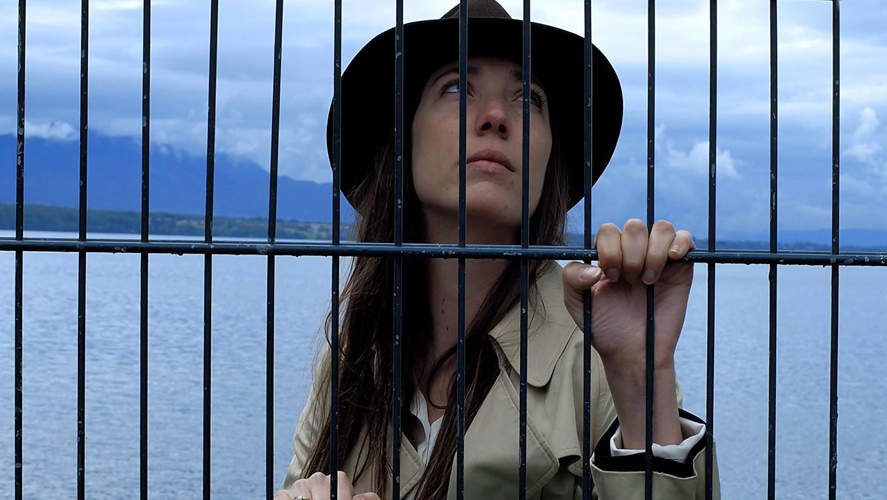
Late Goddar does not really love the audience, everyone knows this. For 30 years now, he has been peering into them for a long time from huge screens of cinemas, after which he suddenly sends all those gathered to hell in a sudden silence. The cinema died, and if not, then it will definitely not be comfortable.
“Farewell, speech” also does not seem cozy movie, especially since in it, Hodar decides to deal with a speech - almost with our main tool for realizing the world (not without reason Heidegger calls the language the “house of being”).
The arguments of the Godard are simple. How much every state already carries the rudiment of a totalitarian regime in itself, the same word carries a shadow of misunderstanding. There is, in fact, there is no fundamental difference between the organization of the compulsory medical insurance system and, for example, the organization of the system of concentration camps. Speech that distinguishes us from other living beings is the best, but at the same time the worst way of communication, only complicating the communication between us. The metaphor is always artificial and opposes the fact that, taking advantage of the term Rilke, it would be worth calling the “open”.
Hodar illustrates his reasoning with an example of a man and a woman. She dreams of Africa and thinks about decolonization, he mainly walks naked and does not close the door to the toilet. They live together, but here is a problem - it is worth starting to communicate as a wall grows between them. Heroes are unable to find a common language. But it is worth the heroes to discard the words how the wall disappears somewhere.
To understand the criticism of the language undertaken by Godar, it is worth remembering an excerpt from the 8th Duin Elegy Rilke, to which Godar directly refers. Rilke writes:
Creatures are listening with all vision
Open. And only our eyes,
On the contrary, arranged around
Traps, blocking the output.
What is outside, we know only by personal
animals: we force children
look and see inside out
not the open that the beast is
his face in which there is no death.
Death is only we seek; Free beast
He left her behind and sees her
only God before and, leaving,
He goes into eternity, like a dry well.
(per. V. Kupriyanova)
In private correspondence, Rilke explained that under the “open” he meant that “the level of animal consciousness plants it into the world, but it does not confront the world at every moment (as we do); animal - in the world; We are standing in front of him thanks to the position that is characteristic of our increased consciousness. ”
Judging by the Film of Godard, “Language” is one of the most important means of contrasting us with the world. Therefore, only by abandoning the endless complexity of words, we can approach the state of harmony. In one of the scenes, the heroes with complete silence begin to remove bedding. In their actions, amazing coherence is felt; Having abandoned the language and trusting their bodies, they no longer experience problems with understanding.
 © Wild Bunch
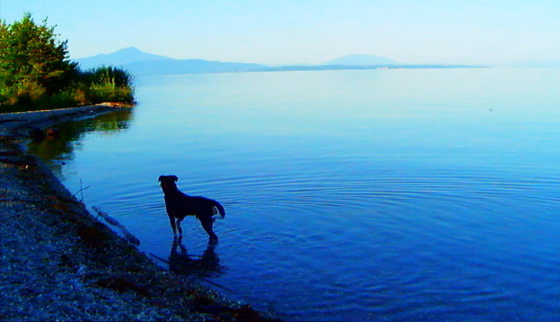
As if in order to emphasize the absurdity of the human method of communication, Hodar introduces a dog into the picture, included in the world, which with equal surprise (or impassivity) looks at people, forest or river. People for her are just people, the forest is just a forest, and the river is just a river, equal parts of the world, simple and holistic, which are not at the same time a reference to anything else. In Russian cinema, such a “pure observer” can be called the postman Alexei Tryapitsyn from the recent picture of Konchalovsky.
Well, the dog is included in the “open” and sees the world from the inside. But we (including Goddar), looking at the dog from the side, see in it not just a dog, but a symbol, a certain abstract image. And here it would be possible to blame Godard for inconsistency (which, however, arises from the very essence of cinema, which turns any frame into an abstract image), but even in his later paintings he was always more artist than a philosopher or a grumpy political activist. Speaking about the impossibility of a language, he builds his evidence base on poetry, which is impossible without a language. Speaking about human exclusion from the “open”, he (continuing to develop ideas in the “weekend” laid down in the “weekend”), recks with this “open” not only nature, but also a beautiful, world culture, forgetting that usually Rilke and dogs are poorly combined.
We can say that the state-ideologist was captured by his art. He fights artificial, not realizing his natural connection with art. You cannot abandon the metaphor in the cinema, the very nature of which is converted to a metaphor of any image captured to the camera. However, it is hardly the main message of the picture should be perceived as a real riot against the language or an attempt to overthrow the metaphor (by creating new metaphors). In the revelations of Godra, you feel more likely the grumbling of an old lover, who is sad, grumbles a little on the intransability of the object of his passion, but still passionately loves and his grunts constantly gets down to a love message.
Actually, “Goodbye Speech” is primarily a poem, and already in the tenth stage a philosophical treatise. True and the beauty of the image here is sometimes more important than copyright reasoning. Even 3D is used to create a poetic metaphor of alienation between heroes. Longing in lost understanding seems eternal poetic longing in lost purity. And every spectator who decides to go to “Farewell, Speech” must remember that he will face the film Po -Esia in its brightest manifestation. Moreover, in the case of Godard, filmpoesia is an endless plexus of quotes and allusions, a network of foggy hints and references to everything in the world that explain anything, but create a certain intellectual and emotional background.
Watching the love with which Hodar is looking at the beasts (and children) deprived of the opportunity to say, you involuntarily catch yourself thinking that in front of you is the work of almost the last romance of the movie. And there is something in this “pure observer” in this dog that does not related to her at all with a “open” lark Rilke, but with the wise cat Murr from the late poem of Khodasevich.
Oh, good gardens behind the fire river,
Where there is no rod, where in the fertile laziness
Eating eternity deserved peace
Poets and animals beloved shadows!
In the end, cinema is still a huge theater of shadows.