
Translated material
Cosmos is like insensibility
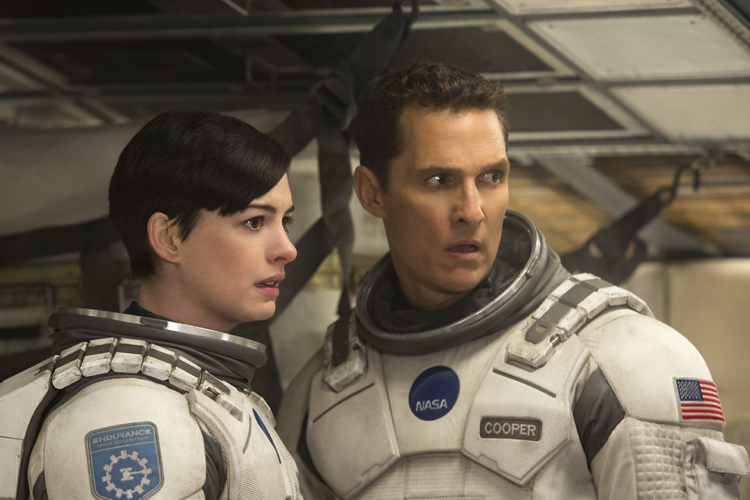
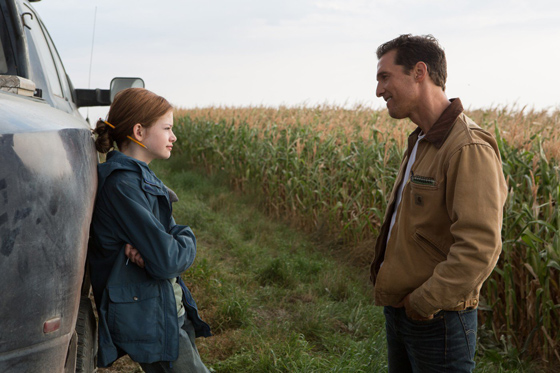
Clouds thickened above the ground. Literally - the planet dying of drought covers with more suffocating sandy storms, wheat and rye already fell victim to the evolution of viruses, thrown back into the agricultural age of humanity lives on the same corn. Among those who grow her selflessly, the former NASA Cooper pilot (Matthew McConahi), a widower beaten with life, raising a couple of teenage children somewhere in the heart of the agrarian all-American nowhere. Cooper holds children in severity and intellectual relativism - with the explanations of the Murphy law, in whose honor Cooper named his daughter (first Mackenzie Foy, later Jessica Chastain). And he also has a faith - faith in the reality of the US space program (at the school of children they teach that all Apollo were a staging, designed to ruin the Soviet Union). It soon turns out that yes - the cosmos was, is and will be, and the pilot, the merchant, who had not previously risen above the stratosphere, has to go there.
We must immediately make a reservation: a three -hour “Interstellar” is an interesting and exciting movie, perhaps the most integral, most folding film by Christopher Nolan, almost all previous works of which were spreading at each seam by separately workshop episodes. At the same time, Nolan chooses the measured rhythm, inflating it only in the third act: “Interstellar”, of course, the space opera, which does not tolerate haste and promotes the flywheel of the narrative. This opera excites the sensory organs, starting into the luxurious panoramas of the movement of celestial bodies, daring to imagine infinitely distant worlds and hypnotizing with minimalistic orchestras. The abundance of these visual attractions makes it almost impossible at least some serious conversation about the film with those who did not watch it-you cannot do without spoilers. In addition, the main argument of those who declare Interstellar smart, adult performance in the infantile territory of studio blockbuster is the deliberate science of dialogues (the heroes every now and then are allowed into the discussion of the singular nue between measurements and almost theory of strings). Well, it is better to listen to the superstrons not in the Yernic retelling of criticism.
 © Warner Bros. Ent.
Nolan, I must say, and he himself puffs his cheeks with might and main, not embarrassed to send it to “2001: Cosmic Odyssey” once every ten minutes, then to “close contacts of the third degree” and independently entering his last name somewhere between Kubrick and Spielberg. Well, it’s logical to ask him as from these classics. Here, alas, we find that the fantasy of a nolan storyteller is simply not recalling his technocratic ambitions. For a genuine visionary, Nolan is too superfluous - his impressive images are for the most part one -dimensional (evil irony is that the film implies the exit of human consciousness outside the four dimensions and time, which are completely devoid of the second bottom: “Mole -free hole” here is no more than “Mole -free hole”, and the rocket so -so -tinker does not mean anything except, khm, rocket (Nolan, nolan. He overcome it himself, the limits of space-time, could become Freud's favorite patient).
 © Warner Bros. Ent.
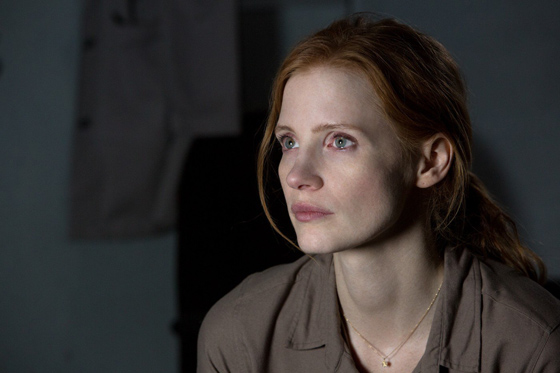
The most destructive is the absence of the second bottom, the eternal Nolan, literality affects, however, not even on the figurative filling of “Interstellar”, but on its dramaturgy. She clearly suffers from excessive, terribly old-fashioned determinism-in essence, the world created on the screen by Nolan is not built on the layouts of the Physicist of Kip Thorne (a scientific genius is listed here by an executive producer), but on the banal nucleus of a family melodrama, three or four emotional notes that Nolan has to repeat once, otherwise, it seems, it seems, it seems, it seems that all the The design is around them. Nolan’s conviction of the fidelity of these notes is the main drawback of “Interstellar”: this is a megalomanian, immense cinema is impossible without a few assumptions that have nothing to do with astrophysics. Here, events of a cosmic scale are subordinated to the children's resentment of one little girl. Here the best scientist can go crazy on the planet, but the robot will never get out of control (even if he is converted from the murder car). Here they look into the great semantic abyss of a black hole in order to find in it a cozy, simple, probably accurately read by schoolchildren the justification of all things.
 © Warner Bros. Ent.
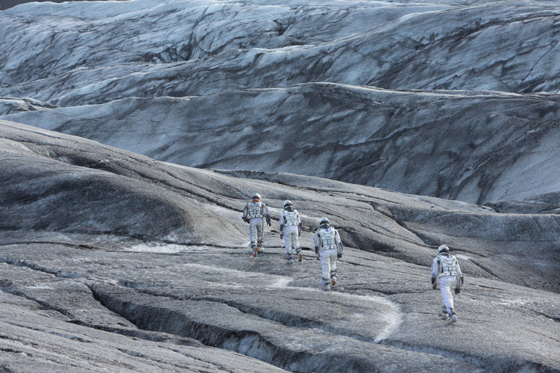
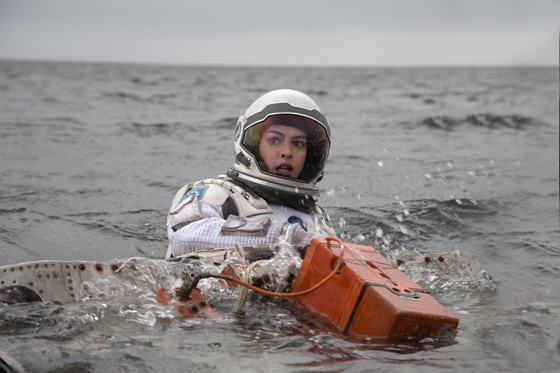
The justification of this, according to Nolan, turns out to be love - and the further into space, the more desperate the film clings to this most non -verbalized of abstractions, ridiculously trying to speak, speak, domestically, and now the humid Anne Hateue for five minutes stops the plot for literally direct text to inform the world that it is spinning for the power of love. Behind her, he nods mournfully, as if agreeing, a robot Tars, dear Nolanovsky hello to the Kubrikovsky Hal-9000. At the same time, Nolan speaks the language of some “memory diary” about love-it overcomes the light years, time and gravity here, but it is not able to broadcast pathetic dialogs without a cruttle. “Come back, Daiv, we will set up all,” whispered at Kubrick Hal-9000, an electronic analogue of the parental figure from the ancient tragedy, preparing the viewer for the fact that the journey through the cosmos will be a reflection of the indefatigable, truly cosmic desire to return to the womb. “Come back, please,” the planet of McConahi flies into the infinity, but then, to give Christopher Nolan the opportunity to reassure the alarmed audience with the return to the coziness of an unpretentious melodrama.
 © Warner Bros. Ent.
Nevertheless, Nolan is a unique author, perhaps perfectly reflecting the aspirations of his time, in which, in order to convey to a billionth audience a simple thought of bitterness with a family, no less than the apocalypse is needed.