
Translated material
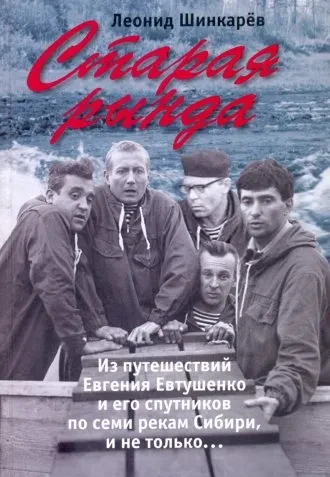
Leonid Shinkarev. Old Rynda
From the travels of Yevgeny Yevtushenko and his satellites along the seven rivers of Siberia, and not only
From the travels of Yevgeny Yevtushenko and his satellites along the seven rivers of Siberia, and not only
Perhaps documentary prose is now the most interesting literary genre. The plots that life offers are brighter than fiction, more unpredictable and dramatic. In addition, the media now clearly feels a shortage of truth ...
Leonid Shinkarev’s book “Old Rynd” is one of the best examples of modern documentary prose. First of all, she is completely artistic! Reading, you clearly see all her heroes (not at all because they are near their quality photographs), and the plot of the trip, which is based on the composition, does not allow her to tear himself away or turn over several pages.
And only one thing in this book cannot like it-the last, 400th page, or rather, one line on this page: “The circulation is 800 copies.” Of course, the Moscow publishing house "Meeting" thank you on this, but ... in what deplorable state is our book distribution?! How difficult it is to “promote on the market” a high -quality “product”, if it is not possible to spend more on its advertising than on manufacturing ... Yes, it is simply impossible. However, in the Moscow store Muscovites and guests of the capital of the capital of Shinkarev can still buy. But “Tyutchev will not come to the Zyryans”, although they are one of the heroes of the “old market”.
In a word, we decided to publish several chapters of this wonderful book. And we will start directly with the author’s preface.
Oleg Khlebnikov
"With you - to the ends of the world"
We did not build illusions regarding the limits of freedom, at that time the available to us, and we could hardly formulate what we are waiting for from wanderings, but if every about two years no obligations were not connected, we, as a signal, went into swimming, sometimes some kind of “condemning charm” in our ranges.
These notes are a belated attempt to understand: what.
Partly attracted space; Even we, living in Siberia for a long time, wondered, but did not really imagine what people in the forest -tundra felt, in the northern tundra, their tordokhs, plague, tonya, bonfires, when they see a heat or a heating or who is a cheerful, dazzling, dazzlingly bright, with deafening music in the night.
These ghosts are no closer to the descendants of Russian Cossacks - conquerors of Siberia, exiles and settlers. The newcomers took the natives to the wives and friends, in mixed families, dark -skinned, wide -sided black -eyed Siberians multiplied.
Even Yevtushenko, what is the player, what a prankster, what a vagabond poet, for the mid-1960s, forced half a world to baptize about himself, even he, the beam of both hemispheres, had not yet stunned, did not believe Socrates that there was no benefit from wanderings if you carry yourself everywhere. No one, I repeat, was looking for adventures, but I wanted to once end up with close people on a wet deck, to feed and west themselves, to open each other, to do simple sailor work together, and to hear the wheezing of civilization from a lonely “Spidola”, in a storm flying off the table.
The book is published more than 40 years after the first navigation ...
For a long time, I pulled it with the notes for a long time, I kept something. Maybe the understanding that time is different in the yard, and it is unlikely that today those swimming can arouse interest. But people leave, dear to me and friends, and I write, so that, as much as I can, at least in my thoughts to sit with them on the shore by the fire.
Perhaps someone is embarrassing that Karbas on Lena called “Mikeshkin”, the name of Lotsman, on the river of the legendary, but Zabuldygi and Drinking, and even allowed the vessel with this name to swim to the ocean near the motor ships that were names of the leaders and their associates. There was neither bravado nor intent to circle someone around a finger, but only a tribute to the talented, folk, wordless element, which has been holding on Siberia and Russia for hundreds of years ...
We did not publicize wanderings, impressions remained inside us. Only about the first, on the carbas "Mikeshkin", they wrote a lot. The expedition was taken by the Izvestia newspaper, a book was released under one cover:
“Leonid Shinkarev. "Mikeshkin" goes to the Arctic; Evgeny Yevtushenko. "Poems from the flight journal" (Moscow, 1970). " Pre -printed preparation fell on the events of 1968, the publishing house demanded to remove the poet’s name from the cover: his poems about the invasion of Prague were already walking in the hands. We got stuck, and the manuscript lay for almost 3 years without movement. But late, in reduction, she nevertheless published as a book of two authors. At the last moment, the publishers, just in case, scored the poet’s name on the cover with a font stunned than the name of the journalist; We both laughed. But this is not about the book and authors - only about time.
Typically, the team was out of 5 people, from the river to the river the composition partially changed, Yevtushenko and the author of these lines remained unchanged. At different times, the participants of the swimming were Arnold Andreev (Bratsk), Georgy Balakshin (Yakutsk), Aron Belkin (Moscow), Eduard Zommer (Irkutsk), Theophilus Korzhanovsky (Irkutsk), Yuri Parkhomenko (Irkutsk), Oleg Tselkov (Moscow), Valery Chernykh (Yakutsk), Naum Shinkarev (Nizhnya Schinkarev (Nizhnya) Novgorod) ...
We are from 30 to 40, family people, different character, all in business, and if we had something in common, then this, as I now understand, is a shortage in the life of mischief.
I remember well how it all started.
It was evening on April 18, 1967 in Irkutsk. The Arctic restaurant has already extinguished lights. A waitress with a high hairstyle, in a white blouse half -sprouted on the chest, with a score in his hands hung over our table. Listening to a feast conversation, she circled us with an enthusiastic and daring look: “Ah, guys, I would go to the ends of the world with you ...” God, like all of us, each for 30 with a tail, wanted to take off to this “edge” with an insightful one, which was so quickly evaluating us so quickly, who understood everything about us.
The end of the world is where? The paper napkin walked around the hands.
A white soft square, smoothed with palms under our fountain burns, soon began to resemble a map of the 16th century Gerhard Mercator. We gasped from the first discovery: the shortest path from the table in the Arctic to the edge of the world - along the Lena River, four and a half thousand kilometers ... and we "got up".
Two months later, the preparation was nearing the end. We went to the Arctic to thank the waitress for the faith in each of us. We were so missing! We saw our goddess from the threshold. At the next table, she changed the tablecloth and circled the new guests with the same mighty eyes: "Ah, guys, I would go to the ends of the world with you ..."
But we have nowhere to retreat.
To be continued