
Translated material
War budget
The State Duma is preparing for the second reading a budget bill for 2015.
It is compiled extremely carefully and conservatively: the macroeconomic balance is the key to survival of authoritarian regimes. But reality may be worse than the most gloomy forecasts
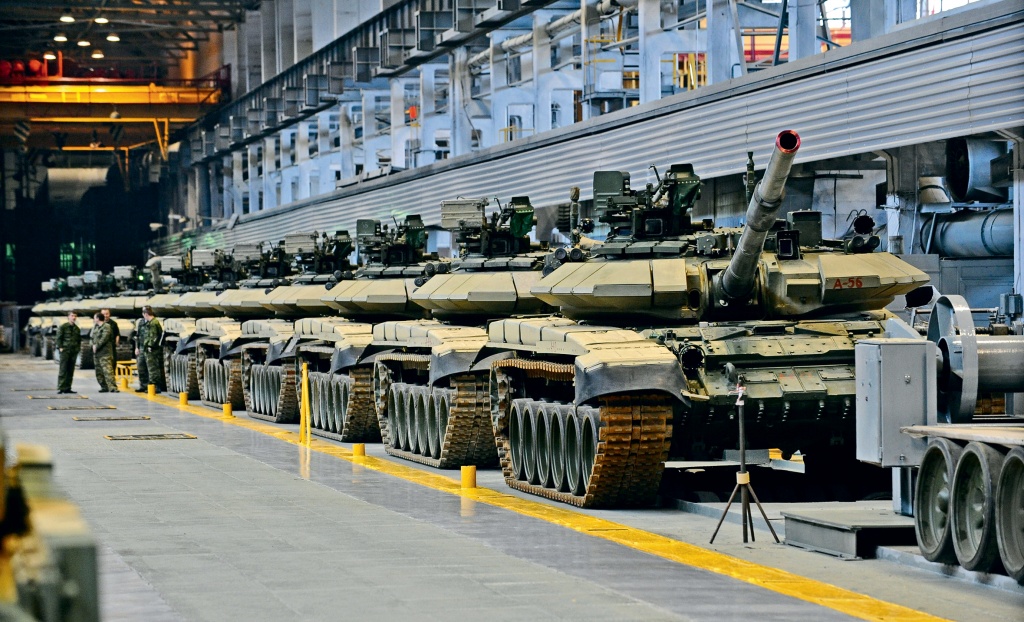
In the working workshop of OJSC NPK Uralvagonzavod, 2012 Photo: Komsomolskaya Pravda/ PhotoxPress.ru
Since 2007, the government annually has been preparing a federal budget draft not for the next year, but for the nearest three -year -old. It would seem that such promising planning should allow all their plans to all depending on the budget in advance, and analysts - macroeconomic forecasts based on the knowledge of budget priorities. However, as the comparison of the “estimate” of the distant budget year with its final implementation shows, no long -term planning options have actually appeared. That is, the federal budget-2017, when the matter comes to it, will not be at all the same as it is seen by officials now. Yes, and now planned in all details the budget-2015 was seen in a completely different way in the “design” 2012.
Under the noise
Plus 3-year planning: the Ministry of Finance has more stages and stages of budget preparation, at which he can cut off lobbyists who want an endless increase in targeted programs, social expenses, etc. This means that the application of each department, before it gets into the real budget, goes on two selection procedures more than when planning for a year. The “three -year -old” has not yet solved other tasks. So, it makes sense to pay attention to observers who are far from the budget process only to the nearest budget year. Both the economic situation and government priorities are changing quite quickly. The state’s obligations for remote years have no “legal force”, the real planning horizon is extremely narrow. But the media, retelling the next 3-year government plan, create a powerful smoke curtain-digital information noise. They cover the reader with an avalanche of large numbers (in trillions and hundreds of billions), from under which it is impossible to see the meaning. And now-the indicators of 2015-2016 will be reviewed so many times that the best that can be done with them now is just to ignore them.
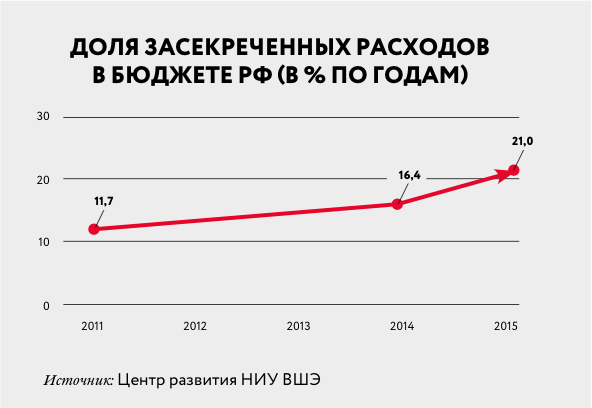
Another circumstance that prevents him from sorting out the budget is its growing secrecy. In 2011, according to the calculations of the HSE Development Center, 11.7 % of budget expenditures were secret. By 2014, the share of secret expenses increased to 16.4 %, and in 2015 it will reach 21 %. Growth by almost 80 % in just 4 years! About 70 %are classified in defense expenses, in spending on safety-20 %, and in the allocations for the economy-5-6 %. “If the tendency to increase secret expenses will be preserved, it will be difficult not only difficult to discuss budget problems, but it is also pointless,” said Andrei Chernyavsky and Alena Chepel, economists of the Development Center.
Moderation and accuracy
Putin’s budget approach has always been caution. In 2000, the state’s expenses - good, the rising oil price allowed - they increased greatly. It was impossible to not share the oil and gas well -being with pensioners, bureaucracy, the army, other security forces and swelled in the years before the Olympics as in the yeast by the state rods. But at the same time, the desire to “share” in the Putin budget planning has always prevailed the desire to make a budget policy reliable, to prevent dangerous dependence on foreign creditors, which, according to Putin, in the 1990s could dictate to Russia what to do.
Budget reserves (now in the reserve fund $ 89.6 billion, and in the welfare fund - $ 81.7 billion) - this is not a tribute to budget conservatism for Putin, but the key to political independence. Therefore, even the requests of the head of Rosneft Igor Sechin about the allocation of trillion rubles from these funds by investment programs by state -owned companies are divided by about 10.
The 2015 budget does not change these traditions. The budget revenues in the past 5 years range at 19-20 % of GDP, of which 49-52 % falls on oil and gas. The deficit is planned very modest - 0.6 % of GDP. This was approximately the shortage of the budget in 2013. This year, the budget will undoubtedly be executed with a surplus, despite the very quickly growing military expenses. The 2015 deficiency in conditions of closing for Russia international capital markets is supposed to be financed at the expense of additional oil and gas revenues. If they are not there, the whole structure breaks down immediately. Then you will have to spend money from budget funds that can be exhausted in 4-5 years.
But the Ministry of Finance is well cheaper in this case. Since about half of his income is currency, he is very much in his hands to fall the ruble course. Literally now, every dollar received by the budget, when recalculating into rubles, weighs about 40 % more than a year ago. But budget expenditures are not growing by either 40 %or even 20 %. Even the priority, priority spending - increasing salaries to state employees in accordance with the Putin “May decrees” in 2015 will be produced by only 5.5 %, noticeably lower than official inflation.
Almost all the obligations of the budget are ruble, and half of the income is currency, so the state is in Russia a “main foreigner”, most beneficial from the weakening of the ruble. In the 1990s, when oil was cheap, and the state had huge external debts, the situation was opposite. This circumstance will not push the Central Bank to the active impact on the ruble. Although the already held devaluation allows the government in the coming budget year to feel relatively calm.
All to defend the Fatherland!
The main "feature" of the budgets of 2014-15 is a sharp increase in defense expenses. This picture makes us recall that it was the disagreement with the growth of military expenditures that was the main reason for the departure of Alexei Kudrin from the government 3 years ago. His successor Anton Siluanov copes well with holding the appetites of all those who wish to interest the budget feeder, except for one - the army. Its financing is growing simply a fantastic pace.
Back in 2011-12, the expenses per army amounted to 14 % of the expenses of the federal budget. This year they will reach 17.6 %, and can exceed this mark. The government finances the army not only abundantly, but also a leading order during the year. So, in January-August 2014, the army received almost 70 % of the money due for the year, and the “national economy”-less than 50 %. Behind this can be hidden both the redistribution of funds within the year, and an unspoken decision to increase military spending by another 100-200 billion rubles. on top of the budget.
In 2015, 21.2 % of all budget expenditures should reach defense expenses. How and why military expenses are growing, it is probably clear to everyone. Another thing is more interesting - due to which a military maneuver is performed?
The main victim is the costs of human capital (education and healthcare), which experts who prepared 3 years ago “Strategy-2020” were so actively called by the president. Everything happens exactly contrary to their recommendations. The share of education expenditures in the budget from 2011 to 2015 decreases from 5.1 % to 4 %, and for healthcare-from 4.6 % to 2.7 %. If in 2011 military spending exceeded the total expenses for education and medicine by 42 %, then in 2015 - by 216 % (3.2 times). Amazing dynamics! If budget priorities in the coming years are not changed, the current rallies of Moscow doctors can become the first swallow of the long and difficult struggle of Russian state employees for their jobs.
Worse, the costs of medicine and education fall not only in relative, but also in absolute terms. Compared to the 2014 budget, healthcare expenses are reduced by 22.9 %, and on education-by 5.9 %. In addition to these articles, the state’s expenses on media, culture and sport will fall, but not so sharply.
The federal support of regional budgets will also decrease noticeably (by 13 %). They also feel very constrained, although their incomes grow (over 8 months of 2014) a little faster than inflation and 60 % faster than expenses, in real terms, decreasing. The budget policy of the regions is now in the main desire to reduce the budget deficit, since, unlike the federal budget, they do not have not only the opportunity to occupy funds abroad, but also budget piglets, from where you can get funds in difficult times.
This year, according to the development center, the deficiency of regional budgets will reach 1.15 % of GDP, or 9.7 % of their expenses. Some regions will have to get into debt - over the past year, their obligations to banks increased by 283 billion rubles. In the most difficult position, from the point of view of the balance of budget deficit to its income, there are central regions (Smolensk, Kaluga, Voronezh and Yaroslavl regions): their deficit reaches 19-21 % of income.
The economy is sacrificed
In addition to doctors and teachers, the main affected by military budget maneuver is the national economy. The “kings of the state order” remain the favorite in it-infrastructure and construction companies serving large construction of the state and state-power supplies. Plus, the oil and gas industry: state -owned companies receive large tax benefits in the development of new raw materials deposits, and the “tax maneuver” with an increase in personal income tax and a reduction in export duties is designed to stimulate oil refining. But this maneuver has been fulfilled quite awkwardly: now it most stimulates the export of fuel oil, which in economic meaning is not much different from the export of raw oil. But the budget at the tax maneuver loses money.
All other subjects of the economy are among those who will pay a sharp increase in defense costs.
Firstly, these are future pensioners-the seized deductions for the funded pension should amount to about 600 billion rubles in the amount. This measure is especially strong in the middle class, in which the funded pension deductions were expressed in significant amounts.
Secondly, small business. The total efforts of lobbyists were able to “recapture” the idea of introducing sales tax since 2015. At a recent Sochi forum, Prime Minister Medvedev proposed introducing municipal fees for the right to engage in 22 types of activities - trade, public catering, carriage, car service, etc. In fact, this is the second UTII. According to the bill, which recently submitted the government to the State Duma, trade for trade will be 600 thousand rubles. per year for small (up to 50 sq.m) shops, and municipalities will be able to increase it by 10 times. Of course, the regions will introduce a new tax carefully, but against the background of an economic recession, even minimum fees can bring a giant number of small regional companies to close.
Thirdly, homeowners. They lose twice. First, due to 3-4 times increasing in different regions of real estate tax. And then, due to the recently submitted by the Ministry of Finance and the other day, the chairman of the budget committee Andrei Makarov, cancel the benefit of income tax in the sale of housing. This measure will hit the middle class again.
Fourth, once again the middle class. Since 2015, the contribution to the MHIF (5.1 %) will be collected from the entire salary, and not from its part. The redistributive function of taxes on income and wages increases annually. Apparently, it is not far off and a return to the idea of canceling a single income tax rate, which will be replaced by progressive taxation.
Finally, the fifth: a large business is growing and taxation, mainly in terms of "environmental" taxes. The idea of a tax moratorium for 3 years, which was lobbying the RSPP, was rejected by the government.
There is no indignant: Russian taxpayers begin to receive exactly what they signed, joyfully approving the accession of Crimea to Russia and the concern for the inhabitants of Eastern Ukraine. It comes time to pay in bills.