
Translated material
"The US administration does not want my return"
Exposure from the publication of an interview with a former employee of the National Security Agency (ANB) Edward Snowden
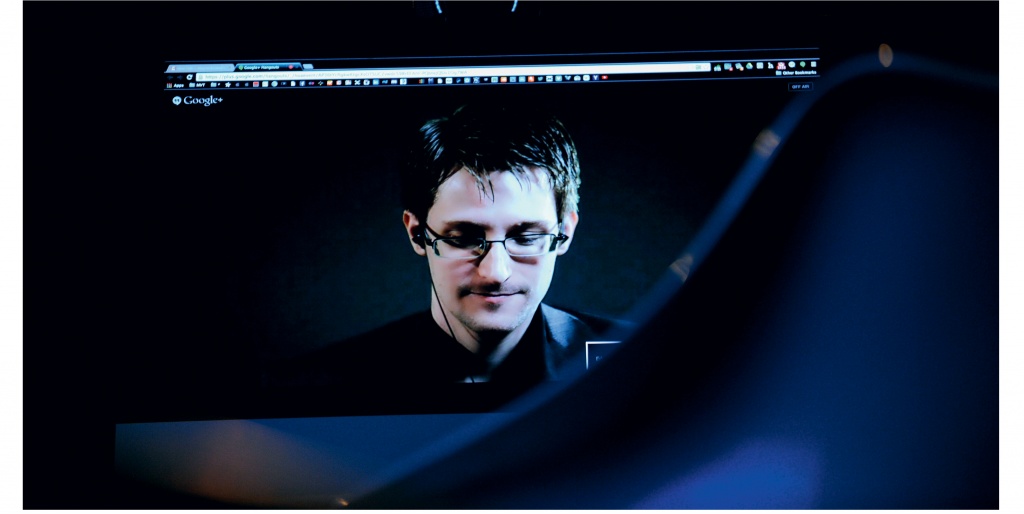
In the November issue of the American magazine The Nation, an interview with a former employee of the National Security Agency (NSA) Edward Snowden was published. The fugitive feels great in Russia, discusses the future of the Internet and does not believe that a fair trial can wait for him in the States.
Do you manage to find (in Russia) time for any social life? Or are you bored and lonely? Actually, I look like a home cat, I am a computer and have always been to them. I do not go out for a walk, I do not play football. I like to invent, build, I want to say, create. And therefore, since I have been here (in Russia), my life is absorbed in the work, which actually suits me completely.
And do you have everything you need for work?
Yes, you know, I do not spend all day, running from the ghosts, hanging a hat on my eyes - I am in exile. My government deliberately withdrew my passport to leave me in exile. If they wanted to catch me, they would allow me to flee to Latin America, where the CIA acts with impunity. They did not want it; They made their choice, locked me in Russia. <...>
And if you want to meet and talk with someone, can you do it?
Yes, I can. Moreover, I go out into the street - and they will recognize me from time to time. They always find out in computer stores. This is something like a mental connection, because no one will know me in supermarkets, be I even in my glasses, just like in photographs. However, in a computers store, even if I shave out smoothly, in a hat, I have nothing to do with my usual look, someone will certainly say: “Snowden?!”
By the way, what do you say about your video questioning on the direct line of Putin this year ...
It was terrible! Oh Lord, it was a crushing fiasco. I hoped to catch Putin on lies, as happened with the director of national intelligence James Clapper (Snowden claims that Clapper lied under the oath in the performance before the US Congress when he talked about the activities of American secret services. - The New Times). So, I asked Putin the same question - about total control over the population in Russia. I know that the same thing happens here. However, he denied everything. And if at least one Russian source unveiled this information, it would not seem little ...
The right to a revolution
The last article by Jonathan Shella (American writer and scientist, fighter with the spread of nuclear weapons. - The New Times) for our publication - he died in March - was about you. He introduced you to a dissident, a radical, a defender of the right to confidentiality. Jonathan asks a fundamental question: what do Americans do when official institutions are useless or do not react? Is it really required to change such "truth -making" as you?
We live in a system of representative democracy. But how did we achieve this? Through a direct action. This is reflected in our Constitution and in our values. We have the right to revolution. But it should not always occur with weapons in hand - it can be in revolutionary ideas, in the principles that we adhere to in order to serve as an example of the world in which we want to live.
The existing order of things can at any moment put our values under the blow-in my opinion, this is exactly what we observe today. Our traditional political parties are less and less represented by ordinary people. And if the government or parties cease to answer our aspirations, we will do it for them ourselves. Actually, this is a direct action or even civil disobedience. But here the state says: "In order for this civil disobedience to be legitimate, you must follow certain rules." It drives us into “zones free for statements”; It says: you can do this only at such and such and in such a way, but without interrupting the government. And it thereby reduces the effect of civil disobedience. We must remember: in order to be effective, civil disobedience must be precisely disobedience. <...>
In your opinion, we live in troubled times. And what will it turn out in the end?
See how the liberal governments reacted to information that has surfaced to the surface about total surveillance from the NSA. A whole discussion unfolded in the United States, officials generally fell into a stupor, because they unbelted the most, obviously violating the country's constitution. Many of our allies did not have such a constitutional protection at all - neither in the UK, nor in New Zealand, nor in Australia. All these countries, as if awakened after high -profile discoveries (made by Snowden. - The New Times) began to rummage in their laws, which for the most part were written for them by the US National Security Agency. They are written so that in these countries mass surveillance without judicial supervision becomes possible, without all those standard verification and control measures that could be expected in this case.
All this inevitably leads us to the question: when and where will the system find its end, in which special services can do everything that they will please? And in my opinion, this will inevitably happen, and moreover, not without the assistance of the Internet business.
For example, Microsoft is now suing the American Ministry of Justice. The Ministry of Justice tells them: “We want to get information from your database in Ireland. She is not related to US citizens, but we still want her. ” Microsoft replies: “Yes, good. Contact the court of Ireland, request a warrant from them. We have a mutual agreement on legal assistance. They will give it to you, you will provide it to us, and we will provide you with information in accordance with the laws of Ireland. ” Then the Ministry of Justice insists: “No, you are an American company, and we must have access to your data everywhere. And jurisdiction has nothing to do with it. And who applies to our request - also does not matter. ”
The lawsuit of the Ministry of Justice and Microsoft is now in the stage of appeal. This is a very important thing. If the United States is allowed to create a precedent that national borders cease to matter when it comes to information protection, then the countries-the neighbors of America-wound something on the mustache. After all, they pay special attention to our behavior in the field of information, for them we serve as an example for them.
Are they still focusing on America?
Certainly! But the most important thing is the same guidelines for our rivals in the world. Ask yourself a question - what will the Government of the Democratic Republic of the Congo or China do after their dissident nominated for the Nobel Prize of the world? Suddenly they want to read his e-mail, located on the server somewhere in Ireland? They will turn to Microsoft and say: “You have transmitted this data to the American Ministry of Justice, which means that you can do the same for us.” And if Microsoft rests, then they will not be confused: “Do you apply other legal standards in our case? Ok, then we will impose sanctions on your company in our countries. We apply special tax measures, we will make you less competitive. ” Microsoft will suffer, therefore, the American economy will suffer.
But many countries rebel against the total surveillance of America after everyone?
Yes, and we see this very well, for example, in Brazil. They turned to the UN and explained: "We (the Brazilians) should better understand what they (Americans) mean when they insist on receiving information from everywhere." And Russia recently adopted the law - terrible, in my opinion - which says: all the data of Russian citizens should be stored in Russia*. The law is adopted to prevent other countries to play the same games in which the US Ministry of Justice plays with Microsoft. <...>
To the question of ciphers
Your revelations have influenced the development of encryption technology for the iPhone-6, which, according to your government, is fraught with an obstacle to the implementation of laws.
This is not entirely true. Yes, large technological companies understood: the government strikes not only by American principles - it damages their business. Technicals thought: “People no longer trust our products” - and decided to correct the shortcomings, protecting their smartphones. The new iPhone has an encryption system that allows you to protect its contents. This means that if someone stole your phone or if the hackers hack it, they will not be able to consider the information stored inside, as well as viewing photos, read your text messages and so on.
But on the other hand, the police will still be able to track your movements through the telephone geolocation system-if the cops decide that you are involved in human abduction, for example. In addition, the new technology does not in any way prevent law enforcement agencies from seeking a warrant from the court to receive copies of your text messages from the provider, they will be able to access your photos uploaded, for example, in ICLUD. Only what is physically on the phone is protected. Only information not posted to the network is protected.
All these arguments are obvious, but our general prosecutor and director of the FBI still jumped to the stands (and fell on Apple): “You are at the risk of our children!” <...>
Extradition is impossible
A fair court in the United States could become a historical opportunity for you to defend the very principles that you are talking about ...
I talked with a large number of very good lawyers around the world. To begin with, I can’t extradite me, in principle. And this is the only real reason for the fury of the US government, and it became furious when I was still in Hong Kong. I can extradite me only following the principle of “politics” the law wins, as my lawyers call such cases.
If it comes to court, they (the US government) can accuse me of espionage. But what is espionage? This is the quintessence of a political crime, which in legal terminology is defined as a crime against the state, in contrast to a crime against the individual. The murder, for example, is not a political crime, because you killed a person, you damaged him and his family, is a crime against the person. But if you harm the state, that is, you have committed a political crime, then you cannot be extradited.
What if you manage to achieve guarantees of an honest court?
[Laughs] Believe me, I will not receive such guarantees - simply because the US administration actually does not want my return. Her calculation is that people in America will forget, as I ended up in Russia. They (the administration) were waiting for me to cure Hong Kong to cancel my passport and lure me into Russia - because it was the most effective step against me, given the political climate in America. They hope that they will be able to prove: they say that Snowden was in Russia of his own free will, and even wears a T -shirt with the inscription “I love Putin” <...>
It seems that you do not want to talk too much about Russia?
[Giggles] correctly. Don't want.
Why? After all, everyone knows that you were here not of your own free will.
This is far from the case. Propaganda against me works surprisingly effectively among poorly informed inhabitants. Of course, special publications or knowledgeable, competent people who read newspapers and communicate with professors-they most likely know the truth. But many others are still not aware that I was never going to stay in Russia. After all, journalists posted on Twitter photos of my reserved place on a flight to Latin America, which I could not get to, because the American government responded my passport. Why did everyone forget about this details? And there are also those who sincerely believe that in exchange for asylum I sold a certain information personally to Putin. Moreover, they believe, despite the fact that the Senate Commission on Intelligence, which reports every morning about the situation around me, has already voiced the conclusion: all these conspiracy theories are from the field of delirium.
* The Law on Personal Data, which enters into force on September 1, 2016, regulates the responsibilities of Internet operators “to ensure recording, systematization, accumulation, storage, clarification (update, change), the extraction of personal data of citizens of the Russian Federation in information databases located in the Russian Federation”.
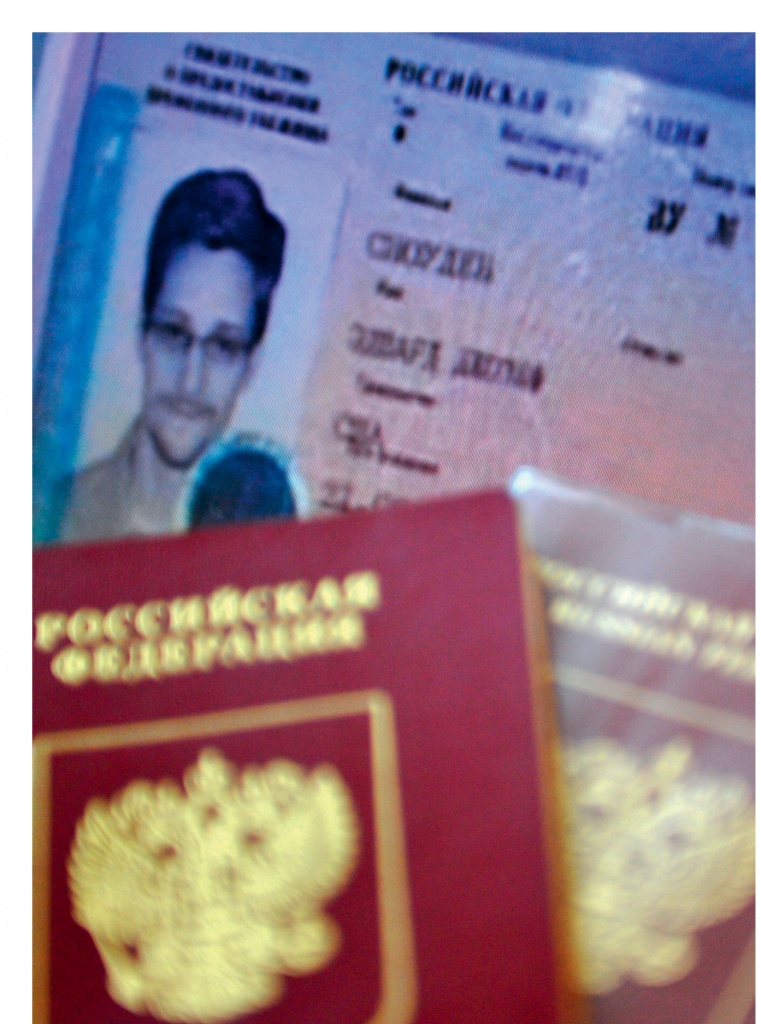
On August 1, 2013, Edward Snowden received a temporary asylum in the Russian Federation photo: Anton Novoderezhkin/ITAR-TASS