
Translated material
Against Stirlitz and BMW
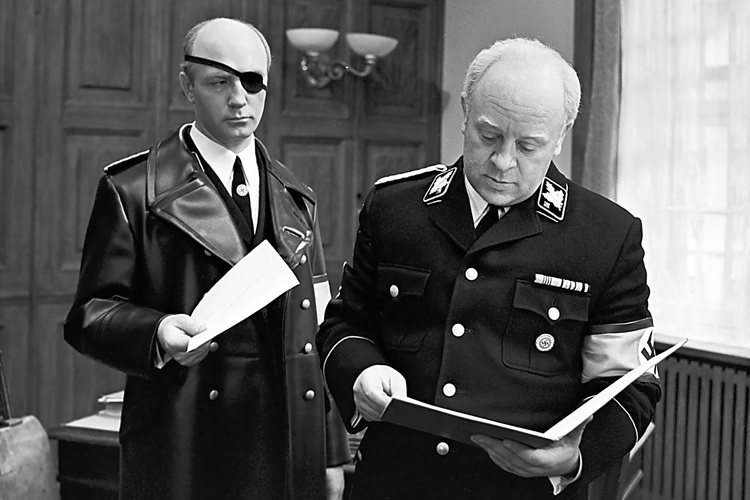
On November 4, nationalists marched throughout the country, and on November 5, the president signed another law, as it were, against all this and for all the good. Amendments were made to the existing Federal Law “On perpetuating the victory of the Soviet people in the Great Patriotic War of 1941-1945 ” (for brevity we will call it “On perpetuating ...”) and the Administrative Code (Code of Administrative Offenses). An employee of the owl information and analytical center Maria Rozalskaya explains why these amendments are meaningless and even harmful.
What kind of law?
We are talking about the ban on the propaganda and public demonstration of the attributes or symbols of “organizations that cooperate with groups, organizations, movements or persons found criminal or guilty of crimes in accordance with the sentence of the International Military Tribunal (Nuremberg Tribunal) or sentences of national, military or occupation tribunals based on the sentence of the International Military Military Military Tribunal (Nuremberg Tribunal) or issued during the Great Patriotic War, World War II. ”
In addition, “propaganda or public demonstration of attributes or symbols of organizations (including foreign or international) is prohibited, which deny the facts and conclusions established by the verdict of the International Military Tribunal for the Court and the punishment of the main military criminals of the European countries of the axis (the Nuremberg Tribunal) or the sentences of national, military or occipulating tribunals based on the sentence of the International Military Military Military Military The tribunal for the court and the punishment of the main military criminals of the European countries of the axis (Nuremberg Tribunal) or issued during the Great Patriotic War, the Second World War. ”
A list of organizations, as well as paraphernalia and symbols that this law will be determined, which should be determined "in the manner prescribed by the Government of the Russian Federation," has also been introduced.
Well, in the end, all of the above prohibitions should be somehow reflected in the Administrative Code so that they can be punished for violations, which is made using new amendments made to Article 20.3. “Propaganda either public demonstration of Nazi paraphernalia or symbols, or paraphernalia or symbols of extremist organizations, or other attributes or symbols, propaganda or public demonstration of which are prohibited by federal laws” (new in the formulation of the article was highlighted).
Why were the specified law and the relevant article of the Code of Administrative Offenses are bad before the amendments?
The law "On perpetuating ..." is bad in that it prohibits any use and demonstration of, say, swastika outside the context and goals. It says: “In the Russian Federation, it is forbidden to use in any form of Nazi symbols as an insulting multinational people and the memory of the victims incurred in the Great Patriotic War.”
Yes, you understand correctly: reconstructors and a film about Stirlitz are also prohibited. Article 20.3 of the Code of Administrative Offenses, which establishes the punishment for this, until recently, existed in the wording that allows at least a conversation on the topic "is the use of Nazi symbols without the purpose of propaganda by law." It talked about the ban on “propaganda and public demonstration” (and now instead of “and” “or” there is no doubt). But it must be admitted that, no matter how these unions are interpreted, almost all law enforcement practice consisted of new amendments when they punished for any demonstration - regardless of whether this demonstration was associated with the aim of promoting Nazi ideas (antiques, reconstructors, Buddhists, journalists with anti -fascist articles - who did not fall under this accusation).
The Living Kuban portal published a photo of the son of a local vice-governor in the image of a Stirlitz and encountered a charge of violating the law.
But there was still a case when the merciless hand of the law also froze in indecision: in 2011, Roskomnadzor announced the need to eliminate the possibility of holding responsibility for demonstrating Nazi symbols without propaganda purposes. Then the Living Kuban portal published a photo of the son of a local vice-governor in the image of a Stirlitz and encountered a prosecution of violation of the law “On perpetuation ...” Obviously, the proclamation of the intention to create an initiative group with Roskomnadzor did not go, because this law and article 20.3 of the Code of Administrative Offenses not only did not change for the better, but also expanded.
What is the essence of new amendments
“On perpetuating ...” is in a number of other laws adopted in political and, moreover, momentary goals. Like all such laws, it was invented to attack a specific phenomenon (person or organization). As in other cases, many completely strangers will suffer from this law.
I will not undertake to take bread from political scientists and will not call the sparrow in which they aimed from this gun. I’ll just give several examples who and what can become the object of application of this law.
So, they prohibit us with the symbolism of two types of organizations: those who cooperate, for example, with the NSDAP or, say, denying the Holocaust.
With organizations of the second type, everything is relatively simple. Many of them, like their symbolism, are prohibited in Russia.
If we talk about the first type of organizations, then the first thing are various opponents of the Red Army such as organizing Ukrainian nationalists. Their symbolism, among other things, is a yellow-blue flag, the ban on which will automatically entail the prohibition of the state flag of today's Ukraine.
Or the Vlasovites in the Russian Liberation Army used a tricolor, which later became the official flag of the Russian Federation.
Or - even funnier - the symbolism of the USSR may also take the ban, since until a certain moment Hitler was a real ally.
And, of course, endless industrial firms that collaborated with the Nazis - up to the use of slave labor: Hugo Boss , BMW , Nestle , Kodak , Ford and others.
And what, so they will take and ban BMW and a sickle with a hammer?
No, everything is more cunning. The law has no direct action. Only those organizations and symbols that, in the manner prescribed by the Government of the Russian Federation will be included in the list of this very government, will fall under it. Simply put, the government itself will decide whom to punish. Here is such a refraction of the principle of separation of powers.