
Translated material
Language of Food Dan Zhurafski: what food says to the linguist
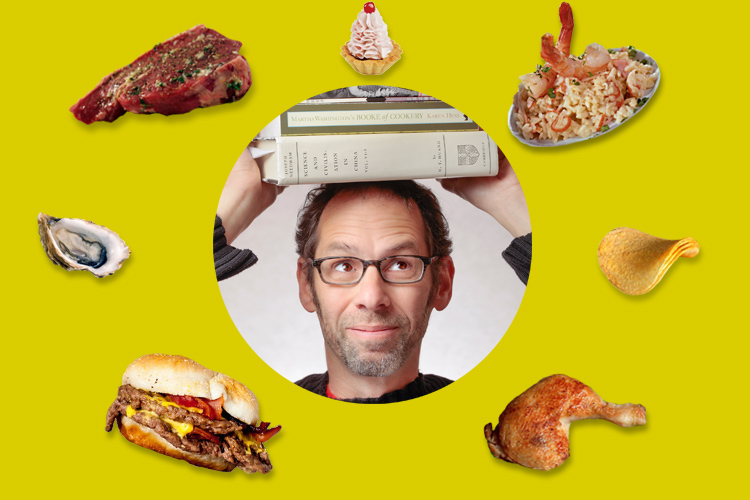
The phone put an end to long letters home. Twitter with its live broadcast effect (“I am sitting in line in a bank”) is naught in the habit of drinking experiences in order to give them out in the form of history someday later. But the narrative found a sudden last shelter - these are complaints about a poor service in a catering.
Zhurafsky, a professor of computer linguistics from Stanford, analyzed, together with colleagues, one million user reviews of cafes and restaurants from the Yelp website . com ( Yelp is Yellow pages , "yellow pages"). Everyone is eaten, and the by-product of this process is a huge case of statements, exemplary “big data”. They allow you to clarify not so much our gastronomic addictions as the features of thinking. If millions talk in a letter about hamburgers and cupcakes, then, probably, they use logical and language constructions that are suitable for something else.
First of all, food is an object of strong emotions. It can be openly not loved, scolded and even incurred hatred, without fear of criminal prosecution under the 282nd article of the Criminal Code of the Russian Federation. Fat or sweets are allowed to despise in the framework of the law. And if the waiter for a long time risotto brought barely warm, and even not with Futty-di-Mar, as they ordered, but with some champignons-you can give feelings a way out. Return home, sit down on a laptop, compose a devastating review. Put one star out of five to the institution.
How do negative reviews differ from positive? Not so much content as a structure. For example, an excess of past tense verbs. They came, chose, came up, asked, brought, returned, refused, called, ignored. If a positive review is rather a toast for health (“Everything is fine, guys, let's continue in the same spirit”), then the negative is a whole story with a tie, climax and denouement. And for many reviewers, such a genre is Vnov.
Chekhovskoye "approaching Stanzia and looking at the nature of the window, my hat flew out" - exactly the same. Why is the language so unnaturally turned out? Because the mournful book probably first puts the writer before the opportunity to speak out on the topic of causal relationships between events. A dozen more complaints - and he will learn.
In complaints about Yelp . COM “We” prevails over the “I” that in the case of restaurants it seems to be clear in the meaning: I had lunch or dinner, joint impressions are described. However, those who liked everything say about themselves in the singular: “I am in admiration”, “I will visit”. It turns out that the language marker of traumatic experience is hiding here. Unfamed beefsteks mobilize the same psychological reaction as the explosion of twin towers: frequent “we” is an appeal to the support group for support. When American bloggers recall that they personally saw and felt on September 11, 2001, “we” again pushing the “I” into the shadow. The language of student newspapers changes in the same way after someone is in a college with an automatic rifle and opens fire on people.
From here you can make a practical recipe: if you want to understand how disturbing around - just look at how the proportion of "we/I" in the same context changes over time. Although in school works on the topic "How I spent the summer."
***
When it comes directly about food, we resort to metaphors of two varieties. Zhurafski claims: about expensive restaurants and wine, they talk in the language of sex, about fast food and beer - in the language of drugs. "Squeezed on the wings." "He threw himself as a burger." To declare harmful food with a kind of heroin means to relieve responsibility: the forces in the struggle are inequal, I am just a victim here.
The area of sex is “surrendered to taste” and oysters that resemble an orgasm reviewers. A variety of “tender”, “air” or “pulling” falls into the same category - everything that is described in terms of tactile sensations. Keywords - “afford”, weaken the control: in sex there is no place for the calculator, there are impulses, and not calculations. If you need to sell us something more expensive than usual, you should knock on this door.
By the way, it is here that the differences between the East and the West declare themselves. Advertising in the United States operates with the categories “soft”, “juicy”, “melting in the tongue”: on a plate - a malleable victim. Meanwhile, in Thailand on TV they promote “sharp”, “hard and bugrist”, “burning”. Such food is a warrior in strong armor, a solid tool for quenching hunger: you need to take it.
Recipe number two: to reflect which of the poles we are closer to in Russia.
***
The food herself talks to us several times a day - for this she does not have to be a reasonable bun, it is enough to have a text on the package. Chips, for example, assure that they do not contain cholesterol and gluten. We know that they are harmful food-and gluten with cholesterol has nothing to do with it, the case is in salt and fats. Manufacturers are aware that we know this. But when we approach the shelf and the brain reminds of calories, polite food is simply obliged to support the conversation on the topic of health.
Different customers are different conversations. The cheapest chips in California are emphasized on “traditions tested by time” and “130-year history”: what is considered to be respectable in Russia, advertising in the United States helps to win the poorest audience. This is important to her, the correspondence of the product is a reliable standard from the past. For the rich, on the contrary, it is customary to emphasize that their choice is different from the default standard - albeit fictional: “No fake colors. No fake smells. No fingerprints that are fluorescent orange in the dark. No need to wipe your hands from fat on jeans. True, nothing like that. " Each “not” on a bag of chips, counted Zhurafsky, who analyzed a sample of 12 brands, adds to an average of four cents per ounce (28 grams) to an average of four.
A separate chapter in the book honestly deserved the word “real” - what's on the packaging, in the restaurant menu. The more bourgeois the place, the less chance to stumble upon the “present”. In the explanation of Zhurafsky, he relies on the simple idea of the philosopher Herbert Paul Graice: if the interlocutor reports something, he has reason to say exactly this to be correctly understood. So “a real crab salad” is a wording in case you have reason not to wait for anything better than crab sticks. The overkill of the restaurant menu from the archives shows that at different points of time, the “present” had to be emphasized in completely different things. In the 1960s, it was a “real oil” (in contrast to Margarin), in the 1900s-“real turtle soup”. (The fake was prepared from the calf brains - therefore, by the way, the tenniel on his illustrations to Alice and depicts the quasi with hooves and the head of the calf.)
According to Zhurafsky, everything that can be said may be said about food. This is an ideal object in order to project any experiences on it. Up to religious: a year ago, a team of experimenter psychologists from the Main Scottish University of St. Andrews proved that a retreat from a diet causes a “sense of unclean hands” and an insistent desire to “wash off a sin” . It is amazing that there is no other such object about which we could experience the whole range of emotions is not even on the horizon. If the cooled risotto teaches to tell stories, the hamburger helps to realize addictions, and expensive chips - do not get hung up on traditions, then a good psychotherapist is obtained from the refrigerator. Talk to him about it.