
Translated material
Commenting on the war
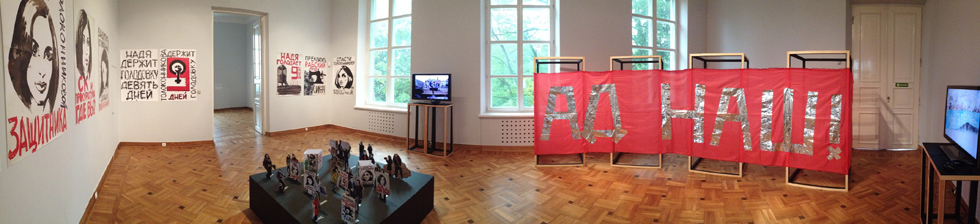
From October 3 to 26 at the Warsaw National Museum of Sculpture. Ksaveria Dunikovsky The festival of contemporary art and the theoryof “commentary” was held, uniting modern Ukrainian and Russian artists involved in politically engaged art practices and socio-political criticism. The festival was initiated by the famous Polish artist Katarzhina trump cards and this year Katya Katya Krupyu, a Russian curator working in the Center for Modern Art, “Veveazdovsky Castle” (Warsaw) was organized. In addition to the directly discussion platform of the festival, as well as a documentary film program specially selected for this case, an exhibition was also held in the museum, where Lesya Khomenko, Alevtina Kahidze, Ekaterina Lazarev, Olga Zhitlina and many others showed their work on the topic of criticism of the current socio-political situation.
The idea to give the artists of the two warring countries for several days of the symposium to comment on the current political agenda of both Russia and Ukraine, of course, was not developed by chance, but almost immediately after the annexation of Crimea by Russia. The art and policy of the wartime - so, perhaps, it is possible to outline the concept of this festival, the main driving force of which was not even a museum exhibition, but a discussion platform, in a certain sense, pushing the artists of both countries and provoking them to the revision of the martial law that has developed after the Maidan, as well as to criticism of mainstream and populist ideologies as Russia and so and Ukraine.
What happened?
The language of art and the war of ideologies
Following Lyotar, contemporary art, trying to talk about war or revolution, I would call such an art that gives us an idea that there is something impartial. Involved, which in a certain, uninteresting way connects us with pain, suffering or lost meanings characteristic of certain events-catastrophe. This impatient one can try to think, realize, but you can not see directly, since genuine reality in its experiences by the immediate witnesses of the event is irreversible. In the Ukrainian case, the discussion of which for the most part is devoted to this article, the art is experiencing such a deep crisis of representation of reality, for the most part due to the hostile work of the Russian media propaganda that we can’t get to aesthetic categories like “unimaginable”. In a sense, it was this discursive moment of the “struggle for reality” that designated the entire festival, which only confirms for me the meaning of the original intention, which was put into it by the pebble of the trump card.
In the conditions of the Maidan and Post-Maidan, Ukrainian art is forced to work out primarily for information needs, pointily fixing the reality of what is happening (portraits of the Maidanovites Lesya Khomenko) or trying to provoke this reality to the surface (Ukrainian national “flags” of Alevtina Kahidze, intended for her friends in the Donetsk region). Perhaps that is why, of the Ukrainian work presented at the exhibition, the performance of the Odessa media artist Maria Gonchar “How to pack and deliver food to the places where people are kept under arrest” was most indicative. Masha showed how to quickly and properly prepare and pack food to transfer them to the places of imprisonment. However, what are more global observations, except for the aesthetic principles of documenting and breeding reality or the struggle for it against the manipulation of Russian television channels, can you make a Warsaw festival after this?
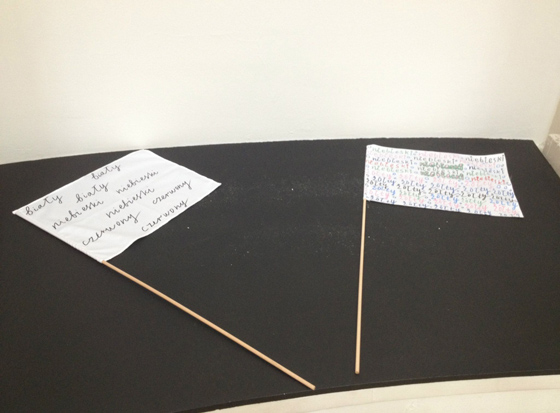 Alevtina Kahidze, Flags, 2014, Courtesy of the Artist
The main conclusion, probably, can be considered that certain terms and concepts (“Cold War”, “Russian propaganda”, “revolution”, “Maidan”, etc.), which are mentioned at every European exhibition about Ukraine, are more simply impossible to use. Not even because they are emasculated and meaningful of their use, but because they are unsatisfactory for describing the object of image/discourse that has changed during this time. In the term of the Moscow Enterprises , Ukrainian artists are forced to “get into”, that is, they fall into the situation “Vliyparo”, where they try to preserve themselves from the pain that is breaking all the pain, which, even at a purely emotional level, did not hide from the eyes of the Warsaw curators and Russian participants. And the name of this “Vliyparo” is Ukrainian patriotism.
Before the same as dissecting this (protective) patriotism, which also revealed itself at the festival, it must be said that the situation in Ukraine changes more often than you can imagine from the media. Having grabbed a piece of this reality yesterday, today as an artist you simply must not turn off the function of doubt in yourself: do you correspond to everything that is happening around or closes with its uncomfortable and obscene inside a patriotic barrier? The well -known concept of antagonism, Shantal Moff and Ernesto Laclot, can serve as a good theoretical help in order to try philosophically, without going into the direct realities of Ukrainian politics, which will still have to resort to later, to describe the mechanism of work of this doubt for the artist, and not only for him, due to the current conditions.
The border of all objectivity, according to Laklo and Moff, is precisely antagonism, which is understood not as a struggle or confrontation, but rather as a constant denial of another discourse (or discourse of another) and the definition of oneself in a negative way. Antagonism means constant negativeness and the lack of positiveness of the participants in antagonism and entails the impossibility of the final design of the company, which, if we talk about Ukraine, at any case cannot at the moment be considered either “designed” or national one. If you try to recognize the nationalist antagonism or even antagonism, taking into account the whole speculativeness of such reasoning, as well as the fact that there can no longer be a more integral and certain more progressive picture for interacting with it. However, the well-known protective-patriotic framework for today's Ukrainian artist, unfortunately, is the framework of his discourse.
The posing of the questions, and not the provision of unambiguous answers to them is the only task of this article. Therefore, if you like, the question is immediately: that in this case, all of the above can mean both for Ukrainian art and for Ukrainian society?
Our colonial-patriotic resessentiment
On September 29, on the eve of the opening of the festival, in another Polish city of Gdansk, Leh Valens presented the leader of the right -winged Ukrainian party “Freedom” to Oleg Tyagniboku a world award with the words: “Today we are passing this award to people who are the embodiment of the Maidan and the struggle of the Ukrainian people.” To which Tyagnibok replied that "this is a reward for the entire Ukrainian people who defeated the totalitarian regime." It’s not even interesting here that Ukrainian ultra -right nationalists are awarded the world “for the whole Ukrainian people” and this happens on the right flank of Polish politics, in the circle of the former leader of “solidarity”. The fact that the fact is alarming for us is exactly the fact that the well -known ultranationalist party of Ukraine at the international level is increasingly perceived as the embodiment, the “face” of the Maidan, while half of the country - Crimea, Donbass and the rest of the East - long before the revolution did not associate itself either from the point of view of the national identity or from the point of view of the conversational canon with this “person” and this “person” and this “person” The ideology of Tyagnibok.
Similar generalization and substitution of concepts (“throughout Ukraine”), despite the fact that the Maidan stood not only supporters of “freedom”, but also its opponents, says that neither we, all the more of Leh Valens in Poland, know Ukraine, trying to impose on some part of its “embodiment” of the revolution, national identity, etc. It is noteworthy, but in the course of work on the video shown at the exhibition (“Maidan: Lost Revolution”, 2014), not one of the activists and just residents of both Kyiv and Donbass with the Crimea said that he or she would like to see the ultra -right nationalist in the future, unless, of course, this revolution takes place in the interests of the whole country ...
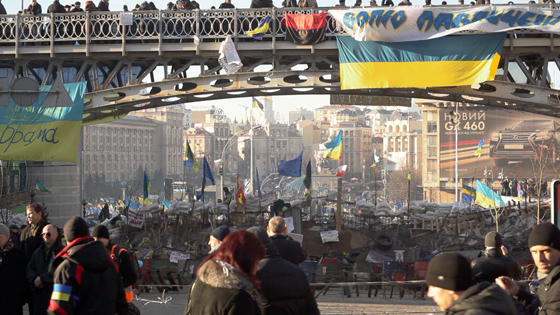 Lisa Babenko, frame from the video “Maidan: Lost Revolution”, 2014, Courtesy of the Artist
Moreover, the discourse of modern art on the Maidan and War in Ukraine gradually turned into a monolithic, patriotic and exported resessentiment . It turns out that in the endless discussion of the truly ugly figure of Yanukovych or in the patterned branding of the imperial and militaristic figure of Putin, which are already devoted to dozens of art projects, we lost the possibility of criticism of both our own mistakes and the mistakes of the new Ukrainian authorities formed from the former opposition. And we have lost the possibility of this criticism in art. Any attempt to go beyond the tough binary “either you with the imperial propaganda of Russia, or you with the Ukrainian national-patriotic propaganda” causes one indignation and duty-consumption of the author of criticism of collaboration with the Kremlin. This leads to the fact that we, “plunging”, in turn, into one or another propaganda, we do not see the rhizomatic root of the Ukrainian problem, equivalent to both the colonial aggression of Russia and the local oligarchic power of the Yanukovych circle, which remained after the Maidan, and gaining momentum of the ultra -right, unusual for the east of the country.
In fact, the festival’s discussion platform showed how difficult it is to speak with each other not to Russian artists or curators with Ukrainian, but to the Ukrainian participants themselves, despite the fact that we are all on one side of ideological barricades about the Kremlin. This conclusion is inconvenient for us that Ukraine is split into the camps of ideological antagonisms, which we have no right to suppress, no matter how rosy we would like to represent the Maidan and its results in the West. So with the main definition of this war, including as a civilian, a demonstrative dilemma is obtained. From a patriotic point of view, it is generally accepted that this war is taking place exclusively with the external aggressor (Russia), while the armed residents of the East (separatists), in addition to really camouflaged soldiers with Russian passports, for some reason, for some reason, have automatically ceased to be considered citizens of Ukraine.
Naturally, the main problem is not in the artists whom in any case I cordially support for the same patriotic reasons, but in the artistic system, which is subordinating to the political mainstream, functioning according to the mentioned binary logic “or-or” in the liberal circles of both Ukraine and Russia. Therefore, what is happening, or rather, is not prolonged today in Ukrainian art-this is the problem of the entire socio-political space as a whole. In this connection, a new question arose following the results of the festival: is another way for Ukrainian artists, except for the patriotic discourse about the Ukrainian situation and the complaints arising from it regarding the omnipotence of Russian propaganda, which, at the same time, as an absolute evil from fantastic Hollywood blockbusters - the more you shoot at it, the stronger it becomes more? And if the path is possible, then what does this Nietzschean and at the same time unifying Ukraine “on the other side” of both Russian and Ukrainian propaganda that unite at the current point in time?
Putin as the main Ukrainian "anti -fascist"
Previously, of course, we need to understand another “transition” taken into the title of this part, where, alas, we move in a circle of the same binary frames, but from the tragedy to the farce and vice versa.
As the editor of the journal of social criticism of Commons and the teacher of the Department of Sociology of the Kiev-Mogilyansk Academy Vladimir Ishchenko, “The participation of the extreme right in the Maidan is difficult, and it should be discussed very carefully. And, unfortunately, polar and equally inadequate positions are popular: “There were no fascists” or “Maidan is a fascist coup”. Both of these positions are incorrect. ” The orientalist image of Ukraine is either the anti -fascist groups of Donbass, fighting against the Kiev “junta”, or it is a democratic opposition, third of the Asian tyrant, is just as irrelevant in relation to such an inaccessible, post -Soviet and post -slope reality of Ukraine .
In connection with the above quotes, it can be assumed that if the extremely right and did not prevail numerically among the protesters on the Maidan, then it does not make any common sense, except for damage-patriotic, to completely hide their role in the outcome of the revolution. “It is impossible to deny that these are xenophobic and anti -democratic forces. Their activists took part in racist attacks, beatings of left -wing and trade union activists. They cannot be maintained with any progressive position ” , and even more so not to notice a politically engaged to a Ukrainian artist or artist (see, for example, software documents in“ Freedom ” ). However, in conditions when the concept of “fascism”, as well as “anti -fascism”, is discredited by both warring propaganda, to use these concepts, except in quotation marks, today is also impossible, although this does not cancel the very need for their critical use. If you follow Ishchenko’s logic, the ultra -right parties and organizations today gained great respect and fame as the “heroes of the revolution”, which, in turn, becomes especially noticeable in neighboring Poland. The reproaches are that regional support for nationalist organizations in Ukraine is completely scanty, are also not based on sociological data based on the study of Ukrainian protests .
It is interesting that the question of this, which was relevant at the festival, makes sense to bring here to a more complete explanation of the situation: why, in this case, “freedom” could not convert its visibility on the Maidan into electoral results? Indeed, the mentioned nationalist parties and organizations during extraordinary elections to the Ukrainian parliament in October this year were only held in majority districts (the election of individual party representatives) and did not get only one percentage of the percentage to the passing barrier that allows them to parliament on party lists. The answer nevertheless will be very prosaic and only confirming the rhizomatic structure of the general Ukrainian problem mentioned at first. Probably, these results turned out to be such because the Poroshenko party competing with the “freedom” and “right sector” of the Revolution party and other famous persons of the revolution have in their ranks the oligarchic elite coated crisis, and for us it is not a secret that for complete electoral success in “big politics”, exactly the same “big” money is needed. At the same time, local activists also need a stable and, most importantly, stable participation in protest, which not to occupy the aforementioned nationalist organizations. In addition, the electoral results are only one of the measurements of the influence of the ultra -right in the post -Maidan Ukrainian society, but the Ukrainian intelligentsia should also think about the following: what is their influence on the dominant social discourse? On the media? To law enforcement agencies? On the field of education? On single -mandate regional districts?
Another point related to this topic can be expressed fluently on the example of an interview with the famous Ukrainian writer Yuri Andrukhovich , which clearly shows the discriminatory and socio-radio attitude of the right-capacity part of the Ukrainian society to the Donbass and other historically Russian-language territories of Ukraine, which developed long before the 2014 Maidan and broke out during the revolution. On the propaganda of the separation of the country by Ukrainian public intellectuals, which in this way practice internal orientalism, there is a useful article by historian Andrei Portnov .
In a psychoanalytic sense, giving always a desperate merry of any painful topic, Ukraine continues to work on the logic of the desire of its big other, thinking more about it than even his own, albeit nominally opposition, oligarchs now adopt in the eyes of the relay of Yanukovych Feudal Politics Relay, Kyiv, Kharkov and Odessa regions). При подобных эмансипативных рывках, которые позволила себе украинская революция, эта логика становится только еще более перверсивной и цепкой, демонстрируя, насколько ультраправый, имперско-колониальный режим Путина и украинские ультраправые, переживающие вновь свою постколониальную травму (Российская империя и СССР), нужны друг другу. Получается, чем более легитимными среди населения Украины будут националисты, тем легче будет российской пропаганде продолжать манипулировать сознанием своих зрителей, уверяя их тем самым, что она — это меньшее зло, ведь единственной альтернативой, равно как и внешней угрозой, блокбастерски раздутой при этом до невероятных размеров, является украинская «Свобода» .
Грамшианская задача
Постколониальное положение Украины (Западная Украина) и ее болезненные социальные ощущения по этому поводу, к которым мы подошли, — особая тема на фестивале, по праву интересующая, в отличие от России, не только правую общественность Польши, но и ее леволиберальных кураторов, историков и журналистов. Однако «возвращение к национальному государству — это утопия» , как считает в последнее время популярный историк Йельского университета Тимоти Снайдер, специализирующийся на постколониальном прочтении истории Украины. Интересно было разобрать этот спорный момент на фестивале: ведь исторически Украине в ее государственных границах, сохранившихся до весны 2014 года, не случилось стать сплоченным национальным государством, и 20 лет независимости тут не сыграли никакой решительной роли. Во многом именно поэтому Майдан был очередной народной попыткой обрести наконец желаемое коллективное тело нации, выражая попутно все то, что для западной части страны касается колониализма Российской империи и «внутренней колонизации» СССР, если руководствоваться определением самого Снайдера. Однако чем оборачивается эта постколониальная травматичность (уйти от которой можно, только полностью сменив курс в сторону объединяющей всех социальной революции) для другой части страны, которая не разделяет, по глубокому авторскому убеждению, основанному на документальных съемках в восточных регионах Украины , ничего из вышеперечисленного?
Насаждаемая десоветизация украинского общества, проводимая активистами партии «Свобода», выражается, кроме прочего, в желании полной ликвидации окружающего (пост)советского культурного кода. К примеру, в течение этой осени массово прошел снос скульптурных памятников Ленину, Артему и тому подобным фигурам советской истории в Харьковской , Днепропетровской и некоторых других областях Востока. Интересно, что как куратор документальной и видеопрограммы я показала в течение фестиваля видео украинского документалиста Кати Горностай о разрушении в разгар революции ультраправыми сторонниками Майдана памятника Ленину. Трогательная сцена оплакивания пожилым мужчиной своего прошлого, с которым он связывал этот памятник, более чем убедительно свидетельствует о неправомочности подобной культурной политики, которая теперь является насильственной изнанкой постколониальной травмы некоторых регионов страны.
Тем не менее получается, что перечить десоветизации Востока нам пока так же трудно, как и художественной цензуре в Украине. Уже по окончании фестиваля случилось еще одно неприятное событие, позволяющее сделать такой вывод. Антифашистская, как ее описывают сами кураторы, выставка «Украинский зигафолк» была закрыта в одной из киевских галерей на Подоле. Как отмечено позже в интервью левому активисту и журналисту Андрею Мовчану, «концепция “Зигафолка” — про очевидные вещи в нашем обществе, которые для большинства из украинского художественного сообщества остаются неисследованными: патриотизм, чернозем, “зов крови”. Но вышло так, что культурная среда отреагировала на наш проект цензурой. <…> Например, 14 октября в центре Киева проходили массовые ультраправые марши, но никто не видит в этом проблемы. Зиги, ксенофобские высказывания, речи Фарион… всем все равно. Неужели не очевидно, что зацикленность на “смерти врагам” контрпродуктивна?»
Более того, как верно замечает по поводу сегодняшнего украинско-российского положения историк и художник Илья Будрайтскис: «Большой стиль Холодной войны опережает непосредственное вооруженное столкновение для того, чтобы утвердить саму логику боя в качестве постоянного состояния общества». Но ведь именно за ее пределы и должен сегодня стремиться выйти украинский художник, дабы не заниматься ее воспроизведением и потаканием ей, не так ли?
В предуведомлении к монографии Пьера Бурдьё «Политическая онтология Мартина Хайдеггера» автор предупреждает читателя: перед ним — вовсе не книга-разоблачение. Точно так же хотелось бы, чтобы и данная статья воспринималась не как попытка разоблачения чего-то или кого-то, а лишь как попытка предложения интеллектуального сомнения как основного инструмента мысли художника, к чему и призывает Будрайтскис. Увы, это сомнение не должно отменяться патриотизмом даже в условиях войны. Независимая культурная гегемония органических интеллектуалов в условиях правого поворота и очередной смены олигархических элит — это, если угодно, и есть сегодняшний грамшианский вызов современному искусству и политике Украины. Услышать этот вызов и принять его и означает выйти «по ту сторону» пропаганды обеих враждующих стран. В свою очередь, именно этот выход, который точно так же подлежит рефлексивной проверке сомнением, может привести нас к социальной революции, то есть революции per se .
Лиза Бабенко — культуролог, куратор, видеодокументалист, публицист журнала социальной критики Commons . Живет в Киеве.