
Translated material
The blockade through the eyes of Leningraders
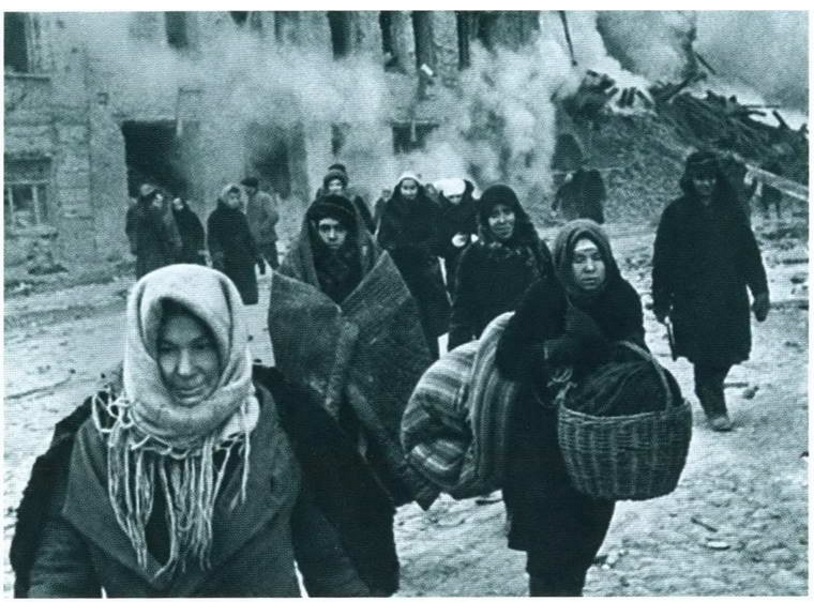
On November 13, another event was held in the I. S. Turgenev library named after I. S. Turgenev from the cycle “Public Lectures Polit.ru”. This time it was again dedicated to the book, which included in the short list of the Enlightener Prize of this year. The doctor of historical sciences, professor of the European University in St. Petersburg and the leading researcher at the St. Petersburg Institute of History of the Russian Academy of Sciences Sergey Viktorovich Yarov spoke about his book. His book is called "The daily life of the besieged Leningrad."
Earlier, Sergei Yarov has already written one book dedicated to the blockade of Leningrad - “Blocade Ethics”. Both books were created on the material of evidence of the inhabitants of the besieged Leningrad: diaries, letters, memories. As Sergey Yarov admitted, working with these archival materials turned out to be psychologically very hard. The historian cannot distractly perceive the terrible evidence of the life of the besieged city, as he perceives the events of past centuries. Therefore, both books tried to write as quickly as possible.
The first book of Sergei Yarov is devoted to how they developed, modified and worked ethical standards in the blockade situation. How they were supported in society and how they were violated, as well as how people reacted to these violations. What were the relationship between a person in the family circle, with friends, with colleagues, with strangers.
Sergey Yarov devoted the second book to the household side of the life of Leningrad during the blockade. He told the listeners that the description of everyday life will become a psychologically more study of ideas about morality in Leningrad as a researcher. But this hope did not materialize. On the contrary, if in the study of blockade ethics, he could still find individual bright moments against the general background of the inhuman conditions of the blockade, then evidence of everyday life turned out to be terrible and did not allow him to remain calm.
In the preface, the author says: “There is a common and classical description of the heroism and stamina of people. They do not complain, support those who have fallen in spirit, patiently endure difficulties, believe in the best future. In the most difficult moments, they are friendly, they think primarily about the neighbor, are ready to give everything to help him. When we see the terrible paintings of Leningraders dying in the torment, we understand that we need other assessments of what they have done. This book is about the feat, but the reader will not find the usual pathos words here. They are not needed, they are superfluous. Everyone did their own business, but in unity with others created that insurmountable wall that fenced the city from falling into the abyss. These people did not choose their fate, but when their death hour came, many of them met him with dignity. ”
The first part of the book is called "City". It talks about how the blockade ring around Leningrad closed, how the city streets looked during the blockade, what happened with city transport and lighting. The theme of posters and the work of radio burns, street patrols and gardens in parks, the condition of the houses, the provision of citizens with electricity, water and firewood, city shops and canteens, trade and exchange in the markets - all this is described in the first part.
It is also described about how subbotniks were organized to clean the city in March and April 1942, when a large number of corpses on the streets remaining after the most heavy blockade winter posed a threat to the occurrence of the epidemic. Since mid -December 1941, the dependents were obliged to work on clearing eight hours a day for free, such measures, of course, were ineffective. Excessed people could not clean the city. In February - March 1942, two subbotniks were held, for which volunteers called on, but there were too few of them. “On March 25, the game in“ Voluntary Subbotniks ”stopped,” writes Sergey Yarov. - It was not up to decency - everything needed to be done, as often happened in any campaigns, in an extraordinary hurry, in 12 days, regardless of the victims. Men from 15 to 60 years old and women from 15 to 55 years old were required to engage in cleaning. Those who worked at stopped enterprises were supposed to work 8 hours a day, on the current - at least 2 hours a day. Children and housewives pledged to work 6 hours a day. Special books were issued that noted the time of work, which evading it were delayed by patrols. There were also threats to deprive of cards violators. Each enterprise or institution was allocated for cleaning, as a rule, nearby territories, sometimes even neighboring streets. ”
In the second part - “at the threshold of death” - the descriptions of hunger left by the blockade. It talks about the psychological state of a starving person and the manifestations of the physiological consequences of hunger. The same part contains a story about bombing, shelling and their victims, the state of bomb shelters, and the behavior of people during air anxiety. A separate chapter is devoted to crime in blockade Leningrad. The last chapter of this part, which is called “Death” tells about the statistics of mortality, the causes of death, the fate of the bodies of the deceased, and the organization of burials.
The last part is called "people." In it, the reader will find descriptions of the appearance of the city’s inhabitants, the story of how the evacuation took place, how the card supply system was arranged and what were the norms for their issuance at different times of the blockade. The chapter "Food" describes that they ate Leningraders, how food surrogates were made. The reader learns what the duranda is - the cake that remained after the squeezing of the vegetable oil from the seeds, and what is the boat - the lower green leaves remaining after removing the cabbage. An impressive document is a kind of “table book”, a collection of recipes, which is attached to the memoirs 3. Ignatovich “Essays on the blockade of Leningrad” stored in the manuscript department of the Russian National Library. Here are just two recipes from there:
“Potato casserole
Rinse the husk from potatoes (sometimes it is possible to purchase it in the market), put in a pan, pour a third part of the water, cook until soft, then thoroughly trap, if there is salt, salt. Bake the resulting mass in a hot pan. For potato stew, add a triple amount of water to the interpreted mass. After it is better to scatter again, if there is enough fuel.
Leather belts
It is better to take not stained belts. Pour them with water in the evening (first cut the belts in small pieces and rinse) and boil in the same water, preferably at least 2-3 hours, if there is fuel. After boiling, season with nettles, swan, widf, wet or other herbs. Good to add a little vinegar. In winter, season with dry grass or any cereal. ”
Interest in the blockade of Leningrad, historians are now not declining. On the contrary, only in our days work appeared that revealing many sulfur life of the besieged city. There are many works of foreign scientists on this topic. A striking example of great attention that modern readers experience for the history of Leningrad is the publishing fate of the diary of the Leningrad schoolgirl Lena Mukhina. It was published in 2011, largely thanks to the efforts of Sergei Yarov, and the publishers doubted the prospects of the book. Over the past moment, the diary has been translated into ten languages from that moment and published in a number of countries.
Among the lecture asked after the lecture, the question was also the question of why talk about the horrors of the blockade today. Sergei Yarov replied that the main goal of his work and both books about the blockade was to show the cruelty and immorality of war. You can agree with this. Indeed, there are already many books showing the inhumanity of war. And documentary, containing convincing evidence, and artistic, created by the most talented authors. But the news of our days show that the need for such books does not disappear.