
Translated material
"Territory of Freedom"
The artists are "rigging" in the Hermitage. Girls in pantyhose in a recreation center. The capture of the empty house by order of Alexander Sergeyevich Pushkin. Three anniversaries of the unofficial fine art of Leningrad.
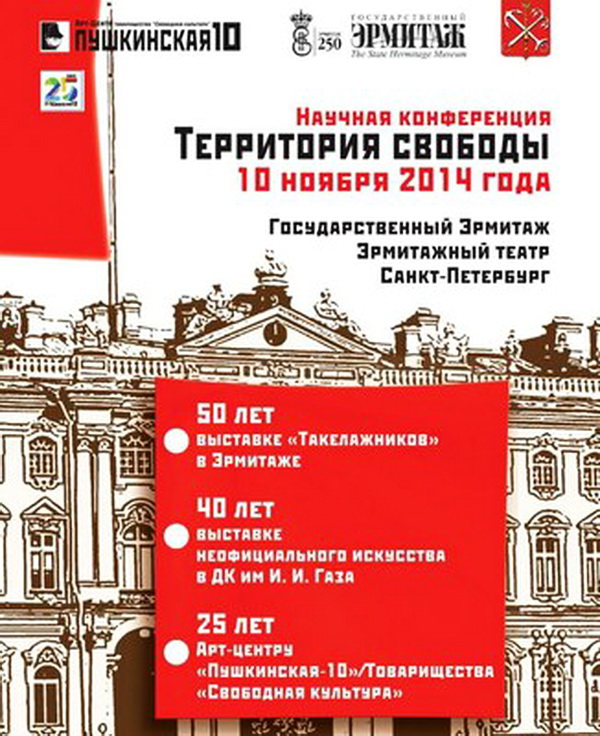
Viktor Rezunkov: On November 10, in the Hermitage, more precisely, a huge number of elderly impressive men and artists gathered in the Hermitage Theater for the first time in the history of St. Petersburg. Here was the scientific conference “Territory of Freedom”, dedicated to three anniversaries at once: the 50th anniversary of the “Exhibition of Tugs” in the Gallery of Rastrelli Hermitage, the 40th anniversary of the exhibition of unofficial art in the recreation center named after I. I. Gas and the 25th anniversary of the creation of the art center “Pushkinskaya, 10” (partnerships “Free Culture”). Art-publicity recognizes these events with three important milestones in the statement of non-conformist, free art in Soviet Leningrad and post-perestroika St. Petersburg.
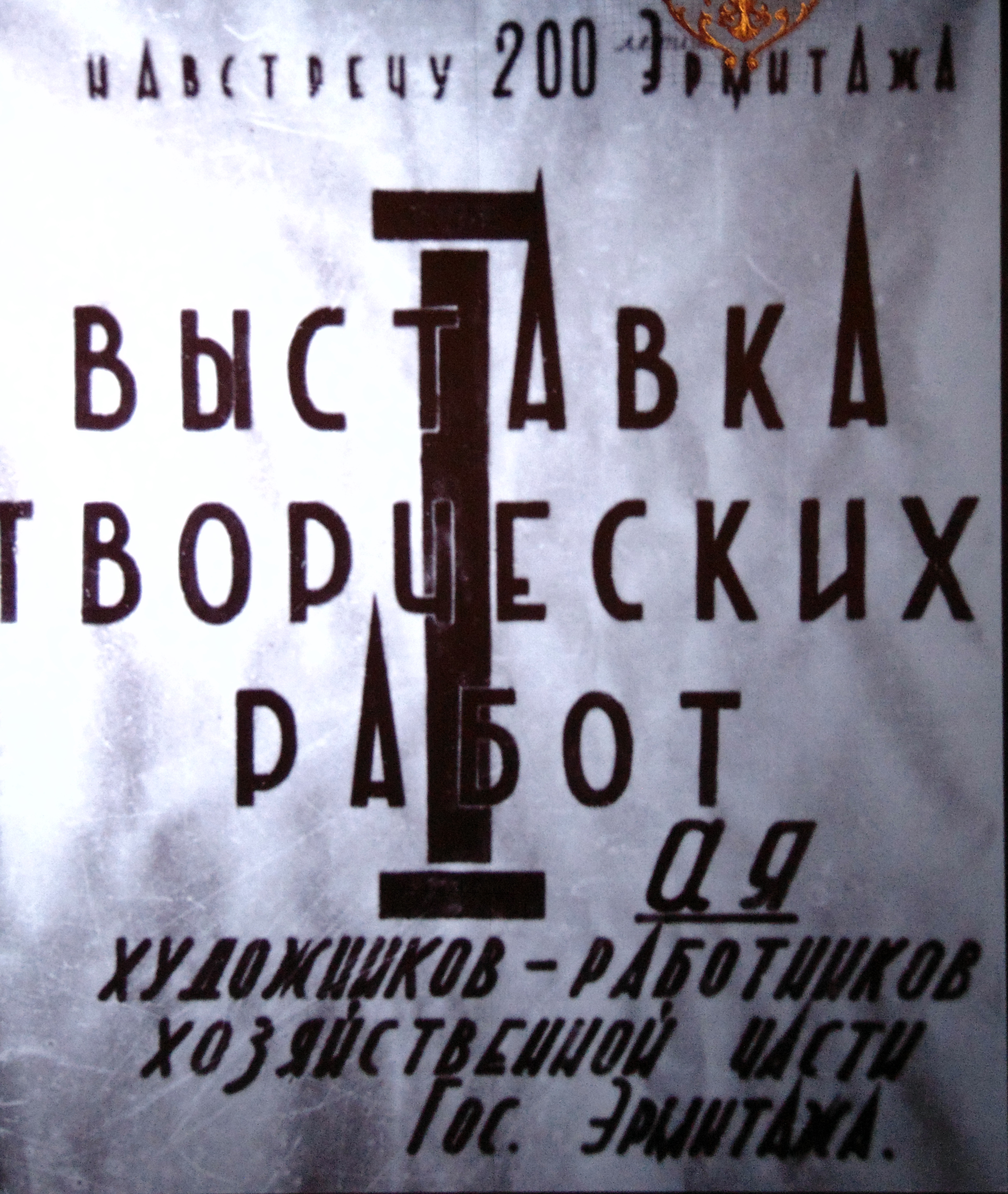
The legendary exhibition “Artists-Workers of the Economic Part of the Hermitage”, which later called the “Exhibition of Tuperiazhnikov”, took place on March 31, 1964. In the Gallery of Rastrelli Hermitage, the works of five “Tuzhnikov” were presented: Mikhail Shemyakin, Oleg Lyagachev, Vladimir Ovchinnikov, Valery Kravchenko and the poet Vladimir Ufland. The exhibition caused panic in the party leadership of Leningrad. The very next day, on April 1, numerous black “Volga” of party bonz stood around the Hermitage, and repression began against “artists-workers of the economic part of the Hermitage”. Mikhail Shemyakin recalls:
The legendary exhibition “Artists-Workers of the Economic Part of the Hermitage” took place on March 31, 1964.

Mikhail Shemyakin: Just on the second day after the work was taken out, the film was made about the exhibition and sent to the Minister of Culture Furtseva. Our exhibition was seen as some extraordinary event. But there was nothing criminal on it. I put illustrations to Hoffmann, Dostoevsky and Dickens, several still lifes and portraits, Oleg Lyagachev also showed several picturesque works, and Vladimir Ufland, the poet, put up funny tiny drawings for his poetry. Valery Kravchenko, who at that time studied at the Theater Institute, had a weak attitude towards visual arts, he also painted something. And Volodya Ovchinnikov exposed a huge canvas, which was called the "jazz orchestra": it depicted several dozen saxophonists in purple jackets, and they all held bright yellow saxophones, but not with their hands, but with the sleeves of purple jackets. The work was taken out, and on the third day, Mikhail Artamonov, who served as director of the Hermitage (huge political post) was dismissed with a bang. His chair was taken by Boris Piotrovsky, also an archaeologist. We, the participants of the exhibition, were called by the director of the economic part of the Hermitage, a certain Logunov, a party worker, who was fired from the ballet school for harassing to young ballerina; He came to the Hermitage and fiercely hated us all. He called us to the office and suggested immediately writing statements about his own free will. We refused. Then they just decided to expel us. We, artists, called and sent to the most dirty work in the morning. In the morning, when we lined up, Olga Bogdanova, our boss, ordered: “Lyagachev, Shemyakin - in the trash! And the rest of the boys will go to open pictures from France! ” You swallow a bitter tear and go in rubber boots to load my slide in the city trash or row snow ...
Viktor Rezunkov: Another participant in the “Thamlazhnikov exhibition”, artist Vladimir Ovchinnikov today is even to some extent by the KGB, but not at all for the repressions that this organization answered artists.
Vladimir Ovchinnikov: I think that this exhibition did not have a noticeable influence directly on our work. But, of course, the measures taken towards us put up new models of our fate, which I did not know about. And I, perhaps, is even grateful for this. We usually do not talk about this: when we were thrown out of our beloved museum, we were in a depressive state. We really loved (and now love) Hermitage really and sincerely loved (and now we love). And, obvious from some complete hopelessness, hopelessness, extravagance, we, together with Mishka Shemyakin, decided ... to enter the seminary! This, thank God, did not work. In my life, there is the only point for which I am sincerely grateful to the KGB: on the one hand, the KGB threw us out of the Hermitage, but, on the other, did not let us into the seminary. He did it very well!
Then Misha Shemyakin met with a well-known man at that time, rector of the Pskov-Pechersky monastery by Archimandrite Alipius (Voronov). He was an artist by education. Alipius invited us to work to himself, and it was very cool, surprising by the way, because before that I had never dealt with an icon. There you need to work in a hard canon, and this is a good school for the artist. Yes, they also paid for it! One summer we worked with Misha, then he left somewhere, and Alipius invited me to the next summer. I worked for two summers. And I am grateful to the KGB for one more thing: I met very interesting people there, and Alipius was a very interesting person, but most importantly, this period of life gave me a powerful anti -lrical vaccine, which, in my opinion, only works stronger.
Viktor Rezunkov: In order to historical accuracy, it should be noted that much earlier than the “Tuelzhnikov Exhibition” in the Hermitage, and even much earlier than the scandalously known exhibition of Mikhail Shemyakin in the editorial office of Zvezda magazine in Leningrad was arranged by apartment exhibitions by another group of artists, which was called the conditional name “Group of Alexander Arefiev” . It arose in Leningrad back in 1949, when in Moscow, according to the memoirs of contemporaries, there were no such groups at all. So the St. Petersburg artists (and they talked about this in the Hermitage Theater) have every reason to add the fourth to three anniversaries - 65 years from the date of the first unofficial group of artists in Leningrad. Says Doctor of Art History Dmitry Seversyukhin:
The circle of artists who were part of the Arefiev Group obviously abandoned any official advance. They basically did not come in contact with the authorities.
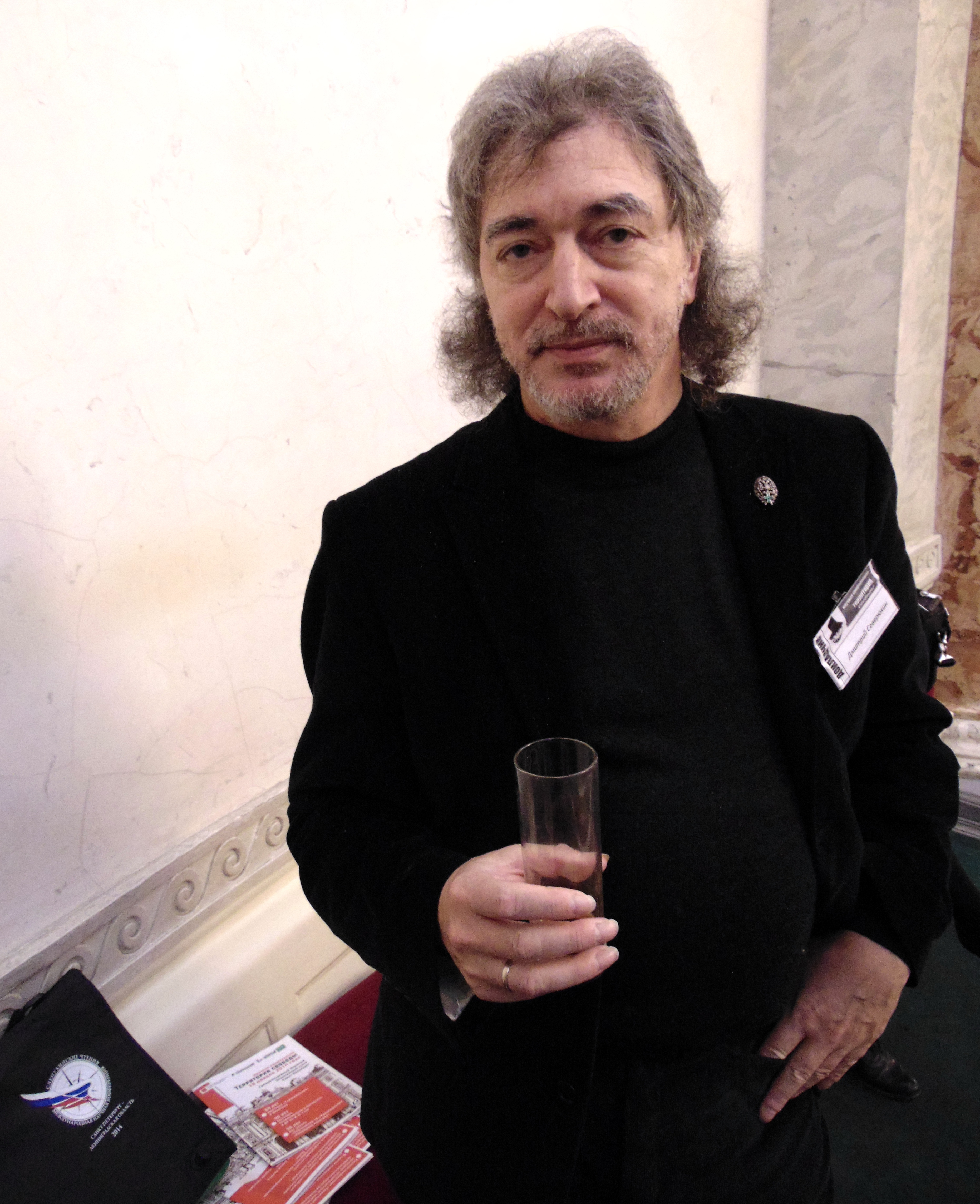
Dmitry Seversyukhin : A few years before the exhibition “Tuzelzhnikov” in the Hermitage in Leningrad, there were several very interesting art groups. First of all, this, of course, is the “group of Arefiev”, as it is now called, the “Arefievsky circle”. This group, today a little legendarized, included wonderful artists, former students of the secondary art school (SCC): Alexander Arefiev, Vladimir Gromov, Vladimir Shagin, Sholom Schwartz and others. They gathered at Turgenev Square (now Pokrovskaya Square), in the apartment of the wonderful poet Alik Mandelstam, who died very early: in 1962. It was an intellectual and, apparently, he possessed such a “magic” that united artists. These were “blockade” boys, probably low-cultural, if we understand the culture of the culture, but highly spiritual and cultural. It is amazing how these adolescents who are isolated at that time from Western art (and they did not have the opportunity to see the paintings of Matisse, Picasso) magically erudited. In their visual works there is amazing harmony, talent, as in the stunning poetry of Alik Mandelstam. Such a group was, she left her mark. And then, already in the seventies, its members joined non -conformism.
Viktor Rezunkov: Another group of artists, who left a trace in the underground culture of Leningrad in those years, is the St. Petersburg group. Its name itself, by those Soviet times, was also a challenge.
Dmitry Seversyukhin: In parallel, regardless of the “Arefiev Group”, the group of St. Petersburg existed in Leningrad. Its leader was Mikhail Shemyakin. It was a different direction in painting. If the “Arefievites” had a roll in the direction of expression, towards French painting, which they did not know, but with which they in some strange way coincided, then Mikhail Shemyakin was more focused on the achievements of the old Petersburg culture: this is the “world of art” and the eighteenth century, as mentioned in the manifesto of the St. Petersburg group, replaced in a machine. These were also unusually bright artists who acted on their own. But it is very curious that the circle of artists who were part of the “Group of Arefiev” obviously abandoned all official advancement. These were people who put the cross on his career. They basically did not come in contact with the authorities. The poet Alik Mandelstam, for example, categorically refused to print his works in official publications. This is an example of selfless service to art.
The special character of the Leningrad unofficial culture is manifested in a positive aspiration, in the constant overcoming of any manifestations of negativity, nihilism and blind rebellion.
Victor Rezunkov: In Soviet times, many radical manifestos were written by unofficial creative groups. But, perhaps, a single manifesto of the unofficial Leningrad (and perhaps Russian) free art can be called the poet Viktor Krivulin, printed in 1977 in the Samizdat magazine 37. This manifesto, in particular, says: “Hundreds of artists, poets, thinkers seek and gain the right to free creativity, a new artistic and philosophical language adequate to the modern state of man, and the expression of a new creative experience. These people are alien to socialist realism. But they do not confront him. The special character of the Leningrad unofficial culture is manifested precisely in a positive aspiration, in the constant overcoming of any manifestations of negativity, nihilism and blind rebellion. ”
Another milestone, another anniversary, celebrated today in St. Petersburg is the 40th anniversary of the exhibition of unofficial art in the House of Culture named after I.I. Gazaz.
This exhibition took place in Leningrad a few months after the scandalously known, so -called "bulldozer exhibition" in Moscow, on the Belyaevsky field. By the way, one of the most active organizers and participants in the Bulldozer Exhibition were two Leningrad artist already known by that time - Evgeny Rukhin and Yuri Zhakhkhki. As a result of the acceleration of the “bulldozer exhibition”, a pregnant American journalist suffered, which, according to legend, led to the adoption by the US Congress of the famous amendment of Jackson-Venik. One way or another, but the Soviet authorities decided to reduce the intensity of passions, and 52 artists already took part in the exhibition in the DC of Gaza, which opened on December 22, 1974 in Leningrad. The event of this scale took place for the first time, so there is nothing surprising in the hype that rose around this house of culture: to the opening of the exhibition near it, despite the brutal frost, a giant queue grew. The artist Anatoly Basin recalls:
Anatoly Basin: A multi -kilometer line ... minus thirty ... before that, however, there was a “world revolution”: female tights appeared, and the girls freezed their wonderful knees in the queue. The boys hurried to save the girls. The multi -kilometer queue was divided into parts. People were let out for exactly twenty minutes: this means six seconds for one picture. After the girls warmed up, the team was heard along the room: “Artists - to the wall! Spectators - in jail! ” It was meant that artists should go to the wall so as not to interfere with visitors to go to the exit from the recreation center.
Pushkin was tired of listening to this, he scolded us with bad words and, pointing to the neighboring house, said: “Go and take it!”. We went and took.
Viktor Rezunkov: Finally, the third milestone in the statement of non-conformist, free art in Leningrad and post-perestroika St. Petersburg: an event whose 25th anniversary will be celebrated from November 26 until the very new year separately in the Russian Museum and Pushkinskaya, 10th a century ago, a group of artists captured an empty building on Pushkinskaya Street and created an art-surge there. Says the President of the Free Culture partnership, artist Julius Rybakov:
Julius Rybakov: In the late 80s, our “partnership of experimental art” (TEII) already existed. By the end of the 80s, despite the fact that we managed to make many interesting exhibitions of left-wing artists, we had no status. The Soviet government did not recognize the members of our partnership by artists. And we needed a roof over our heads, the opportunity to constantly exhibit, and most importantly, the opportunity to work, because, unlike members from the Union of Artists, our masters did not have their own creative workshops. To solve this problem, as the legend says, helped us ... Alexander Sergeyevich Pushkin. The legend is this: three artists were sitting on a bench at the monument to Pushkin on Pushkinskaya Street, drank wine and bitterly complained about their fate, that they had nowhere to exhibit or create. Alexander Sergeyevich was tired of listening to this, he turned, scolded us with bad words and, pointing to the neighboring house, said: “Go and take it!”. We went and took.
An empty huge house that was resettled under major repairs. As it turned out later, this house was built by my great -grandfather and from the very beginning was intended under the art school. In the beginning there was such a school named after Cyril and Methodius. At the beginning of the twentieth century, the editorial offices of various silver eyelid magazines were located there: Alkonost, Sirin. There lived a wonderful Russian actress Polina Strepetova in this house. The best poets of those times wandered along the stairs of this house. And when we learned about this, when we realized what house we got on the advice of Alexander Sergeyevich, we decided that there was no other task for us, except to restore the status of an art center that was already at this house. Which we did. This took seven years of the war with the city authorities who did not want to leave us there. They were very offended by the self -seizure of this house, and the house was captured instantly, because the Leningrad creative underground: poets, musicians, artists - there were quite a lot of them, and they all had no status, or place for work, or place where they could demonstrate the fruits of their work.
Victor Rezunkov: The legendary art-whale “Pushkinskaya, 10” immediately subjected to attacks by the authorities. The artists turned off the light and water. What is the only attempt by the authorities to seize the house for housing for television workers! In 1995, such a project was proposed by the director of the Leningrad Directorate of the VGTRK Bella Kurkov to mayor Anatoly Sobchak, and he supported the project. But all wasted. It was no longer possible to drive out artists from Pushkinskaya.
Julius Rybakov: As a result, we instantly captured all 16,000 square meters of the house. And there began a violent, active creative life, which, as it turned out, saved our project, because despite the fact that for a long time we had neither legal status nor money for repairing a house, that creative activity, then the filling of the city that arose as a result, forced the city authorities to reckon with us. And we connected to the protection of our project the Ministry of Culture, people from the government of Yegor Gaidar, world -class culture figures, they spoke for us. As a result, after the seven -year war with us, the city authorities were forced to leave us a significant part of the house in which today more than forty art workshops, the Museum of Non -Conformist art, and eight art galleries are located. And here creative youth continuously works, who is looking for its own language and their own way in art.

The artists are "rigging" in the Hermitage. Girls in pantyhose in a recreation center. The capture of the empty house by order of Alexander Sergeyevich Pushkin. Three anniversaries of the unofficial fine art of Leningrad.