
Translated material
Hell of good intentions
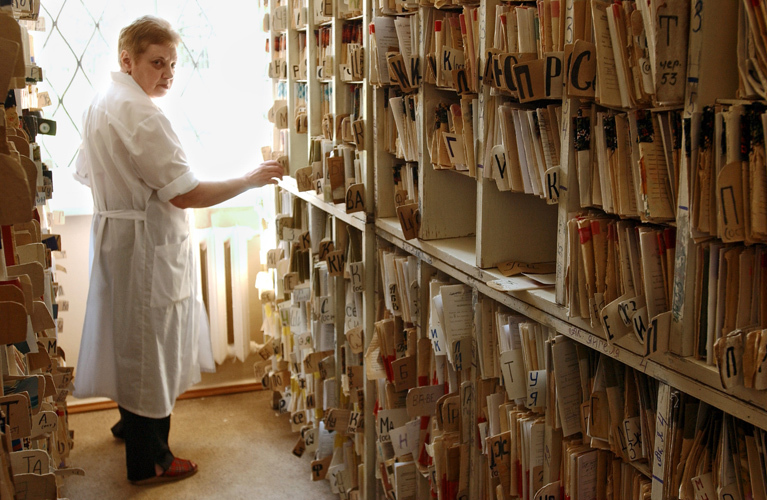
Anyone who curses the bloody regime, accusing it of the current deadly blow to the Moscow (yes, Russian) healthcare system, must first and honestly answer the question: whether it is like the existing system of free medicine.
This is all: a nurse screaming in the registry, a cleaning lady irrigating the gag-green floor with a gray stinking rag, an hour and a half or two hours (“Oh, how we quickly managed!”) The turn to the office, cold chairs along the wall (“And we all the tests managed to take it over a week!”-“Incredible!”), The “next” shout ...
... A tired doctor, immersed in pieces of paper, at best ask a couple of questions: he has six to eight minutes on you, and, to be honest, he does not care deeply, as your life will turn out. They scold him just for incorrectly filled.
If everything is bad and the hospital shines for you, it is immediately clear that without a couple of stools they will not even make an enema in a pocket nanny. An examination with all kinds of tutges will take two or three weeks (which, in general, is critical if the disease is difficult and rapid, during this period, for example, lung cancer can increase the stage). In the ward, there will be nine on six, and if everything is very bad and needed, for example, blood, then your relatives will grow old and lose their human appearance, begging from those from whom it can depend, the right to collect and convey this blood to you. And finally, if you, God forbid, will be painful ... It is worthy of a separate text , because otherwise, describing how much you and your loved ones will have to go through to anesthetize you, I will spend all the place reserved for the reform of the health system.
You must honestly answer your question: do you like the free medicine system or not.
Of course, there are rare exceptions in this gloomy picture: indifferent, talented, speaking several languages and fighting for the patient’s right for decent treatment without the suffering of a doctor. And even some ideologically different from the generally accepted system Russian hospitals. But we are talking about how mass free medicine works. That is why the disease in the minds of a post -Soviet person means physical suffering. To get sick - suffer. Since the Soviet era in the field of free medicine, in fact, little has changed: boorish, often incompetent and, in general, almost absent out an outpatient clinic and long, long, confused and unknown to anyone.
And now, to be honest to answer your question, whether you like it or not, it is unlikely that there will be active and voluntary supporters of humiliation and suffering. As a rule, people try to “get” to “their” doctor (he, as you know, also put him in a pocket). Those who have the opportunity (friends, medical knowledge and communications) may well maneuver in the confusing labyrinths of this very free medicine, and almost without risk to health. A certain number of humiliations in the intermediate stages, however, still cannot be avoided. But people, as you know, the second after rats at the speed of getting used to bad circumstances.
True, sometimes, rushing with the transfer to a sick relative past a huge, drowning in tropical plants and in the idleness of the separation of physiotherapy, you will shield your shoulders: these electrophoresis and kuf are almost like a television program “Morning Mail” - elements of a common post -Soviet nostalgia. Is it possible to imagine a normal free clinic without sleepy physiotherapy? The question “why do they take so much space, if they are empty” hangs unanswered. Or sometimes some active puppete will cry out: why was her friend, who gave birth to abroad, was discharged home the day after birth, and ours are already picking the third (fourth, fifth, and if the “cesarean”-10-12th) day? Or someone else will ask, for what such reason after appendicitis he was ordered to lie in the hospital for at least ten days, although he heard that in the whole progressive world they let go home tomorrow. We will not even go into details of hospitalization and a long (month and a half) “preventive” treatment of patients with chronic diabetes or osteochondrosis. Because again, anywhere in the world, no one lies for weeks and months in the current hospital in order to “eat and gain strength”, conduct an examination for weeks (occupying an expensive bed) is irresponsible. And to drag a palliative patient with the fourth stage of cancer and the fifth breathing stop in the intensive care unit , to torment him and hold him there and hold, hold, hold (without relatives and the opportunity to calmly and peacefully die), so as not to spoil the hospital statistics with this death, in fact, a crime.
All that the city government wants to do is perfectly and useful. But for this they took up the htonic fuse.
However, changing little on the surface, free medicine has changed a lot inside. The USSR ended a quarter of a century ago, and in the system of health care remaining from him, not sparing and not particularly counting, the state swelled and squeezed everything. Nobody state millions, of course, were first plundered. The rest went patching holes. It seems that no one in domestic medicine did not pay attention to ordinary doctors that qualifications need to be improved every day, that a doctor who does not know the English language and daily does not read special literature in this language that does not attend specialized practical conferences and symposia, who does not follow the latest developments in the pharmaceutical field, is not a doctor. On one intuition, even seasoned with a red diploma, you can’t do a brilliant medical career. Our medicine half a century ago was very, very necessary to change. But it interfered from somewhere in the confidence that she was the best in the world (apparently not least because it was free).
They stood on that. The healthcare system was worn by various innovations that most difficult it difficult for its life: for example, compulsory medical insurance, according to which the cost of medical services provided for some reason went to dozens, or even hundreds of times lower than their cost, which means that the insurance system itself lost all meaning. Indeed, in order for such a “curve” the system of insurance medicine to work, the state still should have poured uncountable millions into healthcare.
Or here are more quotas, the authorship of which is still not possible to establish, but they have invented this quantitatively and regionally limited right to be treated and cured under minister Zurabovo, and they could not master and bring to some really useful and understandable to doctors and patients. (Clear example: a quota for the treatment of an adult oncological patient in Russia is about 140,000 rubles. Anyone who has ever heard anything about cancer understands that he will be more expensive, not being treated in our country.)
However, neither quotas nor compulsory medical insurance qualitatively changed the system of work of domestic health care itself. As in a famous joke: the same problems, there are more writings. Early diagnostics remained for Russians with something from the field of science fiction, a bed in good clinics is still in short supply, doctors are also rude (they are not to blame, they have neither the strength nor time), they have to pay free tests and research, they have to pay (according to statistics, the patients did every fifth MRI in the country last year, the patients did at their own expense, For example). The drugs are completely confused with medicines: they are not included in the compulsory medical insurance system, before something was given to someone, but now, due to the reform, it is completely unclear whether it will continue to give something to someone and if it is, then to whom and what.
As a result, a system that needs reorganization as in the air is sluggish and died before our eyes. And in general, she died.
The last attempt to “modernize healthcare from above” was the mass and rather unsystematic purchase in free medical institutions (both outpatient and stationary departments) of high -tech devices for diagnosis and treatment. It was good. But who was already there and like a finger to the sky, he chose which hospital would get is unknown. As a result, MRI sometimes dusted in the maternity hospitals, and cuves for nursing premature babies - in surgery. Sometimes the devices hit the address, but no one knew how to use them in the field. And everyone did not care. Until it came to reporting. Then, upon ordering, doctors were sent to the nearest high -tech abroad to study. They studied as a usually amazing composition: the head physician with his wife and someone from the department, who later called to retell everything to his colleagues on his fingers.
You can build a million modern medical centers, but who will need them if there will be no one to work in them?
You can discuss the monstrous structure of our medicine as much as you like and in any way: from sardonic to apocalyptic. Another question is how to change the current situation (because you can’t change it, the system is about to collapse, it has already collapsed). No one here in “Our free medicine is the best free medicine in the world” has long believed. But you will not cease to be born, hurt, or, say, die from this? I would like, of course, that everything changes. But I would also like the changes not to be given to everyone who is inside the system: doctors, patients. The question is whether this is possible is rhetorical.
So far, no one has explained to anyone: the reduction in healthcare financing by the Ministry of Health by 30 percent and the capital by a third is, as they say, the “tuck chains” or two not related to each other, but at the same time visited their heads brilliant ideas? Be that as it may, the metropolitan authorities from the interview in an interview are diligently repeated: the reform that has begun is designed to make the existing free medical service system more effective. What do they mean? Judging by the open sources, nothing bad: atavisms such as the empty departments of physiotherapy are eliminated, the standards according to bed-days that a person conducts in the hospital after trifling operations will bring in accordance with world standards, large and strange, not requiring, in fact, the long-term stay of patients in the department of the department will attach to others, where the bumps are not enough. They will share the medicine of action, actively treating, and sympathy medicine, that is, social: the plans are the construction of almost three social hospitals, where they will be treated for free, rehabilitate, put in order the poorest. It was even rumored that one of these social hospitals would be transferred to specialized charitable foundations. But so far none of the funds have confirmed this information.
True, I want to note that to save, dress, feed, help urgently is one thing, and building a hospital and a management system and life in it is a completely different one. Therefore, the idea of managing a hospital of a BF is quite adverse. The capital reformers of the healthcare system are also planning a powerful support for palliative medicine, designed to save new modern and strong, updated hospitals from the need to keep the dying on their balance. These incurable patients will now not occupy beds intended for those who need urgent treatment. They also promise to significantly increase the outline and, as is customary everywhere in the world, most of the patients to treat on an outpatient basis (that is, without hospitalization), laying into the hospital only with extreme necessity (surgery), and then immediately, as the need to disappear, prescribe and treat (rehabilitate) on an outpatient basis.
Doctors will confirm their qualifications according to international standards, nurses (in the united departments!) Will finally become, as it should, two or three per doctor, and not one or two, as it is now. Moreover, all this is planned to be done simultaneously with the full and final transition of medicine to an updated compulsory medical insurance system. That is, the state will no longer stealthily feed hospitals, giving blindly effective and ineffective clinics, but simply stop giving everyone. In return this, the tariffs of the compulsory medical insurance will allegedly, and insurance medicine, having finally managed to manifest itself to the fullest, as it will earn: quickly, deftly, efficiently.
In addition, the upcoming reform promises to eliminate the dirty, empty, sniffed hospitals and clinics of the outskirts, placing the whole color of reason and technology to new modern (I want to add-beautiful and bright) clinical centers, where a full-fledged examination will occupy one or two days, and there will be no queues, doctors will stop sitting in papers, because the whole history of the disease will be electronic and record The doctor will be an assistant. Well and so on. The picture is idyllic.
“Everything is as always, soon there will be a complete ass. So far we can, we will treat. ”
Not only that: all that the city government wants to do is perfectly, correctly and useful. Reform, as I have already reported in this text, I have very much needed, and everyone understands this. Another question is that they took up such a htonic fuse for it that all those who are inside the system and close to it are scary: from everything that exists, there will be horns and legs, but when it grows up? According to the most modest calculations, the ambitious plan of the authorities to recover the healthcare system requires about five years. Where and how will people be treated in these five years? Or the system, swallowing the pain of the loss, is aware that only those who get sick in five years can normally treat, and these, current, even somehow themselves?
There are still questions: optimizing the hospital network and personnel composition, the reformers publicly declare that the salaries of doctors will not be reduced, they say, only the staffing is reduced. But any head physician (what is there, any boss) knows that the staff does not consist of people, but of bets. To bring a meager medical salary to at least some decent level, people pull three or four bets. Reducing bets, you deprive doctors and nurses of the opportunity to earn more or less humanly. So why not say directly: we are going to fire people. Let's figure out who is ineffective, and we will fire it (well, by offering retraining for justice). And then, including the mechanisms of internal regulation, the hospital itself is able to decide how, whom and why it is reduced. Let it hurt, but at least without lies.
One of the most sad moments is that the plans of grandiose reforms does not take into account a very important circumstance that makes our medicine an actually unpromising patient: you can build a million modern medical centers, but who will need them if there will be no one to work in them? In order for the Russian (o'key, metropolitan) healthcare today suddenly suddenly switched to a qualitatively different level, the entire higher and average medical staff had to be cooked 11 years ago. Accordingly, in order to, in 10-15 years in Moscow, for example, at least remotely similar to American or European scientific and clinical centers, medical institutions, it is necessary to talk with current schoolchildren and applicants. To give them the opportunity to study and internship abroad, to provide access to knowledge, to promise that, becoming doctors, they will be able to treat patients not in the “list of drugs permitted to the territory of the Russian Federation”, but the most new, the best, most advanced drugs and with the highest technologies ... Alas, everything is not so. And rallies, at which dismissed doctors with sad people with quiet voices report that soon they will have nothing to eat at all, are unlikely to serve as a good advertising of the profession. They won’t go to it, the best of the best and smartest of the smart ones is no longer going.
Well, the last. For some reason, the system did not agree on its good intentions with those whom they directly concern. (So it has already happened many times: the term “palliative” health careers tried without coordination with those who have been engaged in palliative help for many years, and it turned out that Palliative in Russian is additional beds in the resuscitation department. Or the only beds intended for the treatment of an orphans throughout the country, suddenly conveyed in the course of optimization to the conduct of it. the capital's clinic, where they were empty, while the patients in the regions were dying without receiving treatment.)
In decent societies, the reform of healthcare (and so closely related to the insurance reform) is discussed popularly, they vote in a referendum for it, it is the highest point in the public agreement of the authorities and voters. And when this reform begins to be implemented, they all more or less know what to expect from it, what results would be desirable and what problems may arise. Having asked one Moscow doctor to comment on what was happening, I received a grandiose SMS in response: “Everything is as always: all the gandons, there will soon be a complete ass. So far we can, we will treat. ”
This doctor, thank God, works in the federal clinic. Реформы в эти стены только рикошетят. В телефонном разговоре доктор пояснил дополнительно то, что и так было в общем-то понятно: те, кто и раньше лишний раз к услугам бесплатной медицины не прибегал, стараясь полечиться «у своих за денежку», сдать анализы платно, родить по контракту и т.д., никаких драматических перемен в своей жизни не почувствуют, просто отыщут платную клинику ближе к дому, по душе. Квалифицированные доктора, «попавшие вдруг под раздачу», тоже не останутся без работы: сеть платных клиник, как было сказано, растет. А к услугам неквалифицированных разве кто-то хочет прибегать? Хуже всего тем, для кого бесплатная больница со всем приятным или не очень набором услуг — единственный, безальтернативный вариант. На все время реализации благих намерений реформаторов их жизнь превратится в настоящий ад. В общем, если сможете не болеть, не рожать и не умирать до окончания реформы, потерпите. Потом должно быть полегче.
Почитайте также монолог врача-реаниматолога , который решил уехать из страны, записанный Светланой Рейтер