
Translated material
Man behind him
Who is he, Victor Zolotov, the new head of the National Guard?

As the head of the presidential guard in 2000-2013. Viktor Zolotov (on the right) was relentlessly followed by his boss. St. Petersburg, June 9, 2007. Photo: AP
60-year-old Viktor Vasilievich Zolotov is one of the most non-public Russian security forces. There are not many photographs on the Web, the data of the official biography of the stingle, and most of the people addressed to The New Times, refused to answer questions about Zolotov or agreed to speak on the conditions of complete anonymity. “Cruel, secretive, ready for anything to achieve the goal,” say some sources in the Ministry of Internal Affairs. “A good professional, smart, demanding of personnel, but does not give up its own; Wonderful, it always goes to meet visitors, ”his former subordinates say. “Not shocking, some deputy ministers have 200 square meters of rooms, and Zolotov did not rebuild, not it” (however, this does not prevent Zolotov from having as much as 9 depomes - more than other ranks at the top of the Ministry of Internal Affairs). “Incomplete, you can’t distinguish this in the crowd, a real gesnik. A devout, modest, loves dark glasses and black costumes, and dresses without a complaint, costumes could be more expensive; He drinks, but never gets drunk, swearing in moderation, like everyone else, ”says another employee of the ministry. All, however, converge in one thing: "Zolotov is infinitely devoted to his boss and will not betray him, no matter what happens."
Despite the fact that the resignation of Kolokoltsev was not officially announced at the time of delivery, the sources of The New Times in the Ministry of Internal Affairs are sure that the decision was made. “Everyone sorry for Kolokoltsev, he is a real policeman, knows the department like his five fingers,” one of the interlocutors of the magazine admits that Kolokoltsev had the tasks of the reform of the Ministry of Internal Affairs, the fight against corruption and crime, but “... today the realities have changed, we entered during political turbulence. The leadership of the country should be confident in the reaction of the security forces in the case of popular unrest or attempts to a coup. Golotov close to Putin is an ideal candidate. ”
The second reason for the possible appointment of Zolotov to the post of head of the Ministry of Internal Affairs is his stretched relationship with other security forces. “Zolotov on knives with Bortnikov ( the head of the FSB. -The New Times), and Putin needs to constantly keep the security forces in tension so that they quarrel among themselves, turn to the president as a referee and do not think of something against him,” says the interlocutor of the magazine from the law enforcement agency.
Who is new
The change of manager will lead to the castling of the deputies. According to the magazine, the people of Rashid Nurgaliev (headed the Ministry of Internal Affairs in 2004-2012), as well as some colleagues of Zolotov from the Federal Security Service (FSO), which structurally includes the Presidential Security Service will return to the Ministry. The Lakmusova Paper for the Public should be the name of the person who will take a vacant position of resigned today on October 28, Deputy Minister Sergei Gerasimov. According to the source of the magazine, if the current head of the Main Directorate of Own Security of the Ministry of Internal Affairs Alexander Makarov becomes new to the new deputy, then Kolokoltsev may resist if, instead of Gerasimov, the current head of the FSO special communications service Alexei Mironov is appointed, then Zolotov will sit in the Minister’s chair.
As for the rest of the personalities, Nikolai Golovkin, the head of the Main Directorate of the Moscow Region, during the time of Nurgaliev and the head of the head of the Moscow Region and the head of the head of the headquarters in 2011-2014, who became a defeated a number of scandals, about which the media was written: in 2011, Golovkin, was witnessed to the criminal case on the underground casinos, was subject to some. His name with a scandal around the redistribution of land in the Krasnogorsk district of the Moscow Region in 2009 and with the raider seizure of the Stupinsky Metallurgical Company in 2004. The site of the state secretary of Igor Zubov may also come close to Nurgaliev, Major General Yevgeny Novikov, who in 2010 was involved in the scandal with the illegal use of weapons and drunk driving (the case was even instituted against the article “Hooliganism”, but they did not give the progress). The place of the lieutenant General of the police Arkady Gostev may go to the head of the Moscow Glavka Anatoly Yakunin, and Viktor Kiryanov, who oversees the traffic police, may go to one of the structures at the UN-the police general Mikhail Sukhodolsky, the head of the Main Directorate of the Ministry of Internal Affairs of St. Petersburg, may sit in his place: after President Medvedev dismissed him in February in February 2012 (a formal occasion was the death of a 15-year-old teenager in one of the St. Petersburg police branches), Sukhodolsky refused to resign , barricaded in his office. “All this was forgotten, then he wrote a report and asked for treatment in Israel. He was released. They have long been familiar with Zolotov, Sukhodolsky can be very useful, he knows the entire kitchen of the Ministry of Internal Affairs, ”says a source in the ministry.
Farewell to the past
September 27, 2004. The Golden St. Petersburg autumn plays sunny glare on the crosses of the Prince-Vladimir Cathedral, into which the richly decorated coffin of the red tree is introduced into. One by one, representatives of the Mercedes drive up, some, accompanied by police motorcies. Parking is led by a guard policeman. The streets around the cathedral are blocked, everywhere you can see OMON fighters with machine guns. Men dressed in strict black costumes come out of the cars, remove hats, enter the cathedral, leaving a numerous guard on the street. The leadership of almost all the law enforcement agencies of the city, including the head of the St. Petersburg Central Internal Affairs Directorate, the head of the Main Directorate of the Ministry of Internal Affairs in the north-west, acting and former officials of the FSB, gathered at the memorial service. One of the last - right from the airport - arrives the head of the Presidential Security Service Viktor Zolotov. He immediately approaches the coffin, picks up a candle in his hands, looks at the deceased concentrated.
They are buried not by a large official or general, but by the modest general director of the St. Petersburg security company Baltik-Escort, 42-year-old Roman Tsepov, poisoned by a high dose of drugs for leukemia. Tsepov is a former colleague and a close friend of Zolotov, and according to rumors, and one of the criminal authorities of the Northern capital.
Zolotov and Tsepov met back in 1991, when Zolotov, at that time, a modest FSO officer, was sent from Moscow to St. Petersburg to protect the mayor Anatoly Sobchak. The family of the mayor, the wife of Lyudmila Narusova and 10-year-old Ksenia Sobchak, also needed protection, but they did not put state protection, so Zolotov turned to the service of the Baltic-Escort, which was created in 1992, nominally led Roman Tsepov, but it was Viktor Zolotov who was called the company co-owner. And in 1994, the City Hall of St. Petersburg entered into a new agreement with Tsepov-to “protect public order in the places of Putin V.V.”, at that time the vice-mayor of St. Petersburg. It was then that Zolotov began to communicate closely with the future president of Russia, becoming his sparring partner in judo.

20 years in "nine"
The protection of high ranks was a profession for Zolotov. A native of the Ryazan region from a simple working family, he began his career as a locksmith at the ZIL factory, but then he worked for almost 20 years in the 9th Administration of the KGB of the USSR, which was responsible for the protection of the first persons of the state and their families. In addition to the security itself, all the services of the life support of the Secretary Generals and members of the Politburo of the Central Committee of the CPSU - drivers, cooks, and maids included the “nine”. On the one hand, it is convenient - everything is systematized, on the other hand, the entire personal life of the country's leadership is in the palm of the omnipotent KGB. From the "nine" Zolotov smoothly went to work in the FSO at the beginning of Alexander Korzhakov, the personal guard Boris Yeltsin, whom many then considered almost the second person in the country. Together with Korzhakov, Zolotov even guarded Yeltsin during his famous performance from the tank on August 19, 1991. Korzhakov also sent Zolotov to St. Petersburg in 1991, there he worked at first in shock: a week in St. Petersburg with Sobchak, a week in Moscow under Yeltsin.
Lyudmila Narisova had the most positive memories of that time: “Victor was pleasant in communication, we sometimes spent time together, including on vacation. He has a beautiful wife Valentine, his son Roma was friends with Ksyusha, they were about the same age. " According to Narosova, Zolotov’s wife “was the wife of his husband,” and his son is engaged in business today. In 2010, Roman Viktorovich Zolotov was listed as the head of one of the departments - to organize the safety of property of legal and individuals during transportation - in the Federal State Unitary Enterprise “Protection” of the Ministry of Internal Affairs of the Russian Federation - we can say that he went in the footsteps of his father. Lyudmila Narusova remembers that Zolotov Sr. was an interesting interlocutor, loved to recite poetry about love, but most importantly, he was infinitely devoted to his boss. “When the persecution began against my husband, Zolotov stayed with him until the last,” recalls Narusova.
However, according to one of the sources of The New Times from the St. Petersburg, the originally Zolotov was sent to St. Petersburg not so much to guard Sobchak as to look after him, and therefore he dangled reports to the capital every week. But Zolotov was “turned over” - he was absolutely loyal to both Sobchak and his closest environment: “Yeltsin’s environment was afraid of the possible presidential ambitions of Sobchak. Zolotov then took the side of the new boss, which Putin could not help but appreciate. ”
Alexander Korzhakov refused to discuss his former subordinate with The New Times: “I won’t talk about villains,” he snapped, repeating the words spoken in an interview with the Rain TV channel on June 5, 2013 and added: “He is very vengeful, as well as our first person with whom he is close. And I'm an old pensioner, I have children, why do I need these problems? " “Yes, this is because Korzhakov himself is a villain,” retorts Lyudmila Narusova. “He is incomprehensible to fidelity, he himself told in his memoirs, as he almost fastened his width to the drunken Yeltsin.”
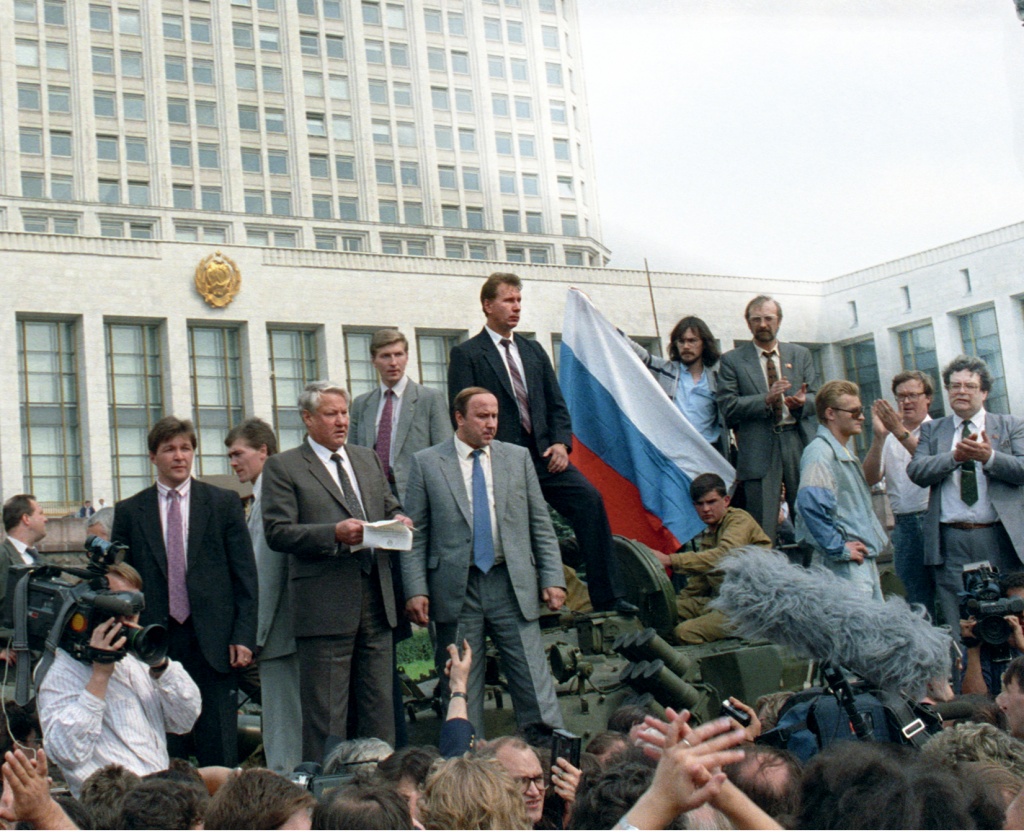
During the August putsch, Viktor Zolotov, together with Alexander Korzhakov, guarded Boris Yeltsin during his famous performance. Moscow, October 19, 1991
Fruits and banks
In 1996, Sobchak lost elections for the mayor of St. Petersburg (the head of his election headquarters was the first deputy chairman of the government of St. Petersburg Vladimir Putin), and in 1997 he fled to France, not without the help of Putin. It seemed that Zolotov’s career was completed, he leaves the civil service to the business: good, during the time of working with the mayor the necessary contacts were developed. And Zolotov really left-in the Baltic-Escort, belonging to the Tsepov. However, according to one St. Petersburg entrepreneur, who was familiar with Zolotov in the late 90s, in addition to the Baltic Escort, he also organized security services in banks, was the head of the security service in the largest Olby-Dzhaz fruits at that time.
The same source recalls that under the governor Vladimir Yakovlev, the affairs of the Baltic-Escort things went just as well as under Sobchak, contracts for the protection of city infrastructure and events, cruise courts and tourishing stars fell on the company. “The nickname Tsepov was a producer, this was his main talent, he knew how to negotiate,” they told the magazine in St. Petersburg. Some sources have a hypothesis that through it the new leadership of the city solved issues with the St. Petersburg mafia, often representatives of various criminal groups, instead of arranging shooting, preferred the mediation of the Baltic Escort.
In addition, according to the interlocutor of the magazine, the field of the security company also included the monitoring of the traffic of black cash, owned by both officials and local crime. Rumors associated the name of Roman Tsepov and with multimillion -dollar contracts, however, each time the main role was played not by his security business, but by useful acquaintances among the St. Petersburg, and then the Moscow establishment. The head of Zolotov (who was called the spool or Vasilich) at the same time became a defendant in criminal stories: illegal storage of weapons, the threat of an entrepreneur-Rieltor who decided to abandon the “roof” of the Baltic-Escort, manipulations with real estate, kickbacks for contracts of government agencies. However, not a single criminal case was brought to the end, and Viktor Zolotov managed not to tarnish his name.
## again
Everything changed when, after the Czech Republic with the Prime Ministers in the late 90s, the director of the FSB Vladimir Putin was appointed by the next head of government. Viktor Zolotov returned to Moscow, replaced his beloved Saab (they say he has a special addiction to this brand) to the government BMW, becoming the head of the Prime Minister’s security service, and in 2000 - the head of the Putin President’s Security Service.
“In principle, this is the most important position, only a person you can fully trust it,” the historian of the Russian special services said in a conversation with the New Times, a former officer of the GRU special forces Boris Volodarsky. “He (Zolotov) is undoubtedly entering the nearest round of the Russian president.” According to Volodarsky, Zolotov is an excellent guard. A devoted to the owner, but tough in relation to others: “He himself has great physical strength, very cruel. It is not surprising that Korzhakov refused to talk about him, I am surprised that he dared to call him a villain. ” As Volodarsky assures, even during the presidency of Dmitry Medvedev, when Zolotov remained the head of the presidential guard, Vladimir Putin’s security was also under his jurisdiction. “He, on the one hand, remained under Putin, on the other, held Medvedev under the cap,” several sources noticed in a conversation with The New Times. The fact that Zolotov in 2008 did not move after Putin to the government, but remained the main under the president-successor in order to keep the latter under constant control, the interlocutors of the magazine have no doubt.
According to the sources, Zolotov, when he was his guard Putin, answered almost every minute of the president’s life: “Putin is very afraid of the assassination attempt. Drivers, cleaners, cooks, gardeners - all men, Putin does not trust women. The selection of staff depends on the security service, ”said the interlocutor of the magazine. - The second fear of the Russian president is poisoning. All food is checked before serving, everything is served in plastic boxes sealed with a film, on it - stickers indicating the time and surname of the person who checked food. The organization of the food process was also under the jurisdiction of Zolotov. ”
According to another interlocutor of the magazine from the Russian establishment, it is Viktor Zolotov who knows the personal finances of Vladimir Putin and his family, however, the magazine could not find evidence of this, as well as evidence of other sources. The degree of Putin’s confidence in Zolotov also says that under his supervision, the construction of the so -called “Putin Palace” in Gelendzhik was undergoing. Businessman Sergei Kolesnikov, who was related to the construction of the facility, said that Zolotov personally came to Gelendzhik, gave instructions on the protection and communications.
It is curious, however, that Zolotov, despite such a long and close relationship with Putin, was not part of the nearest circle of the latter until 2008: Putin did not sit down for the holiday table for the festive table - he remained in the guard room. However, at that time Zolotov also had a new “clicked”: he turned from Vasilich and the spool into the Generalissimo. “Because I loved to receive stars,” said the interlocutor of the magazine in one of the law enforcement agencies. And the truth: in 2000, Zolotov was only a colonel, in 2006-already Colonel General.
Special Service researcher Pete Earley in the book “Comrade Jay”, based on many hours of interviews with a former SVR and resident in New York, recruited Americans, Sergey Tretyakov, talks about how the FSO was preparing Putin for the UN Summit in New York, and Treyakov Trekayakov. He invited him to his home for dinner of his old acquaintance, deputy director of the FSO, Alexander Lunkin, who came to the United States on a business trip. According to Lunkin, who is quoted by Pete Irley, Zolotov was not considered very smart, but they were inseparable with Putin, partly due to the fact that Putin’s hobbies were boxing and judo, and Zolotov was his sparring partner. Lunkin allegedly warned Sergey (Tretyakov) that he should be afraid of Murov and Zolotov. “They are ordinary thugs,” he said. Pete IRLI gives Lunkin’s story about how one day he was present at a meeting of both officials, and in the conversation the name of Alexander Voloshin (then - the head of the presidential administration. - The New Times). Lunkin allegedly said that Murov and Zolotov openly said that Putin envied Voloshin and his political weight. Putin, they say, wanted to dismiss the "gray cardinal", but could not do this for political reasons. According to Linkin, to which Irley referred to, Murov and Zolotov suddenly began to discuss the methods of murder of Voloshin: one of the ideas was - to kill him and accuse him of the Chechen terrorists; The other is to dump his murder to the Russian mafia, who allegedly punished him for some dark deeds.
Then Irley writes: the more they said, the more they came to the understanding that Voloshin’s murder would not protect Putin from political difficulties. I would have to get rid of the main members of the Voloshin team and some oligarchs. They also had to begin to kill Russian journalists who could investigate the murder of Voloshin.
Pete Irley writes that according to Linkin, Murov and Zolotov, they decided to make a list of politicians and other influential Muscovites who had to be killed, so that Putin had unlimited power in their hands. After they finished work on the list, Zolotov seemed to exclaim: “There are too many people. Even we will not be able to kill so many! " However, other sources of the magazine said that such a conversation could hardly take place: the times are still not the same.
## Dry from the war
In 2007, Viktor Zolotov took part in the war of the security forces, in which, on the one hand, the then head of the Federal Service for the Turnover of the Nagitus (FSKN) Viktor Cherkesov fought, and on the other, the FSB director Nikolai Patrushev, the head of the Investigative Committee, Alexander Bastrykin and Secretary of the Council of People's Commissars of the Council of People's Commissars of the Council of People's Commissars. The FSKN was then engaged in the investigation of the case of the withdrawal of funds by Russian security forces through a chain of banks , including the Russian discount bank and the Austrian Raiffeisen, which in practice meant the collection of operational data on the defendants in the case - the wiretapping of telephones, photos and video surveillance. The FSB and SK could not put up with the fact that some other department designed to fight drug dealers began to get into the sphere of large and very large cash flows and responded with criminal cases and arrests of FSKN employees. Viktor Zolotov then sided with Cherkesov, who in 1992-1998 was the head of the St. Petersburg FSB (FSO director Yevgeny Murov worked in St. Petersburg as his deputy). But Cherkessov lost the fight. According to the sources of the magazine, Putin did not forgive Circassian to the fact that he carried out intra -corporate showdowns between the Chekists from different departments to the public - an article by the head of the FSKN appeared in the Kommersant newspaper, in which he wrote that the country that fell into the abyss managed to save it on the “Chekist hook” and condemned his colleagues that became colleagues that became colleagues that became colleagues that became colleagues that became the colleagues that became the colleagues. Torgashi and thereby staining the bright uniform of immigrants from the KGB of the USSR. As a result, Circassians are now a modest deputy from the Communist Party in the State Duma, but Viktor Zolotov remained a man covering the president’s back.
In September 2013, Zolotov was appointed to the post of Deputy Commander -in -Chief of the Internal Troops of the Ministry of Internal Affairs: then they spoke that Putin instructed Zolotov to create a national guard (see The New Times No. 16 of 05/19/2014), and on May 12, 2014, in the midst of the Ukrainian crisis, the first deputy minister of internal affairs - the commander in chief of the internal troops of the Ministry of Internal Affairs of the Ministry of Internal Affairs of the Ministry of Internal Affairs RF, and this is 220 thousand people in uniform. And not just in uniform - in the jurisdiction of Zolotov are all the special forces of the country at the disposal of the Ministry of Internal Affairs - 25-30 thousand well -trained fighters.
According to some interlocutors of the magazine, this position is just a step towards the ministerial portfolio, the opportunity to prepare, and study the department. But other sources of The New Times said that Putin needs Zolotov precisely in the current position. “The minister is not for him, this is a public position that implies a great degree of responsibility, he is not used to it, he will bring more benefits by commanding a certain personal guard of the president,” says Boris Volodarsky, according to which in the near future there will be a new structure on the basis of the internal troops of the Ministry of Internal Affairs, designed to protect the head of state. “Operational and counterintelligence units will be created, except for security and specials. The existing service will be significantly increased and strengthened by special forces class forces. The powers will be unlimited, ”says Volodarsky.
“Any attempt to change the regime both from the outside and from the inside will face the inexorable gold,” another interlocutor told the magazine to the magazine. “So it doesn’t even matter how his position will be called.”
Photo: Valentin Kuzmin/ITAR-TASS, Photoxpress