
Translated material
Theory of small affairs
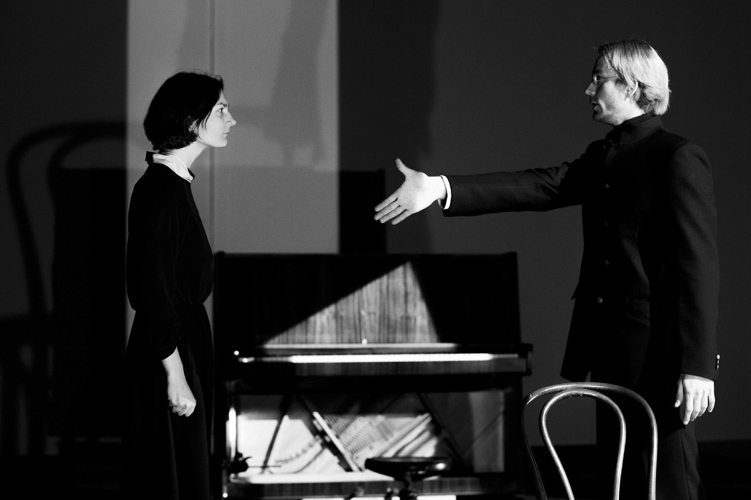
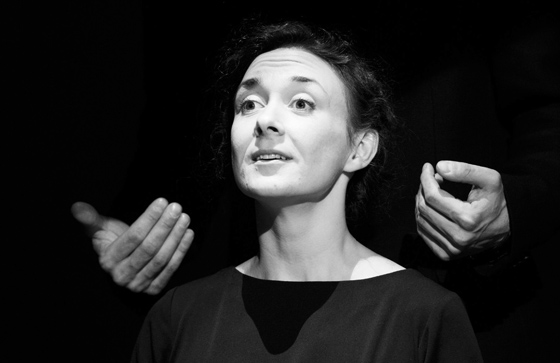
Vera Pavlovna (Nina Alexandrova, in another composition-Irina Vilkova) lived in a large beautiful black and white box, invented by the artist Alexander Shishkin. She knew how to play the piano music of the composer Nastasya Khrushcheva, without even touching the keys, and beautifully waved her arms in the air: instead of the piano strings, the Festino choir vocalists, perishing in the corner, responded to her passes. In dreams, Vera Pavlovna was the beauty (Varvara Pavlova) - a spectacular, short -haired woman with a bad habit of getting on chairs and talking in a horn in a commanding voice. Vera Pavlovna, faithful to the voice of beauty, refused marriage by calculation and left the house of her backward parents (George Stil and Iruta Vengalit). She concluded a fictitious marriage with a young doctor Lopukhov (Dmitry Lugovkin), and soon she fell in love with his friend Kirsanov (Egor Medvedev) without memory. The noble Lopukhov did not stand in the way of loving hearts, staged suicide and went to America. It would be time to be born with Vera Pavlovna “thorough confidence that the further, the better it will be”, but we are not talking about the old novel by Chernyshevsky, but about Andrei Mogeli, so instead of the book of acquaintance with the bums, Verochka sees the fifth dream. There, Lopukhov and Kirsanov look like fools who are multiplying about everything in the world and planning her, Verochkin, future, and beauty is completely similar to the great inquisitor. Vera Pavlovna immediately disappointed in her sewing workshop, cried and ran to the author (Boris Pavlovich) to sit with him in a pile of fallen yellow leaves.
 © Stas Levshin / BDT
Vera Pavlovna is really heartily sympathetic to this: after all, she has about the same as the authors as the nannies of the impeccable child. The light will go out, the audience will disperse, and Pavlovich will explain to the heroine that he is the author is not vashemeline, but is forced to try on the role of the animator and talk with the public in pauses between the scenes only because he leads the educational program of the BDT “Environmental Environment”, in the direction of which the performance has been conceived. And he will tell Vera Pavlovna that the director himself is by profession, but he does not answer for this performance, since he was set by the Hudt BDT Andrei Mogeliy. The mighty director will probably politely send Verochka to Alexander Artemov and Dmitry Yushkov, the authors of the staging and the creators of the theater “Trus”, in which the actors repeat ridiculous and ridiculous texts many times in a row. Well, these guys will send directly to Chernyshevsky and will be right. In terms of ridiculous and ridiculous, he actually began the first. He was distracted by an essay from the hardships of the prison casemate, he came up with the heroes rather flat and boring, but he played enough and with obvious pleasure in the cliche of the Boulevard Roman in order to smuggle several favorite thoughts about the “new people” of the advancing socialist paradise. There is definitely no one to wipe the tears to Vera Pavlovna.
Once they gathered Bazarov with friends, caught a frog, did not cut, did not kiss, looked at it with a meaning and parted home.
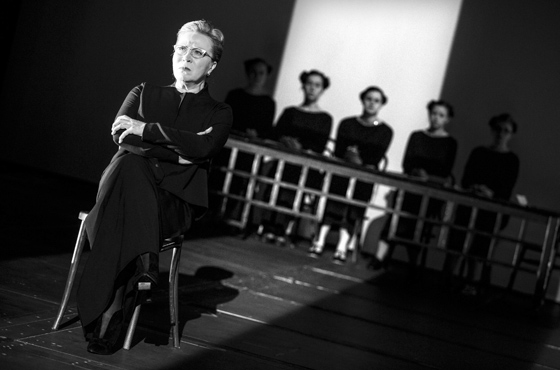
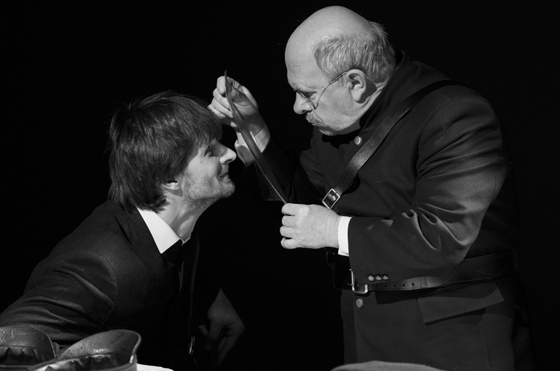
It is much more surprising that these tears were generally possible. Literally from the first scene, the play "What to do?" demonstrates remarkable comic potencies. Since the time of the "lubbing" Alexei Balabanov, it seems, there was no second such case that the people's artists irrevocably flew out of the frame, not having time to utter a couple of replicas. George Shtil grunted a little on a chair, and now he already bows at the right backstage. Iruta Vengalit throws his weighty curse “new people” and also disappears. Andrei Sharkov very funny depicts the priest, God -fearing baptizing from every sound, but, having come to the fore for a few seconds, he immediately strives for the curtains. The sextet of stupid policemen (Sergey Losev, Evgeny Chudakov, Valery Degtyar, Anatoly Petrov, Vasily Reutov and Evgeny Slavsky, who joined them) lingers a little longer before the audience, but what could become a homerically ridiculous divertism, as if wrapped in a foam. Comic estimates are so quiet and careful, as if mourning is declared in the city and joke awkwardly. Only Rakhmetov manages to break this conspiracy of seriousness. The debutant Viktor Knyazhev appears on stage with an enchanting number, almost a monoscope. The revolutionary ascet and a hero, killing the flesh with lying on the nails, performed by Knyazhev, turns into a touching iron, similar to a broken toy - stuttering and continuously scratching. I don’t want to return to the moral suffering of “new people” after this first -rate clowning. And it is necessary.
 © Stas Levshin / BDT
“You probably think that there will be mockery over the classic? What will change in modern costumes? " - The author asks mockingly at the beginning of the performance, he is Boris Pavlovich. If we thought, then we were mistaken. And the point is not in costumes, although the uniforms invented by the artist Evgenia Panfilova hint that the action takes place in some kind of multiple past. The respect for the letter of Chernyshevsky in a new performance by Andrei Mogovy surpasses all sanitary standards. The classic is not desecrated by the transfer of a monologue into a dialogue, not littered with household surroundings, not burdened with the acting, fitted under the text. The actors pronounce the pood monologues of abstract content, raising the eyes of the grief and almost not stabbing (a little stabbing, but they are not machine guns). The conversation rotates mainly around the painful impossibility of divorce in tsarist Russia-one of the few socio-political topics that can be called obsolete with the full basis, and nothing would be explained in the performance of it, except Pyatet to Chernyshevsky. But the creation of warm -blooded, voluminous images of the heroes of love for the classic is still not enough, although young actors who debut on the stage of BDT in large roles would clearly be useful. Yes, this, apparently, was not included in the plans of Andrei Mogeli, who needs to bring the performance to a pre -prepared message that Chernyshevsky was largely mistaken, utopia is dangerous and generally “everything is difficult”. Excessive heat -blood is not necessary here: this and Vera Pavlovna will not cry when it is supposed.
 © Stas Levshin / BDT
"What to do?" Andrei of the mighty is a bewitching sight in his own way. Its power is how the performance overturns any - good or evil - expectations. The “new people” will wait for bright aesthetic gestures from the theater, but they will have to limit themselves to brazenly scanned at the Bedete stall with a spectator machine like those that are placed at Western festivals. “Rutiners” will look for what to dig into, and dig to the saint - a leisurely literary theater in the manner of Sergey Zhenovach. Once they gathered Bazarov with friends, caught a frog, did not cut, did not kiss, looked at it with a meaning and parted home.