
Translated material
Our possible future
About a year ago, I caught fire to repeat the journey of the poet Velikir Khlebnikov in Persia, which he committed in 1921. In the period from 1920 to 1921, the Socialist Republic existed in the province of Gilyan in the north of Iran - the power of the Soviets tried to rekindle the revolutionary fire in the east. The Red Army was in constant confrontation with local sheikhs (or, speaking the language of the then Soviet propaganda, “khans”) for power in the north of the country. In addition to the battles on both sides, active propaganda work was carried out. Khlebnikov was sent to Gilyan from Baku as an agitator and columnist of the newspaper Red Iran, who went daily in Russian for the Red Army soldiers who served in Gilyan.
My project was conceived as a romantic study of the disappeared socialist republic and the appeal to the theme of the Russian avant -garde through the figure of the poet Khlebnikov, who, due to many mystical coincidences, I consider it to be the artistic alter of the ego.
 © Sergey Savenkov
Having somehow formulated my idea, I began to look for artistic residences in Iran. Despite the fact that most of the acquaintances from whom I asked the contacts only twisted a finger at the temple and talked about the authoritarian regime since 1979 - what kind of artistic life is there?! - My friend, a journalist who writes about art, tied me with a certain alires who worked in the Raf Projects gallery in Tehran. On Imil, with my proposal, Aliser replied that they had been closed for six months already, but there is a center of contemporary art of Sazmanab with the same residence and their dear friend, Okashani, who is engaged in the exhibition program there. A year has passed more than leisurely correspondence and exchange of courtesies on Facebook , and the Okhb, about which there will be a separate story, invited us with my friend and co -author, photographer Sergey Savenkov, to the residence in Tehran. Having received a briefing that if you are not engaged in calligraphy or studying Islam, then it is better not to count on tourist visas, we issued documents through travel agencies and were in Iran two days later.
Square has already managed to establish the prohibited Facebook and the forbidden YouTube through the prohibited proxy server on the computer of Sergey.
I was driving a bus from Baku - it was an unforgettable journey. About 10 minutes before crossing the border somewhere in the mountains, all women on the bus, from small to large, began to get some coats and dark veils and pull it all over themselves, not at all embarrassed by the presence of men. As always, I have not prepared, hoping that a small scarf would legitimize my nakedness. As a result, all the bus had to change my clothes. At the passport control, the invisible hand pressed me some kind of heap with clothes, I looked back at my neighbors in turn: they clutched exactly the same in their hands. I decided that this is without fail, you never know, maybe because the ticket was very cheap, they give us baggage in the load, it also happens in the Baku train. They put me a seal in a passport, and a kind woman from Dagestan says that now I have to give my package to that person around the corner and get some fogs, in the region of a thousand rubles. So I unexpectedly drunk for myself and lagged behind my bus, I had to catch up with a taxi. There were no more dangerous adventures - only good ones, although sometimes with violation of laws.
It gets dark in the south early, especially in an unknown area. A taxi that the bus driver called for me brings me to the residence. I did not expect that it would be a three -story marble mansion behind a transparent bamboo fence in the area built up with elite housing, in the no less elite northern part of Tehran, right at the foot of the mountains. Okhb has already managed to establish the prohibited Facebook And the prohibited YouTube Through the prohibited proxy server on the computer of Sergey. While they were waiting for me, they managed to drink one and a half -liter bottle of forbidden Arak, local grape vodka, so they looked a little tired.
 © Sergey Savenkov
I will make a small digression regarding the ban on alcohol and other disciplinary laws that limit the freedom of Iran citizens. I would compare everyday life in Persia with such an important principle in Arabic philosophy as “Zahir - Batin”, that is, “obvious - hidden”. By coarsening, this idea can be stated something like this: noble treasures can be stored inside the house, anything can happen there, but this should not be visible outside the home. There is a law, it can always be circumvented, as many of my Iranian acquaintances say. You come to visit new friends, counting on a modest home dinner. Everyone eats pasta and play musical instruments, talk about culture and politics, but at the end of the evening you find yourself on the dance floor, where girls in shorts shake their hair under the dubstep and alcohol pours a river, the rest can be imagined. In public space, everything is different: pressure and control are felt there, but compromises are possible there. For example, you are sitting in the evening with friends for Dastarkhan on the seashore, and suddenly a new person seeps into your company and asks something very friendly about something. Friends, having changed in his face, answer him insinuatingly, they hid vodka and poured tea into glasses as soon as they noticed his small figure on the horizon. It turns out that a new acquaintance is walking here for a reason, but for a small payment helps the police: he walks along the coast, dressed in a civilian one, and if he notices that someone drinks alcohol or violates still, I still do not know what orders, he immediately reports where he should.
They founded the institution, although no one asked them about it, and did it at their own request, without sponsorship or state support.
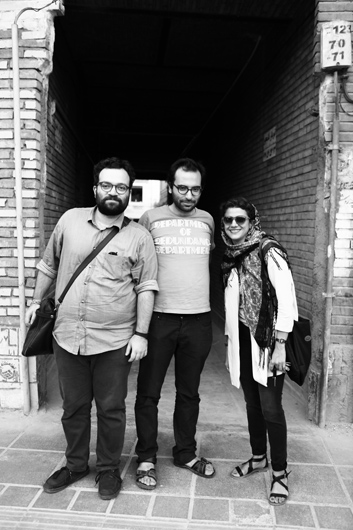
The next day, we went to watch the building of the Sazmanab art center, which is now on the reconstruction and in one of the halls of which our future exhibition should take place. The building of the 1930s-the outlines and transparency of architecture issued the influence of Bauhaus-was originally built as an apartment building. The aforementioned OVB and two of his friends, the founders of Sazmanab , bought the building at their own expense under the exhibition space. Okub-the artist and curator, the son of the famous screenwriter Farid Mostafavi , who had just won the Golden Leo at the Venetian festival, works a 3D designer; His partners are the architect Abbas-Omid, artist Salman Matinfar and Ziba, which means “beautiful”, as we were presented to us. Ziba studied at Kingston University, works as a coordinator and a curator of projects in Sazmanab . Guys - immigrants from intelligent or wealthy (or all together) families. They founded the institution, although no one asked them about it, and did it of their own free will, without sponsorship or state support, such an example of self -organization and enthusiasm.
 © Sergey Savenkov
From their colleagues, a lot of traveling at work, you often have to hear about N Etwork as interaction, the exchange of information in a new place that they visited. For example, in Brazil there was a “terrible nonsense”, which means - the receiving side did not inform us of anything about local cultural events, and in Berlin the non -workshop was fantastic, we were constantly carried to various discoveries, discussions and conferences. So in Iran, a nonsense is not a prerogative of cultural institutions, it is something like a national sport. You go out into the street and swim along the waves of non -general and good. You go in a trolleybus and do not have time to look back, like a 50-year-old engineer who lived half a life in America, has already found out everything about you and draws a card to the Museum of Modern Art, and at the same time for the Museum of Cinema. In excellent English, they tell you that just in case you need to keep the bag closed and put on the shoulder, the scarf should cover not only the head, but also the neck, and this is all: “By the way, inexpensive large scarves are sold in this square, let me look through the window. Maybe they work today ” - a short glance that almost escaped the fate of being noticed, slides along my collar. Otherwise, our new acquaintance continues, you will be taken by the "hijab-police." If you see a police car, and inside a woman is in a cap, then be careful. They will take you to the site and call your husband, if your husband is not, they will call your parents and will not let go until someone comes for you. The entire trolleybus at this time, in the Soviet joke about sex at a stop, gives advice and exchange opinions. At the exit it turns out that someone has already paid for your passage. “Iran has a bad state, but good people,” I hear in the end.
For some strange reason, the museum remained, it was not burned, like an American or Israeli embassy.
Something like this I ended up in the Tehran Museum of Contemporary Art , about which, like, probably, most readers, I have already heard a lot. Just in case, a short excursion. The museum building itself, located in the western part of the huge Lale Park, was open to the public in 1977, shortly before the revolution. This museum does not have a website, there is no official information on the Internet in any language except Farsi, so you have to trust the opinion of Iranian friends, guidebooks and Wikipedia.
The modernist reinforced concrete building of the museum was designed and built by the Comran of Diba, the cousin of the Farah Pahlavi , the wife of the last Iranian Shah. In his project, the architect used the modern achievements of urban planning and the basic elements of Iranian architecture at that time. Ventilation pipes in the building, very similar to those that the Pompido center, should have reminded, according to the architect, the so -called air towers - a traditional air conditioning system, used for many centuries in the Middle East.
 © Sergey Savenkov
Farah personally participated in the formation of the collection of the future museum, acquiring works from artists. The collection of the Tehran Museum of Modern Art ( Contemporary ) will now correctly call it a collection of modernist ( Modern ) art - is officially considered one of the most significant and European and European. It contains the work of the most progressive artists of all directions from the beginning of the last century to the 1970s. There is impressionism, Russian Suprematism and Italian futurism, phovism, cubism, expressionism, Mexican muralists, surrealism, minimalism and conceptualism, abstract expressionism and American genre painting. The cost of the Tehran Museum collection is estimated in the amount of 2 to 5 billion dollars . According to other sources - 1-2.5 billion pounds.
Most people here, even police officers, play a game called “Shucher! Leader! ”, Like in a pioneer camp.
Seeing her, however, is not so simple. Throughout the reign of Akhmadinejad, the collection was hidden in storage facilities, away from the eyes of the general public, as it is associated with the corruption of the West. Basically, the museum shows traditional Iranian art, sometimes there are thematic exhibitions at which you can still see work from the treasury of the museum. I was lucky: just one of these exhibitions took place at a time when I was in Tehran. It was doubly lucky, because it was an exhibition of etching and other author’s printing techniques, and I adore this item. The curatorial text is striking in depth: “The print function for today is not only the possibility of reproducing images; No, this is also the richest media in the field of visual arts, which can transform new experience into a pure image expression. ” Further even more interesting: “Modern society needs public art; What can be cheaper and more accessible to society than Printmakes , that is, engraving techniques, etching, etc. ” Indeed, these techniques of circulation graphics were very popular and became widespread in the period from the 16th to the middle of the 20th century. Now these are rather refined, very expensive and energy -consuming in the production of media, which is simply ridiculous to speak about the general accessibility. “Thus, the work of artists, which are the result of many years of search and experiments, should not be closed in museums, they can be accessible to all people” - well, a couple of words about the benefits and the liberating potential of the reproduction of the image have not yet interfered with anyone. Comments, I suppose, are unnecessary. Such exhibitions are held at the State Museum of the country, which has been living in conditions of censorship and isolation for many years.
 © Sergey Savenkov
I am watching the activities of my colleagues-artists in the context of the "State Museum" as a place under the control of official cultural policy. I participated in the parallel program "Manifesto" in St. Petersburg, where there were censorship and self -censorship, where the exhibition itself could serve as a visual aid that tells about the relations of the parties representing art and power. But the exhibition in the Tehran Museum creates a slightly different sensation incomparable with the modern Russian situation. I would call this a reconstruction of the future that modernist art represents, after the explosion of the atomic bomb. Well, there was a disaster, many died, a certain vacuum formed, a few survivors or just born adapted.
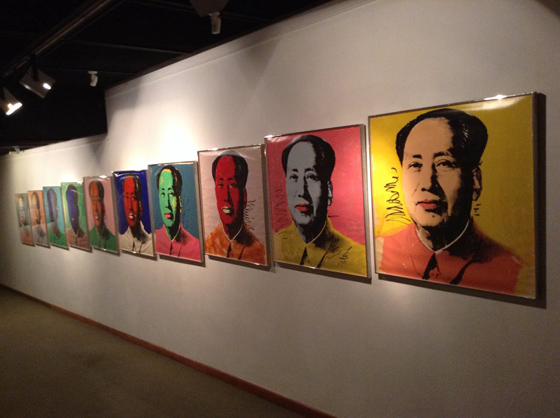
For some strange reason, the museum remained, it was not burned, like an American or Israeli embassy. Look to the left: this is what the futurists imagined the future under the influence of technological progress; on the work of Richard Hamilton and David Hokni, we can make an idea of the interiors and the economic situation covering the life of the middle and higher class in America in the 1970s; Here are the still lifes of Roy Liechtenstein, here is Andy Warhol. Then, in 1977, there were McDonald's and jeans (real Denim, not like China), American films showed in the cinema. Well, Kola remained, Cola how much you want in any kiosk - I don’t know if Obama and Lana Del Rey drink her, but you can still.
“Iran has a bad state, but good people,” I hear in the end.
We go down the stairs, maybe the most beautiful modernist building of all where I had to go. The kinetic sculpture of Bruce Gray descends from the ceiling, a portrait of the president hangs under the ceiling. Several paintings, in a primitive manner of depicting scenes of the battle from the Persian epic, opposite them - the installation of Donald Jadd. Further - an hour and a half of pleasure from the absorption of images. Indeed, at the exhibition you can track the path of development of printed graphics in seven decades of the twentieth century. From Tuluz-Latra and Munk to Raushenberg, Hokni and Warhol. As well as Picasso all periods, Miro and Dali, Kandinsky and Shagal, and for some reason the bronze sculpture of Umberto Bochchoni. With all its minuses and the simple curatorial idea, the exhibition makes an impression.
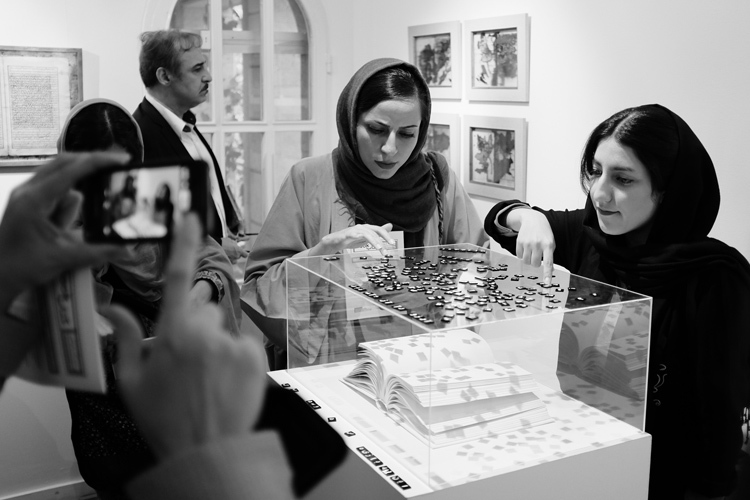
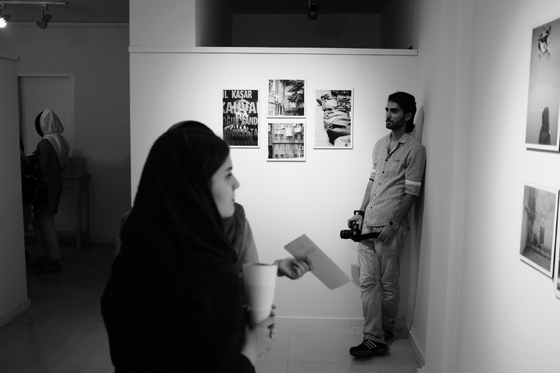
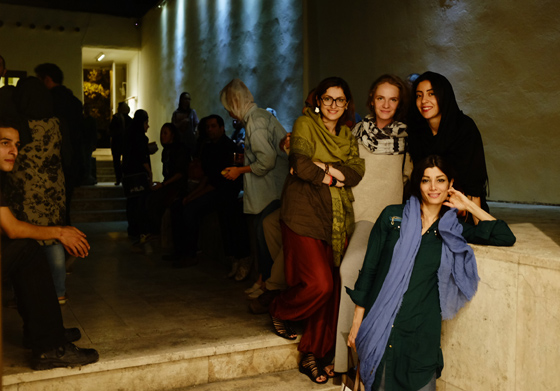
With contemporary art, everything is good here, despite the complete lack of state support. Every Friday in Tehran is a gallery day, many discoveries pass. In one such evening of vernissages, we visited six galleries in different parts of the city. The last place was in the north, high in the mountains. Aun Gallery was designed and built specifically for the exhibiting of contemporary art: a large space with a courtyard near the industrial zone, the owner is an architect. The famous Iranian artist Khosrov Hassanzade presented a series of panels from tiles depicting the traditional Iranian struggle. Several galleries on this day showed the work of very young Iranian artists, others - venerable and already commercially successful. Judging by the fact that I heard from my colleagues, everything is fine in Iran with the art market: in June, the first art collet Iran art was held in Tehran, there are collectors who enthusiastically invest in the work of local artists. On the vernisages - huge bouquets of flowers, which, as a rule, send the families of artists, especially young ones, with wishes of success, and there is no alcohol at all, which does not affect the attendance of exhibitions. Apparently, people here really love and are interested in art.
 © Sergey Savenkov
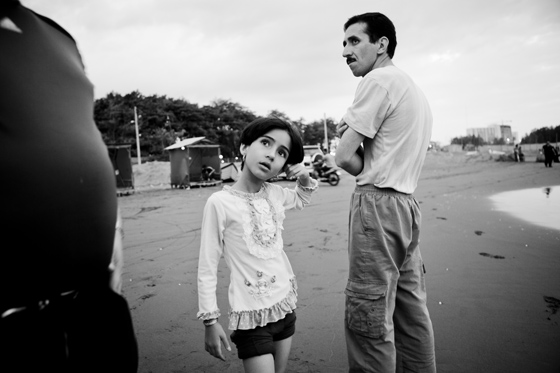
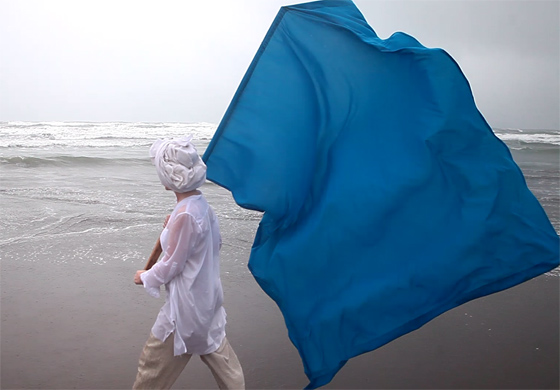
And here they like to dance, invite you to visit in the first two minutes of acquaintance right on the street, dress up beautifully and write “My Dear Sweet Ksenia” and “Much Wormth, Azizam” even in official correspondence. In the poem "Pipe Gul-Mullah", Khlebnikov wrote about the extraordinary kindness and hospitality that he met in Persia. He believed that people were so kind to him, as they took him for Dervisha, a priest of flowers and a preacher of the revolution. I think the poet was mistaken: hospitality is the same part of Iran’s life’s life, how to smile in response to a passerby who accidentally hit you, smoke a habbel, in our opinion-a hookah, and cross the road to any signal of a traffic light. It seems that most people here, even police, play a game called “Shucher! Leader! ”, Like in a pioneer camp. On the first day of filming at sea, we fell under the rain, in search of a cafe, we came across, as it turned out, to the police station. In RBT, you can not remove without permission to shoot, but we did not have it. The police invited us inside, gave us a blanket to hide, gave us to eat a hungry mouth. Задали несколько вопросов о фильме и, хочется сказать, отпустили на волю, но это не совсем так. Минут 15 мы помучились под дождем, работать все же нужно, камера намокла, экранчик не показывает, на одежде не осталось сухой нитки. Подъезжает машина, за рулем один из полицейских, заднее сиденье заботливо укрыто полиэтиленом. Оказывается, новый знакомый просто решил любезно подвезти нас до города, раз уж мы такие отчаянные промокшие иностранцы без документов и разрешения на съемку, бегаем зачем-то в бурю по побережью с голубым флагом Председателя Земного Шара, бисмилля, алла, алла.
Автор благодарит центр современного искусства Sazmanab и людей, которые в нем работают, за гостеприимство, а также музей «Гараж» за поддержку.