
Translated material
What happens to the air in Moscow
Burning wood, calm weather and technogenic factors: all versions are true
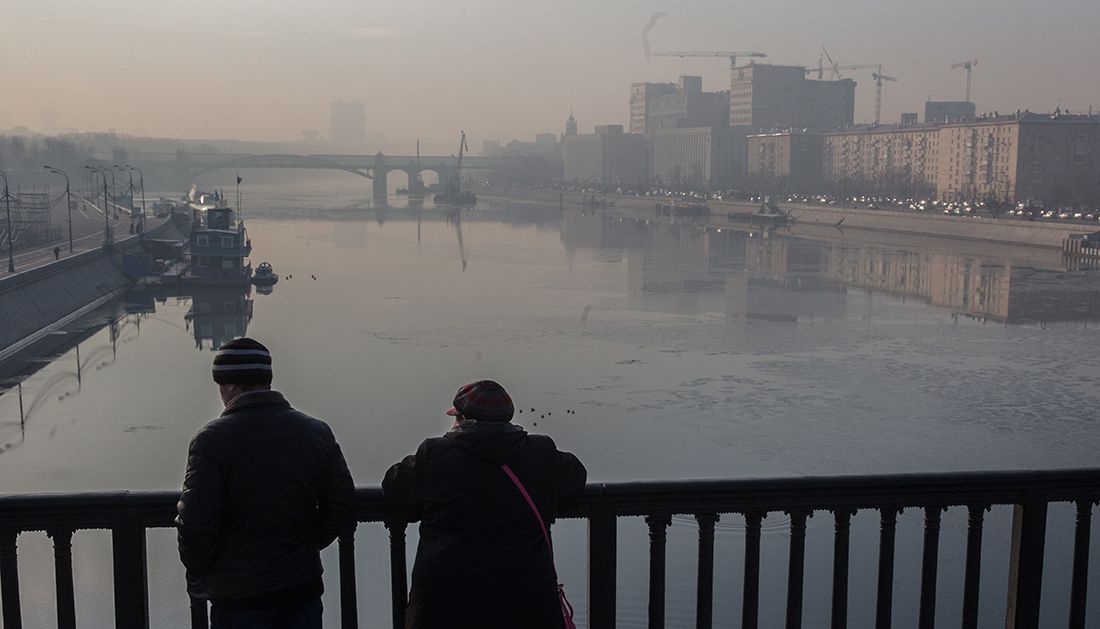
On Friday, November 21, in Moscow there was a pungent smell of smoke. In the morning-in the south and south-west of the capital, by noon, the haze reached the center. Rospotrebnadzor urgently recommended that people with respiratory diseases and the cardiovascular system remain at home. This is the third case of a sharp deterioration in the air situation in Moscow for this fall. In the Ministry of Emergencies, the cause of what was happening was announced by the planned burning of the “wounding residues” (wood) in the suburbs. By the middle of the day, more than 100 people were involved in extinguishing planned burning, and the Moscow Region Forestry Committee ordered to cancel the burning to a special order. Medusa tried to understand what is happening with the air in the capital.
The version of the burning of “waxing residues” does not cause any confidence among independent environmentalists. They note that the authorities for the third time refer to the same reason. However, in October, smoke came to Moscow from burning peat bogs in the Bryansk region; In November, it was not smoke at all, but a hydrogen sulfide, the release of which, presumably, occurred at the Moscow oil refinery in Kapotne (that owned the Gazpromneft factory, this information did not confirm this information). Environmentalists insist: no “waxing residues” will be enough to arrange such smoke. In the best case, it is a set of factors - a burning forest, calm weather and the general gas storage of the city by vehicles. At the worst - we are talking about the next industrial eruption.
The Main Directorate of Information of the Information of the Ministry of Emergencies of the Russian Federation responded to the morning calls with complaints about the state of air and curses on social networks at ten o’clock as soon as the working day began. “Due to the prevailing meteorological conditions as of 9.00 in the morning on November 21, 2014, in the territory of Moscow in the atmospheric air, exceeding the maximum concentrations of pollutants, which are products of burning the bandage residues in the Moscow region, as well as a high concentration of exhaust gases of cars,” the official statement of the department said. It was quite standardly recommended to refrain from traveling by personal transport - this seems to be a universal recipe for any incomprehensible situation in Moscow, from snowfall to anomalous temperature. In addition, the Ministry of Emergencies asked citizens not to burn the “warrant residues” in their summer cottages.
An hour after the Ministry of Emergencies, the Forestry Committee of the Moscow Region made his statement . From this message it became clear that the air was by no means ruined the summer residents. “On November 20, in the forests of the Moscow Region, planned burning of the warranty residues (bitch, branches) was carried out at the places of sanitary cutting in the areas of forest, which died as a result of an epidemic of a cirrus-grid, on a total area of 61.2 hectares,” the committee said. “Of these, in the forestry adjacent to Moscow: Istra - 0.82 hectares, Zvenigorodskoye - 1.76 hectares and Noginskoye - 1.5 hectares.” The department carefully noticed that due to weather conditions-in the capital frosty and calm-"the probability of accumulating combustion products in the air arose."
By noon, it became clear that the probability of accumulation did not just arise - skyscrapers of the Moscow business center disappeared in the haze. The smell of Gary was felt not only in the southern regions, he reached the center. The burning smelled even in the subway. Moreover, many users of social networks have noted during the day: for ordinary wood smoke, the smell is too sharp, it provokes a strong cough.
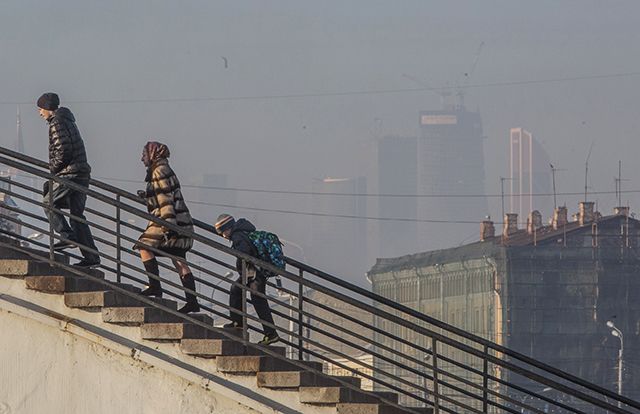
Then Rospotrebnadzor said that "in connection with adverse meteorological conditions in Moscow and the Moscow region, a negative effect of harmful chemicals on persons with chronic respiratory organs, cardiovascular system is possible." People with such diseases were offered not to go outside. At the same time, Rospotrebnadzor continued the monitoring of air pollution: in the morning exceeding the maximum permissible concentrations on “various chemicals with a characteristic smell (nitrogen oxides, sulfur, soot, fine particles)” he did not reveal.
Meanwhile, the Ministry of Emergencies continued to say that nothing supernatural in the atmosphere was happening. True, at first the burning places were investigated from helicopters, and then more than a hundred people were involved in extinguishing the remains of the forest, according to Interfax .
The state of air in Moscow in real time monitors the state budgetary institution "Mosecomonitoring". The Istra and Zvenigorod forestry mentioned by the Forestry Committee are located in the west and north-west of Moscow. The Mosecomonitoring stations that are closest to them showed that on the night of November 20 to 21, the maximum permissible concentrations of combustion products in the air-oxide and nitrogen dioxide-increased, on average, from 0.9 to 1.3-1.5 of the norm. The station in Zvenigorod itself, which is characteristic, did not record any excess of the MPC at all. Noginsk Forestry is located east of Moscow; The nearest Mosecomonitoring station to Kozhukhovo, a sharp emission of combustion products into the air, also did not record. At the same time at night there was a leap of content in the air of phenol - up to 3.2 MPC. Phenol - Carabox acid - is not a product of wood combustion.
However, the complaints of Muscovites to the smell of Gary began not in the north-west and not in the east of the capital, but in the south and southeast. There, observation stations showed a double (at times and more) excess of MPC in the air of nitrogen dioxide. In the city center, the content of combustion products in the air in the afternoon of November 21 was exceeded by 1-1.5 times.
“It is clear that laboratory readings are needed, but so far we can talk about the totality of factors - calm weather, colossal motor transportation. Perhaps there were still traces of the previous burning in the air, ”says Mikhail Antonov, coordinator of the Moseko environmental organization, in an interview with Medusa.
“I think that the waxing remnants are not the main reason for the occurrence of smoke in Moscow,” said Alexei Yaroshenko, Coordinator of the Forest Program, the Greenpeace-Russia forest program. - This is a convenient explanation for the Ministry of Emergencies. So they explained the smoke that came from the Bryansk, and then the Tver peatants, for example. ” Yaroshenko explained that the “warful remnants” are forests that died after the invasion of a boutist beetle. The wood, which could be used for production or processing, was taken out, and the tops of the trees and non -endo wood according to sanitary rules are required to be burned. “There are not so many of these defective residues that we would feel smoke from their burning in Moscow,” Yaroshenko believes. - Today, technogenic sources make the main contribution to air pollution. But which ones - it is impossible to say right now, this is the area of guesses. ” Greenpeace-Russia notes that in addition to the refinery in Moscow, three garbage plants and several enterprises in old large industrial zones work in Moscow.
“The authorities about the warranty remnants are such that you will not confirm it or refute it,” said Nikolai Shmatkov, the Meduza Coordinator of the Russian WWF forest policy. “It should have been a very powerful focus of fire so that the consequences were felt in Moscow itself.” Shmatkov recalled that the smell of hydrogen sulfide, which was very felt in the capital on November 11, also tried to write off on the waxing remnants. “In general, to burn wood on a large scale near a metropolis is of course the cheapest option. But far from the most effective, and residents have questions, ”he said.
In the evening, the head of the Moscow Department of Nature Management and Environmental Protection Anton Kulbachevsky said that there was no panic to succumb, and there is no threat to the health of citizens. “There is a lot of incomprehensible hysteria on the Internet,” Kulbachevsky expressed his discontent. However, why in Moscow it smells so smoke, did not explain.
According to weather forecasts, the smell will dissipate with the onset of wind and variable weather, that is, immediately after the weekend.
Smoke in the capital in photographs from social networks: "Moscow in November: nothing to breathe"
Andrey Kozenko
Moscow