
Translated material
Outsiders of Paris
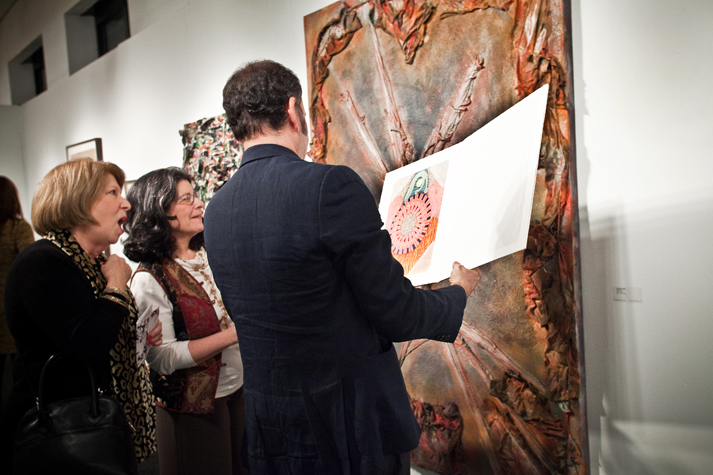
Most of the art community flows to Paris in the last week of October, FIAC week. Fiac is a list of the largest art fairs in the world, such as London Frieze , German Art Basel and the American Art Basel Miami Beach . Their French analogue, probably, is not so obligatory to visit, but since the fair takes place next week after Frieze , why not dive under the La Cans and not taste oysters at the same time? At this time, Paris is guaranteed a galaxy of discoveries, events, parties and buffes.
And we, too, drawn by the hype, came to bask in the neon rays of European contemporary art. But this time, Paris prepared for us an unexpected surprise, beckoning much more than Fiac and its canapes with champagne (15 euros glass). It was the world of the so-called outsider-marginal art.
Walking around Paris in the area of the Sacre-Cur church in anticipation of the opening of Fiac , we wrapped in a nearby two-story museum, representing the mysterious creations of non-professional artists-mentally ill, disabled people and simply obsessed. The thread of marginalism led us further, to the fair of outsiders, into a hotel, full of miracles to the top, from there to an impressive exhibition of a huge personal collection of Art Brut and finally in the gallery at the channel, where the Belgian workshop of the mentally retarded was exhibited. Thus, we almost completely forgot about the calling light of the fair.
What is an outsiderist?
The concept of blurry and controversial, but basically we are talking about marginal artists who are not inscribed in the ruling art structures-galleries and museums. It can be just artists without education, but often they are disabled or mentally ill, who do not consider themselves artists at all, but create something according to the spiritual need. Often these artists have an exciting and tragic fate - they create works in obscurity or locked up, not finding understanding until his death, or recorded in crazy ones. Experts divide this art into several categories, which subsequently argue a lot.
“Naiv”, or “primitive”, the art of non-professional artists, is distinguished by its childhood irregularity, often has bright colors and many details, purely and optimistic in mood. Naiv was the first to be popular. Bright examples of the genre: Henri Russo - a French customs officer who painted juicy jungle, whom he himself had never seen, the favorite of the Parisian bohemia of the early twentieth century; Nico Pirosmani is an eternally poor, rejected by society by a Georgian self -taught, drawing signs on oilcloths.
Art Brut . “Brut” means “rough (brutal)”, such art is often the fruit of the author’s insanity, and not just his unprofessionality as an artist. The term was introduced by French artist Jean Dubuff, who was the first to collect this art and whose museum in Lausanne is now the most famous ART collection in the world Brut . While the “naive” artist can work as a postman during the day, and in the evenings to draw, the artist ’s stereotype Brut is rather torn by passions and not understood by society, whose comprehensive creation is the whole meaning of his life. The most famous examples: American Henry Darger , who, having escaped from a Catholic shelter, worked all his life with a cleaner, composing and drawing his grandiose masterpiece - an erotic book about enslaved children; In Russia, Alexander Lobanov , who, living in a psychiatric hospital, expressed his love for weapons in the mass of subtle drawings and photo-apportors-collages.
The English-language term “outsider-art” was also introduced, denoting a certain combination of both directions, but determined not by the quality of work, but rather by the negative principle of non-profitability of this art for the generally accepted artistic “hypebies”.
But for now, art historians and psychologists are fighting for ways to determine Art BRUT, by aesthetic and psychological characteristics, artists often do not suspect anything: most would never call themselves outsiders, or primitive, or brutal, and if they called, probably, they would just immediately arouse suspicion among experts. In any definition of this art, some arrogance lurks: “naive” - stupid, inept; "Outsiders" - losers; “BRT” are completely socially dangerous. What is the attractiveness and riddle of an outsider at the same time humiliates him - this ethical aporia always accompanies this world, and maybe creates its dramaticity.
 © Ariadne Arendt, Alexey Turchin
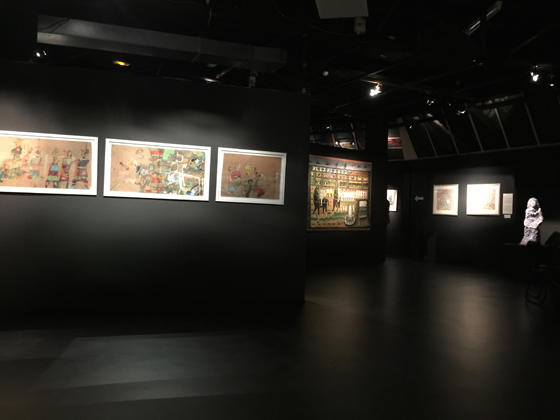
Halle Saint-Pierre
In the former market on Montmartre, a permanent museum has been opened on two spacious floors since 1986, showing exclusively ART Brut and, as they themselves are expressed, the "singular" art. We found there a large exhibition lasting six months from the collection of the Dutch Museum of StadShof.
The first floor of the museum, where the more famous classics of the genre were represented, was painted in a dark, almost black color, apparently referring to the mysterious darkness, which gave rise to these creations as light flashes of inspiration highlighted by bright spotlights. On the second floor there were brighter and more multi -format works - sculptures, tiny drawings plus large -scale installation of the city. Of the Russians, Pavel Leonov is represented there.
The museum also has a cozy cafe and a specialized bookstore, which even shuts off some works of art. There was a lot of information about the outsider-world almost all of Europe. Having typed an armful of leaflets and invitations there, we went further like an Art . Brut in Paris.
 © Ariadne Arendt, Alexey Turchin
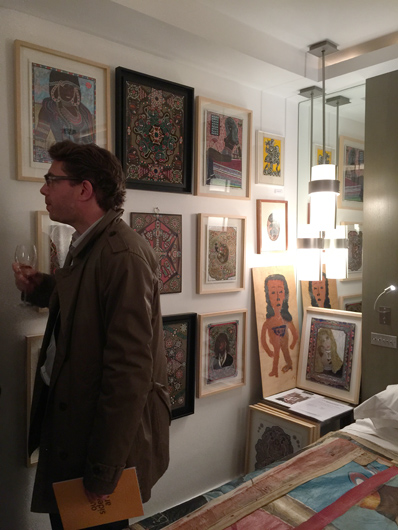
Outsider Art Fair
We still heard about outsider Art Fair in advance. It was organized in New York in 1993, but a couple of years ago it was bought by a New York galleryman Andrew Edlin and launched the Parisian version last year. This mini-fair in the Fiac model opened the day after it. But, unlike the clinical pathos of ordinary fairs, the outsiders acted in an unexpected way - the fair captured a small hotel, and each gallery was assigned one of 25 rooms on six floors. The work lay on the beds, stood in bathrooms, hid on a variety of shelves, even in the bathroom. No more than 10 people could get into the room, including the Galerists themselves (which, by the way, then spent the night), which created the situation of live and close communication. The prices for work were small, many were sold, there was an active trade before our eyes.
But there were expensive things: the aforementioned Darger and another ART star BRUT - Mexican Martin Ramirez , uniting the themes of Mexican folklore and modernization during the period of stay in a psychiatric hospital. Prices reached 250,000 euros.
 © Ariadne Arendt, Alexey Turchin
ABCD in Maison Rouge
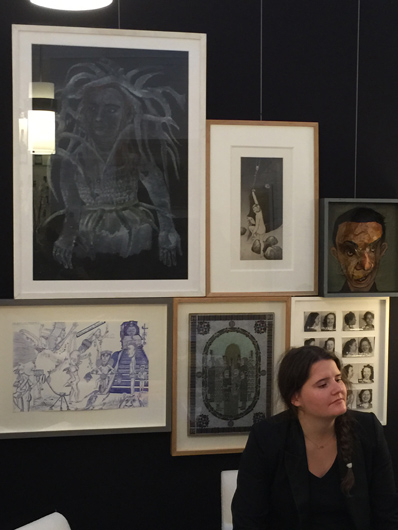
Meanwhile, the largest French collector Bruno Descharm developed tremendous activity. He opened an exhibition from the best works of his collection ABCD ( Art Brut Conaissance & Diffusion ) in Maison Rouge (not to be confused with Moulin Rouge ; founder, Antoine de Golber, he himself collects an outsiderist). Desharm has been ART for more than 30 years Brut , although he was initially a film director, and his collection is one of the largest private collections in the world. At a huge exhibition, approximately a third is presented - thus, only one masterpieces are shown that are grouped by topics: for example, an imaginary space or parallel universes. There is a whole room of bilateral Dargers (twice as large than those that were sold at the fair). Another room is given from suspended aircraft. Of the Russians, Romanenkov, Lobanov, Kalyakin and Medvedev-Petrov are represented (found by Descharm on his journey through Russia with the famous English museum in total during preparation for exhibition No. 5, held in the “garage” last spring). The taste of Descharma is noticeably reflected in the exhibition - it gravitates to the Brut, and you will not meet a typical naiv here.
Desharm also simultaneously made a personal exhibition in his small ABCD gallery and oversaw the exhibition in the gallery of Christian Burst. Burst himself, the largest gallery, who is engaged in outsiders, just now, at the end of October 2014, opened the second space in New York and went there with the whole team.
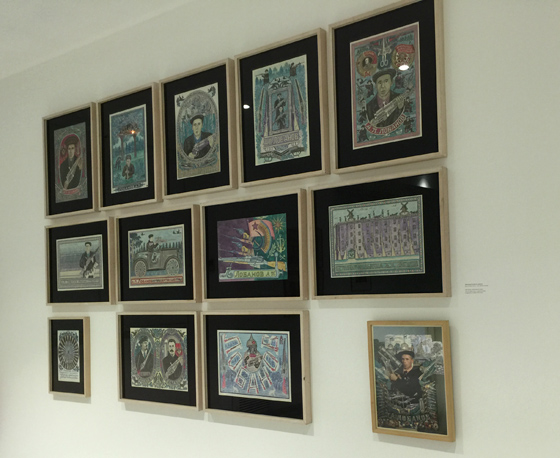 © Ariadne Arendt, Alexey Turchin
La 'S' Grand Atelier in Chez Agnès B.
In the space of the famous French fashion designer Agnès B. (today the trend among fashion designers is to patronize art: Prada , Louis Vuitton , Comme Des Gar ç ONS ; The latter, by the way, also recently became interested in outsiders and released a line of clothes with their images) there was an exhibition of the Belgian studio La 'S' Grand Atelier . It should be noted that the studios are a separate outsider-art genre: these are the space-master, bordering on boarding houses, where artists with mental and physical deviations work; The best of these workshops give artists creative freedom, provide support, but shy away from the clinical “art therapy”. Nevertheless, the atmosphere of collective work in the workshop can affect creativity, and this is noticeable.
La 'S' Grand Atelier, specializes in the integration of its artists with "normal" modern artists, inviting the latter in the residence to work in cooperation with the workshop. This time, the comics specialist Warry Van Hassel was invited, and the exhibition showed the fruits of their interaction around the topic of “struggle”: the organizer of the studio explained that there is a double meaning in this, since cooperation is also a kind of struggle.
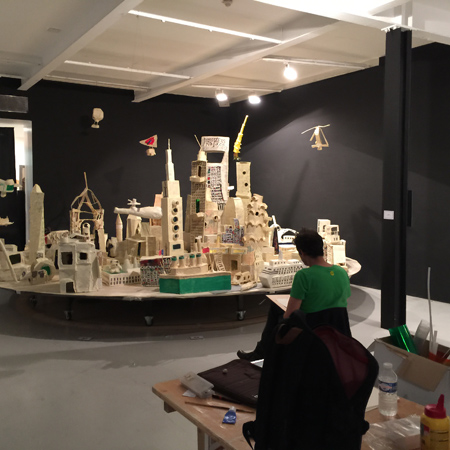 © Ariadne Arendt, Alexey Turchin
***
Maybe it is here that the mystery of the popularity of outsiders lies - in comparison with the "traditional" Contemporary Art ? The outsiderist in some of its manifestations is very similar to contemporary art-for example, distorted expressive forms, a large role of the text; Here you can find installations, even large -scale, like Environmental Art , and the so -called Research Based art that explores one topic. But, despite these morphological similarities, a deeper difference lies between the genres. Typically, contemporary art attracts attention, taking the most bizarre forms, but often the same clearly calculated logic is behind them: good PR, inscription in context, “concept”-we have long ceased to look for the artist’s soul in the works of simply. The outsiders, on the contrary, “overwhelm” with this soul: each sheet is a direct imprint of someone’s thawed, obsessed soul, and behind everyone there are completely different stories, without thoughts about PR and context.
Along with this, the genre is also attractive for a novice collector, since it is simply very cheap in comparison with, let’s say, “insider-art”.
A professional, galleys or art critic, genre of outsider-art, like nothing else, provides an opportunity to “hunt”. The artist of the outsider can be opened, extracted from complete unknown and, if the bet was correct, soon promoted to the star. Of course, this is not a direct road to enrichment, and there are a lot of risks, but in these risks and capabilities there is a drive for professionals.
Nevertheless, for the further advancement of the genre, he needs to find the right point of intersection with his older brother - contemporary art. And to one degree or another, all the projects we saw in Paris testify to this trend. Indeed, initially the creations of outsiders were mainly attributed to the world of psychoanalysis, the collections gathered exclusively from psychotherapists who exchanged works, since it was forbidden to trade them. Over the past half a century Art Brut smoothly migrated from the world of psychology to the world of art, objects were retrained from the symptom of the disease into the creations of unrecognized geniuses. But until recently, the world of the outsider-art existed a little from other things from contemporary art, he had his own galleries, collectors and fairs, and although this was no longer considered something clinical, it still retained marginality both inside the work and in the atmosphere that accompanies this genre.
In the past couple of years, strong changes have occurred on this front. Last year, the success of outsiders was crowned by the inclusion of the most famous in the main exposition of the Venetian Biennale, the "Encyclopedic Palace", which was the curator of which was Massimiliano Joni. And the current powerful presence of outsiders in Paris, a city that can probably be awarded the title of birth of this genre, indicates the continuation of its growth.
But while the reputation and recognition of outsiders are growing, they are increasingly faced with the problems and paradoxes of self -identification. The outsiders who have inscribed in the world of the artistic mainstream will have the greatest recognition and success (both public and commercial), but they are attractive precisely by their marginality and nationality to it: madness and friction - this is their visiting card that allows you to pass the context and laws of that world. However, its exploitation entails a threat of unspoken correlation, so taboo in the West. To focus on the internal-aesthetic qualities of work is safer-but would they be so attractive if we did not know the dramatic biographies of the authors? These problems accompanied the genre from the very beginning, but in his desire to enter the arena of great art they acquired a new acuteness, and maybe precisely due to this inconsistency and insoluble, the genre continues to attract attention.