
Translated material
Russian Palimpsest
From the author
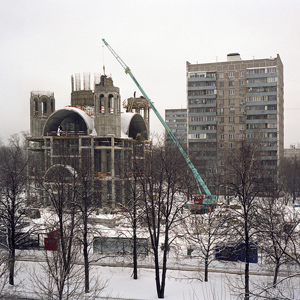
My unfinished project “Russian Palimpsest” is a kind of catalog of archetypes of the modern post -Soviet city landscape, which experiences the transformation from communist utopia to the homegrown version of capitalism. The name of the project indicates the desire of the author to perceive the landscape as a carrier of the layers of visual information that have been layered on each other about the culture of everyday life, which needs to be fixed and comprehended.
I photograph new buildings - residential, public, commercial - and old, adapted for new use. My task is to fix a typical and recognizable in our living environment: supermarkets, business centers, gas stations, residential buildings.
In Soviet times, free photo documentation of the appearance of inhabited spaces was, in fact, by ban. One of the few sources of visual information about the inhabited territory of their own country for Soviet citizens were postcards issued by state departments with views of cities, but they, as a rule, were depicted only sights, more often ideologically charged. Only a small part showed something ordinary/typical-a department store, a stadium, a cinema. It is this small part of the Soviet postcards for me that is the ability to find a flimsy visual “support” for reunification with the pre -revolutionary tradition of documentary photographs of the living environment.
I deliberately take off the buildings and views that can be seen in any village of the former USSR.
Another important support is the photograph of Stephen Shor, Robert Adams, Bernd and Hill Beher, whom William Jenkins united in 1975 at the Rochester exhibition of New Topographics , as well as their students who formed the Dusseldorf school. They, too, in one way or another made up photographic catalogs of built -up landscapes.
I deliberately take off the buildings and views that can be seen in any village of the former USSR. So I shift the optics from the delightful to the banal, or, in other words, I make banal attractions in order to demistify, to spell the image of the landscape.
The symbolic aspect of the work of a photographer, studying and fixing the inhabited landscape, is also important. The postutopic state of our society requires an active post -Soviet individual to defend even such basic things as the right to look freely at his own country from his private point of view, without imposed constructs that interfere with perception. In this sense, the project is also partly a way of a metaphorical appropriation of a look at our inhabited space. This is an important mental operation for a person living in an authoritarian society, where public space is still in many ways the space of power, and his image has long been a monopoly of the state.
At the exhibition "The Origin of Species: Topographics of Russia" at the Museum of Architecture named after Shchuseva photos from the Russian Palimpsest project will be presented in the form of postcards. A set of such postcards of 24 pieces specifically for the exhibition was published by a circulation of 300 copies. They can be bought at the museum and on the author’s website. The exhibition will also be shown old Soviet cards from my collection.
Exhibition " Origin of species: Topography of Russia " at the Museum of Architecture. Shchuseva will open on December 5