
Translated material
The voice of other people's times
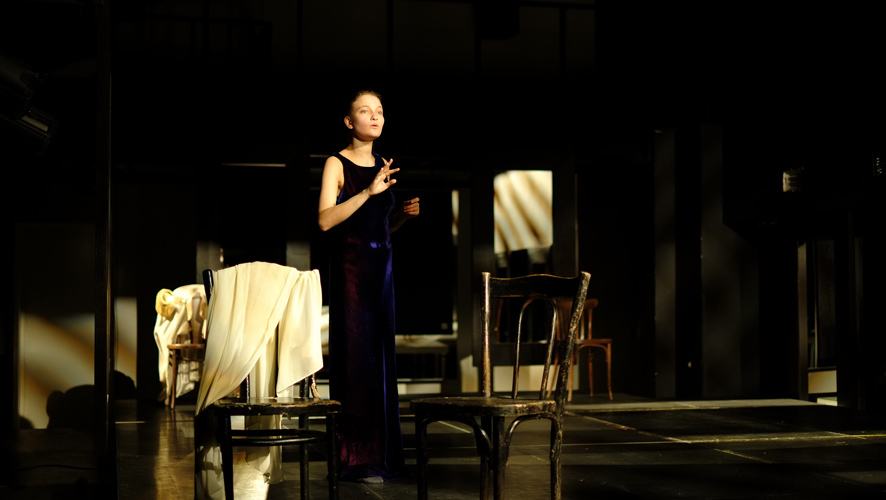
The play “Retribution” just nominated to the “Golden Mask” is in the center of drama and directing, in which life has been boiling recently. I was boiling, boiled, and with the advent of the new director Dmitry Balaguta, somehow all inadvertently boiled. There are almost no spectators, the buffet does not work even during a five-hour performance to drink water from the cooler, you need to ask the minister a glass: she will bring him from somewhere in the bowels of the administrative part. The posters decorating the facade of the building make you think that it was not the municipal theater, but the head office of some self-propelled scales. And in the middle of this strange estimate of wild capitalism and a dull Soviet desolation, a quiet miracle occurs.
Klim's “Retribution” is an amazing example of theatrical service and at the same time theater service, in the case of the performer of the performance, Ksenia Orlova, also a theatrical feat.
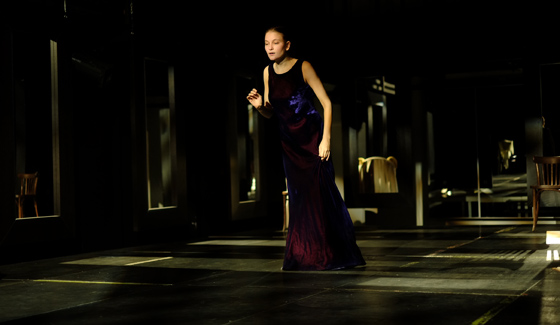
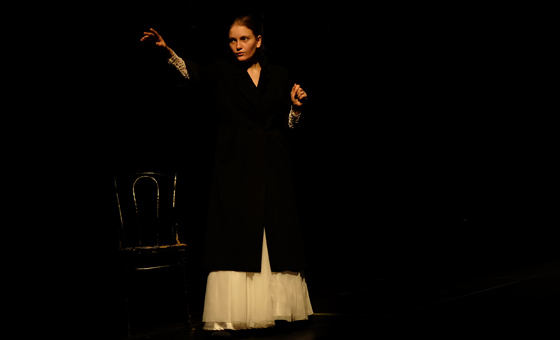
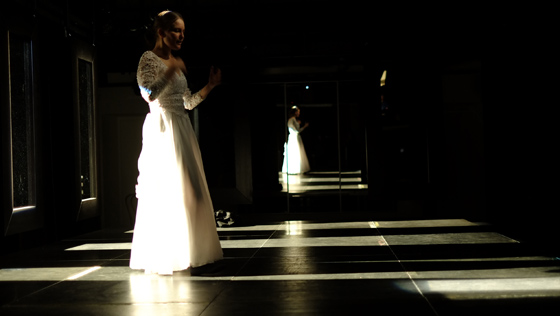
Orlova reads a block for almost five hours in a row - on an empty stage, without a “support group” in the form of music or stage effects, one on one with block text. The word "reading" here, of course, can confuse. It is least suitable for bewitching melodiclamation, in which bloc lines at first exist as an undivided substance, which is born from from the depths of acting subconscious, or, as another Russian poet would say, from the heights of “supramirny cotton”. But this is not singing, and not a campaign, and not a surplus. Ksenia Orlova virtuoso reveals the words, then embeduates, then runs back again.
The powerful social pathos of the poem here, if it sounds, is implicitly. Even when, following the “retribution”, Orlov suddenly begins to read “twelve”, the attitude of the block to the revolution does not become the main plot of the performance. The plot remains the complex relationship of the stage game and prosodies, that seemed to be separately from the performer of the poetic substance, which, by the will of the actress, decays into separate phrases, semantic elements, characters: Dostoevsky appears in the interior of Anna of the Vrevskaya, victorious extends the wing over Russia, and then condenses again into the verbal cloud, grazoly soaring over the auditorium.
 © Klim
Meanwhile, having run away from direct sociality in the scenic text itself, Klim before the start of his action (rite? Session?) Did not fail to notice how relevant and visionary to him the Blok poem seems to him now. And since in the course of a five -hour performance you will inevitably renounce what is happening on the stage from time to time, I now and then began to reflect on the justice of these words - the relevance of the Blokovsky “retaliation” or, more precisely, about its inequality ...
The striking similarity of situations that have developed at the beginning of the last century and at the beginning of the present is really striking. The winter of our anxiety was again in the fourteenth year. Like a hundred years ago, the danger of a great war again loomed before us. Like a hundred years ago, “unprecedented changes”, “unprecedented rebellions” were preceded by the obese years of stability and relative economic prosperity. We again scare the possibility of the collapse of a huge empire, in which a strict and, as it seems, strong centralized power as a result of the influence of unpredictable external and centrifugal internal forces may turn out to be a colossus on clay legs. But there is something fundamentally distinguishing our fears, our forebodings, our expectations from the forebodings and expectations of the turn of the century.
The poem is not accidentally called "Retribution." This word for the block is key. In it, the essence of an unfinished epic designed to cover for several decades.
The idea of atonement, guilt, victims of the entire 19th century, “the age of the nineteenth, iron, truly cruel century”, animated the life of the educated class of Russia. Just a block, one of the “repenting aristocrats of the revolution”, expressed it as acutely and brilliantly as possible.
Russian totalitarianism and Russian liberalism suddenly merge in a deadly embrace. And, by and large, they still cannot spill.
For him and his thinking contemporaries, it was almost axiomatic that the acquisition of a new sky and the new land was always retribution, that the upcoming storms, waves of popular anger, social shocks and rebellions will go to us, prosperous and well -read, right. The cruel and Iron Age was actually a sentimental, compassionate, pathos. As at Lopakhin “with every cherry in the garden, from each leaf” his serf ancestors looked, Russia, a poor Russia with its gray huts and the people inhabiting them, appeared for Blok behind the album of a beautiful lady.
This sublime and beautiful love (“Oh, my Rus'! My wife!”) Was, of course, not everyone. Ivan Bunin, unlike Alexander Blok, had a good idea who lives in gray huts and what threatens his country, and the arrival of lumpenized plebs to power to the whole world. The harbinger of “cursed days” can be found in his own “village” (1910). Chekhov has some exact forebodings in the “men” (1897), Tolstoy’s “Power of Darkness” (1887). But these forebodings and forebodings were not a trend of time and even more so the trend of liberal thought. The trend was a willingness to sacrifice - we are loafers, talkers, summer residents; We must leave, disappear, and then another, bright life will be built on our graves.
What certainly does not experience the educated class of Russia now is a complex of guilt. And what is the least ready for is to accept the upcoming cataclysms as retribution. Who is retaliation? Us? Who suffered here? People? Yes, here we ourselves were in the first place! This was destroyed, we were shoved from the country, we were not allowed to write, read, think, breathe. And now again? No, sorry - move.
 © Klim
It is curious how the place of a small person in Russian literature of the twentieth century changes. The whole XIX century, iron and cruel, it is almost always an object of compassion. In the twentieth century, in the works of Russian classics, he becomes an object of not only ridicule, but sometimes hatred. This is especially striking in the work of Bulgakov, who is stylistically inheriting Russian classical literature. The more striking the change that occurred in his gaze on the ordinary (small) person. It is difficult to imagine in the works of Zoshchenko, Erdman, Pilnyak, Babel a figure, at least in some ways similar to the Tolstoy Plato Karataev or akim from the “power of darkness”. But Bulgakov does not just take a step aside: he goes in a direction diametrically opposite to the 19th century. Varenuha, Stepa Likhodeev or Nikanor Ivanovich - this is not Fedka hard labor. These are ordinary inhabitants, who are not very distinguished by their small sins against the background of other inhabitants, but the author with poorly hidden voluptuousness leads them to the monastery, turns them into vampires, sends them into “Crimean”. The crown of this Bulgakov theme is Polygraph Polygrandic Sharikov. The only thing to do with him is to turn back into a dog. Then life will get tired, will enter the usual track. And before that - darkness, chaos, a return to the laws of the Stone Age, devastation in the toilets and in the heads. Even the devil is good against Bulgakov’s works in the works of Bulgakov! Russian totalitarianism and Russian liberalism suddenly merge in a deadly embrace. And, by and large, they still cannot spill.
The guilt of the Russian intelligentsia has long been replaced by the complex of the victim. Popularity - Polodophobia. This, of course, is not only Soviet experience knocking ash into our hearts. This is the experience of all totalitarian regimes of the twentieth century - both with the left and the right bias. They relied precisely on the people, which turned in the twentieth century from the object of history into its subject. In the end, ideological slogans, posts with banners can be different: “The party is our steering”, “ Deutschland, Deutschland über Alles, über Alles in Der Welt ” . All this is just a decorum of the gray mass of the gray mass that has shook to power, which will plug the mouth with all the smart ones, and if they resist, it will plug it with clay. Just in the space of the former Soviet empire, this experience was especially traumatic. The German brown plague managed to win, the Russian gray mass turned out to be invincible.
 © Klim
It is not surprising that the political and ideological life of modern Russia is amazing shifts. From time immemorial, conservatives, including opening the owl wings over Russia K.P. Pobedonostsev, expressed their disbelief in broad masses and offered to limit their freedoms, so that it would not work out. In Russia, the early XXI centuries are conservatives and obscurantists in all areas of life - from political to aesthetic - appeal to popular opinion and refer to the preferences of the majority: contemporary art in the garbage dump, homosexuals in prison, Crimean, and Russians are not surrendered. (By the way, it is unlikely that almost all the Writers, who made an attempt to rehabilitate the small (simple) person during the years of Soviet power, were then among the obscurantists almost in full force.)
And vice versa: modern Russian liberalism is liberalism with the right bias, like a flash of a shocking wide electoral layers, not believing in the lower initiatives, which secretly dreams not of expansion, but, on the contrary, albeit a cunning, but limiting popular rights. The people in the minds of the progressive part of Russian society have long been the main source and foundation of despotism. And it is still unknown what is worse: the current Russian government or these conditional 84 percent that support it. Give them free rein, they will build the LPR, and the DPR, and there it’s a stone's throw to ISIS.
The Russian liberal is clamped between the electorate and the authorities. He does not want to repent (for what?). He does not believe in a bright future (what the future!). He knows for sure that his voice will not be heard. He understands that any victim is in vain. He has only one desire - to survive.
And the ingenious lines of “retaliation” are now not a warning, not by consolation. They sound with the dissonance of our time.
Like a real and subtle artist, Klim felt it. In his performance, contrary to his own declarations, there are no social allusions, no rhymes with today. Blok’s poetry is just hovering over the hall. As a call of other worlds, as the voice of other people's times - their exalted ideals, their beautiful illusions, their great delusions, which we no longer have.