
Translated material
Foreign Ministry: Bukovsky has no Russian citizenship
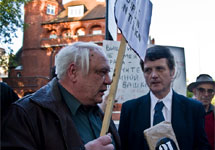
The Russian Foreign Ministry stated with reference to the results of the audit that the former Soviet political prisoner Vladimir Bukovsky does not have Russian citizenship, as well as legal grounds for receiving it without moving to Russia for permanent residence. This is approved in the response of the department to the request of the State Duma deputy Dmitry Gudkov, sent to the head of the department Sergei Lavrov on October 31. The answer dated November 24 was signed by the first deputy minister Vladimir Titov.
Titov added that without moving to Russia, Bukovsky will be able to obtain citizenship if he appeals to the Presidential Commission on citizenship issues with a request to restore the deadline for submitting an application missed for valid reasons. In the event of a favorable decision of the commission, the Russian Embassy in London will receive the right to issue him a new passport on the basis of a more liberal law on citizenship in 1991-2002, the deputy minister explained.
In early November, the Russian embassy in the UK stated that it doubts the presence of Bukovsky citizenship of Russia . By this, the diplomatic mission explained many -month -old wires with the issuance of a new passport to the former political prison to replace the delayed.
The embassy claimed that Bukovsky, contacting the consular department for new passports in March, failed to confirm his citizenship by presenting "the documents provided for by the regulations", and submitted an application with a request to conduct "standard for the applicants who were in such a situation, verification of circumstances indicating the presence or absence of citizenship." The Russian foreign policy archive does not have data on Bukovsky’s receipt of Russian citizenship, officials noted.
Meanwhile, Bukovsky during the expulsion in 1976 was not deprived of Soviet citizenship from the USSR, and in 1992 he received a Russian passport. When a year later, the former political zyt wanted to abandon Russian citizenship, the embassy was explained to him that such a procedure does not exist. Later in the 1990s, Bukovsky was not allowed to go to his homeland twice, since his Russian passport was expired, and he was not given a British visa. The former Politzek received the new Russian passport only in 2007.
Bukovsky himself is confident that he is intentionally not allowed to go home. “They don’t want me to go there, I know,” he said in an interview with “Voice of America”. “The last time I was there in the verdict in the Khodorkovsky case, which was postponed as a result, they put two cars with two operars. And these groups drove me day and night, 24 hours a day, on the house, where I lived, where I lived, and Sasha, and Sasha, and Sasha, and Sasha, and Sasha, and Sasha, and Sasha, and Sasha is a racer. When I flew, I was detained at passport control, they said that something is unclear with the passport, they say, wait for the moment that my plane flew away, and then they said-come in, everything is in order, as they say, there is nowhere thicker. ”