
Translated material
Fighting club
Farly ahead of competitors, the “new opera”, taking either the European or the Ministry of Culture for intensification, offers the third premiere in the season. After Britten and Mozart, the French lyrical opera. And we can also. And everything on its own. Well, almost.
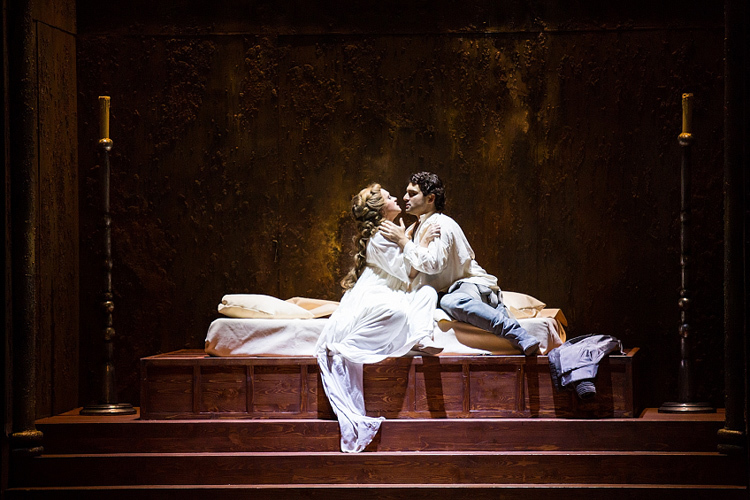
For the first time in 40 years, one of the main operas of the French repertoire was set in Russia, Romeo and Juliet Charles Guno, whose foamy beauty hides two completely unbearable parties of the main characters. And the "New Opera" found who to sing them. She is ready for two pairs of Veronian lovers. The premiere performance was entrusted to the local Alexei Tatarintsev, every time on the upper notes victoriously demonstrating his tenor valor, and the invited craftswoman Irina Bozhenko, who shone a couple of years ago on the Taxes of the Yekaterinburg Opera in the Rossinievsky “Count of Ori” and now an engaged by a large theater. The most famous opera’s most famous number - a virtuoso waltz Juliet, a luxurious sopranian visiting card - immediately sewed up by her - immediately demonstrated that there was nothing to worry about.
The most valuable contents of this opera are four love duets, including the final one, in the grave crypt, for which Juliet should wake up faster, and Romeo will die more slowly than usual. So if there are two good main performers, then the business can be said to have been done by 90 percent. Nevertheless, the rest of the ensemble did not disappoint, but, say, the small number of the boy-boy performed by Anna Sinitsyna deserves individual applause. High -quality and fresh vocal forces, which, without unnecessary noise, indulge the “new opera” - is perhaps its most attractive quality.
 © Daniil Kochetkov / New Opera
Another thing is that a thin and refined frame of these forces will not hurt at all. And in the last few works of the theater, carried out under the leadership of the chief conductor Jan Latam-König, she was. This orchestra copes with the languid metal structures of Wagner, and with the finest Britten graphics. But now, in the Guno, evenly chopped and roughly sewn in some completely unlucky square-nested way, the orchestra, led by the invited maestro Fabio Mastrageelo, was not recognized. All the whimsical tenderness of this score broke up about the mumble of the orchestral tutti, and the precious French sauce spread through the flat sheet of fast food.
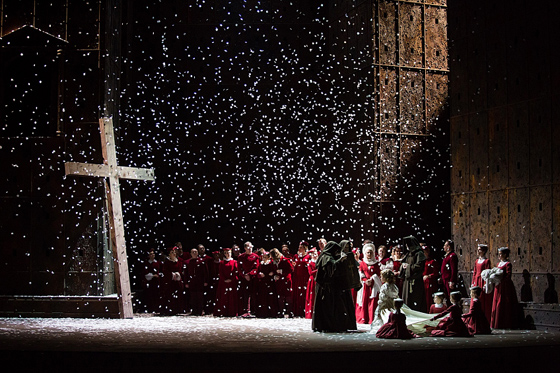
As for the performance, the turnkey made by the Frenchman Arno Bernard (this is his third work in Russia after the “Judine” and “Bohemia” in the Mikhailovsky Theater), he is knocked out firmly, without unnecessary ventures and reflection. Arno himself managed with directing, and with scenography, and with light, and with costumes. Capulet in red, Montecki in black. She is in white, he is in gray. Pressing Veronian walls, in different combinations, surrounding heroes - rather made of rusty iron, eaten by a design fungus than from stone. There is no balcony. There is a laconic window from the Italian postcard.
 © Daniil Kochetkov / New Opera
The short -term appeal to this free -free, inhuman world is introduced by the father of Lorenzo, represented by a kind of advanced revival thinker. There is no crucifix in his corner framed by ancient capitals, but there is a globe and a telescope. A huge cross then arises in the scene of the failed marriage of Juliet with Paris; Seeing the death imaginary Juluttin, her father God -beads the cross to Earth God is perhaps the most striking directorial gesture in this performance.
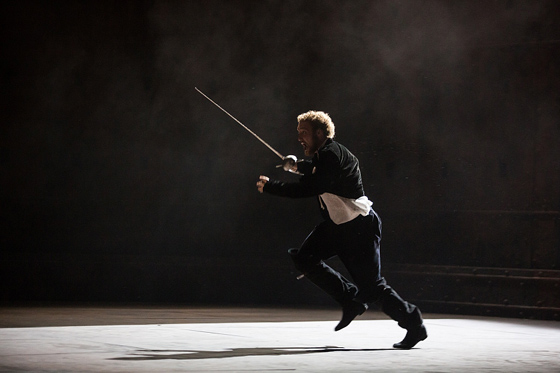
In general, the only Russian production of the opera Guno was quite unexpectedly good not at all with love scenes, but with fights. If Romeo and Juliet love each other very well, not knowing where to put their hands, and intensely thinking about the most important thing-a high note, then their warring relatives fight directly in the kinnoye, piercing their swords, not falling into a vain pile-small, enthusiastically yell and freeze in spectacular poses. The well -known Hollywood master Pavel Yangchik with a whole team of Russian craftsmen was engaged in the production of fencing brawls, and in order for him to turn around, a large battal scene was added to the Opera before the overture - it is very promising that the performance begins. It’s even a pity that the idea to turn the melodrama into an action movie is completely forgotten for the finale.