
Translated material
Energy. Delusions
Two performances of the Schaubühne Am Lehniner Platz theater shown at the Net festival were presented by Katie Mitchell and Michael Talhaimer in an unexpected directing for them. Radical, it would seem, changing the style, techniques - the artistic method itself, the famous theatrical practices, between which zero similarities, puzzled the Moscow public, exciting its discussion impulses.
Katie Mitchell, after the fundamental restructuring of stage technology in Schaub ü Hne (“Freken Julie”, held at the Net -2012 festival under the name “Christina”, “yellow wallpapers”) composed a literal “breathing” , as a visual aid. Michael Talhaimer, ex-head of Deutsches Theater , inclined in his own territory to the minimalist and mysterious directing “out of nothing”, set Tartufa, actually, conceptually.
The only thing that unites these performances is the outstanding German actors, perhaps the best on the world dramatic scene. Physically trained, with voices that do not need microphones, with long breathing, internally plastic, mentally sophisticated, capable of, it seems, to perform any claims of directors. Including the absence, at first glance, of any claims.
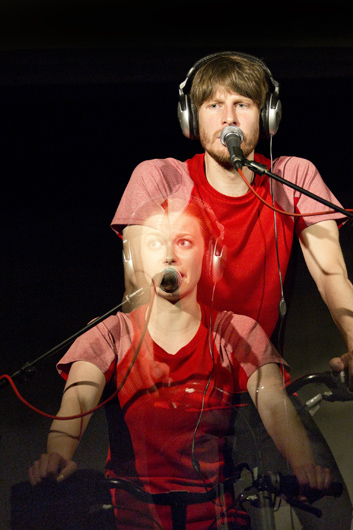 © Gianmarco Bressadola Scene from the play "Breath"
In previous works, Mitchell showed the production of the performance on the stage, where the actors shot several cameras, where episodes were mounted, sometimes voiced, and he himself went exclusively on the screen. In this case, theatrical "shadows" gained the living life of actors in the cinema. In the "breath" she decided on the theater of direct action. The illusionist nature of cinema and stage conventionality entered the former Mitchell into the relations unprecedented at the theater. She was not so much rehabilitated by stage (conditional) realism or illusionist (unconditional) cinema, as a method of production of reliability problematized. The task is equal to the pioneer both for the worn -out “psychological” theater, and to break with all the ways of using video that have long been stamps.
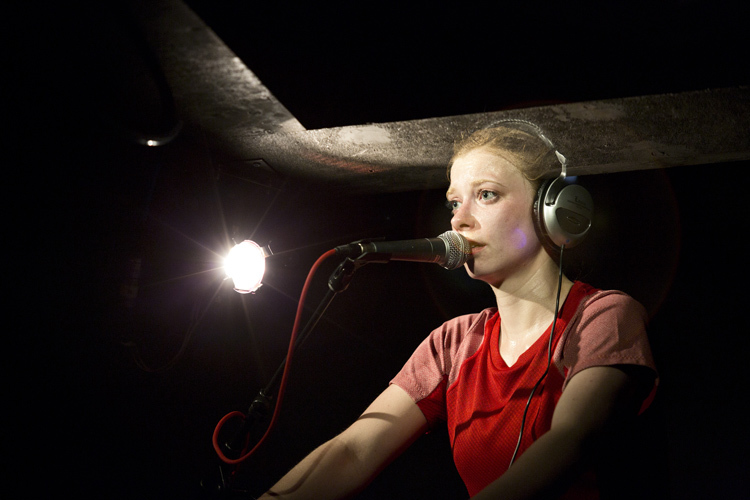
In the "breath" in the text of Duncan Macmillan, two characters, unnamed Europeans of the middle class, he and she (Christoph Gavenda, Jenny Koenig) participate. For one hour fifteen minutes they pedal bicycles in the frontal mise -en -scene in continuous speaking - discussing personal problems associated with the problems of ecology, painfully affecting their everyday life. Here you have to make a decision: to give birth or not to give birth to a child on a overpopulated planet and due to the inevitable natural disasters. The line running on the screen fixes, as long as the performance lasts, the chundious replenishment of the population. Energy - in a figurative and physical sense - this performance is provided with bicycle pedals or a kind of “running” actors on the spot. And in the background - five athletes (at Moscow shows it was young from the Spartak club) producing a current for lighting, for a running line on the screen, for sounds (noise). The wires and units that filled the stage ate the efforts of strong actors who manage to tell without inhibition about their ideas, classes, relatives, passions, fears-but also visit (in retelling) in bed, club, and the ETC hospital. To survive a miscarriage, parting, the birth of a baby and - to grow old. Such is the internal action (or plot) with the uniformity of the stage picture.
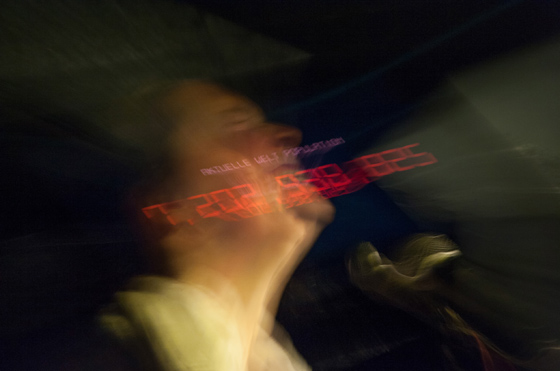 © Stephen cummiskey scene from the play "Breath"
Mitchell boldly, without thinking about the possibility of the public to get bored, illustrates the idea of energy, which is immediately created, is immediately spent. The movement, literally presented on the stage, transfers abstract energy into a metaphor for the cycle of life. Just as in previous performances, Mitchell did not imitate stage reliability, but produced it, in a new job she does not imitate the movement, but produces it, transforming the muscular actions of actors and athletes into electricity. Thus, “production relations” become for Mitchell almost the main feature of its directorial thinking.
In “breathing”, it reunits (“globalizes”) personal fears about the environmental situation with the private life of anonymous (generalized) characters. Inside the most important threat to Europeans, the threat is invested, as a “kinder-surprise”, the history of an ordinary couple, cells of society and humanity, men and women who think not only about whether to make kinders, to live together or part, but how to behave in a micro and macromy.
Of course, this performance could put “not only” the director, but also a person who is not limited by aesthetic ambitions. Meanwhile, the anti -surveillance of the enterprise, where the role of action is played by a stalomatic picture of movement - and this is not Oxymoron, is the story of “breathing”, voiced by remarks, suitable for a lecture about the ecology and for a household play, is the expansion of stage practices. The condition of influence instead of the usual stage action Mitchell chooses the interaction of the actors through the headphones. The characters pedal, without looking at each other and communicating “outside the partner”. So the communication unexpected for the stage and the hall is born. Direct and at the same time (technically) mediated.
Our spectators, sometimes feeling the comic of the plot in the absence of acting, when discussing personal experiences, overlapping an environmental nightmare (for us even more pressing, but soaked in another relevance), nevertheless, for one hour, they feel like real Europeans.
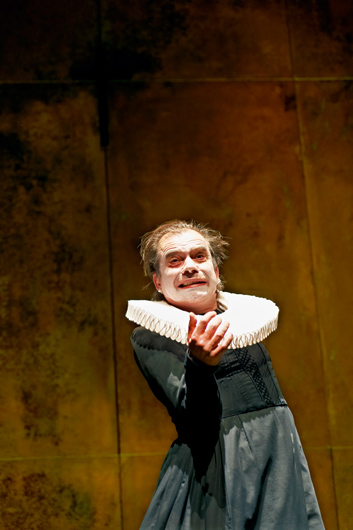 © Katrin Ribbe Scene from the play "Tartuf"
Tartuf Talhaimer is a multidimensional conceptual performance. In the field of the Terrible formidable, and in the grotes of their Theatrical. Talchaimer enters into dialogue with Moliere, putting his farce, his Dell'arte tragicomedy on the material of role -playing copies with originals. (In the first petition, the king about Tartuf Moliere wrote that “the originals have achieved a copy of the copy, despite the fact that it is well -maintained and, as they say, is true.”) But the times changed. And Talkhaimer, reading this comedy, pressing its text, translated into modern German (unlike the archaic Russian translation, chosen for Moscow tour), heard Pernel's replica: “Yes, this is not a family, but a crazy house!” - populated balders, degenerates of ETC. (It is no accident that only the actor, as Ms. Pernel, is dressed in a stylized costume of the Moliere Theater.) But the main thing is that Talhaimer reflected the “visibility” that “deceives us”, reconfiguring the audience living beyond the threshold of the theater in the insane world of other relations between the copy/original. Even if, “as they say”, postmodernism is over.
This Tartuf, cutting the truth-uterus, seems to have been released from prison, where Moliere once sent him.
Flapping the faces of the actors and thus pushing from Moliere's personality, aggravating their physical, mental idiocy, Talheimer raised his hand to the “Holy Family” for the only “virtue”: willingness to put up. By shifting the conflict, he showed that they are a panoptic of freaks. "And how is Tartuf?"
Talchaimer does not put a comedy of blinding or deception. He demonstrates that the worst in this best world can only compete with the worst. The hopelessness of his strict, electrified by the sermons and plastic intergles of the performance-in the absence of, of course, the Happy End. Or bow to the sovereign.
The show-premature performance inhabited by the paralytics of the will, infantile cretins, a sexually mature with a warmed puppet, a murulfine Ms. Panel. Between them are the detached, semi-native Elmira (Eva Mekbach) and observant non-cnd of Dorin (Katlen Gavlich).
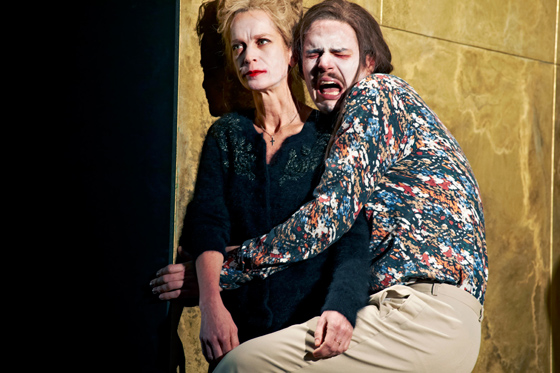 © Katrin Ribbe Scene from the play "Tartuf"
The Moscow public watched this performance differently than in Berlin, where I saw it too. We are mostly surrendering, even if we ourselves do not seem so. Regardless of the degree of understanding of falsehood, participation (involuntary) in evil, regardless of whether the audience is witnesses or participants in the fraud, this performance is about vision, and not about visibility. For seeing the powerful Tartuf-bead (Lars Idinger), whose muscular body is dotted with tattoos of probably religious texts, indistinguishable from tattoos of a criminal, and not to give him a weak, pale or crooked fools is impossible.
This Tartuf, cutting the truth-uterus, seems to have been released from prison, where Moliere once sent him. And this criminal, decorated with biblical quotes, will never give freedom to anyone else.
In Germany, such a performance is perceived rather in a metaphorical sense. We have metaphysical. This meaning is strengthened, embarrassing someone in the hall, namely the Old Testament curses.
The nature of evil. The sexual and almost the divine nature of Tartufa-Aidinger celebrates the decisiveness in this performance, for which “pious” nerds are incapable of. The tartuf, which is proposed, is also frank in his escapades, the mise -enumen scenes “in crucifixion” is not caused. Let the world turn over or even over its head - and the square of the stage “box” moves, making it difficult to run the characters to freedom, for the curtains, and there is no way out of the deceived.
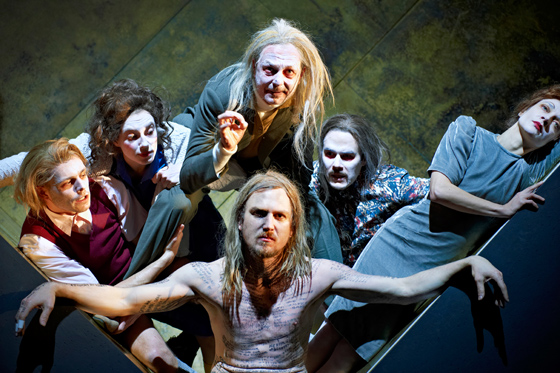 © Katrin Ribbe Scene from the play "Tartuf"
The mixture of irony with contempt with which Talheimer rewards the characters of the crazy (as Ms. Pernel has long noticed) the Orgon family also spreads beyond it. The bailiff - Mr. Loyal (URS Jucker) - writhes in convulsions, a psychiatric hospital cries on him. Such an interpretation of the representative of the state not only presents Talheimer - criticism of the system. Such an interpretation testifies: yes, government officials are psycho, but Tartuf’s victims would not hurt to heal too. More than others, of course, Orgon (Ingo Hulsmann), in which the tearful grimaces and children's blahs are drawn to the diagnosis (“He is obsessed with it,” Dorin is sure). The inadequacy of the perception of evil is generated, according to Talchaimer, not only stupidity, but already physiological decay. Total degradation. All patients are family and “kingdom”. Healthy is only Tartuf, who came out of the coarse of will.
Turning the decoration - a conditional theater world with actors in fat women, wigs - characters (red clowns in white masks) intend to stay alive in Antimira. Talchaimer is an experiment. He sits on them, turning the box, gigantic tests for survival in the cramped “communal”, five by five meters, a square, inhabited by copper, radiating the golden glittering light of church salaries (scenographer Olaf Altmann).
The plot is played high above the stage. In space above human height. Or understanding? The angular characters and dexterous actors can fall out of the nest at any moment, do not hold balance. They are scared when the design is rolled up, ready to stand their foreheads or grind with the whole body against the wall.
What about Tartuf? Tuner is he or the Savior? God news: in the final of Dorin, the text is minted about retaliation.