
Translated material
NATO will prick the spear tip
A group of increased combat readiness of Spearhead Force based on NATO response forces will be created at the beginning of next year
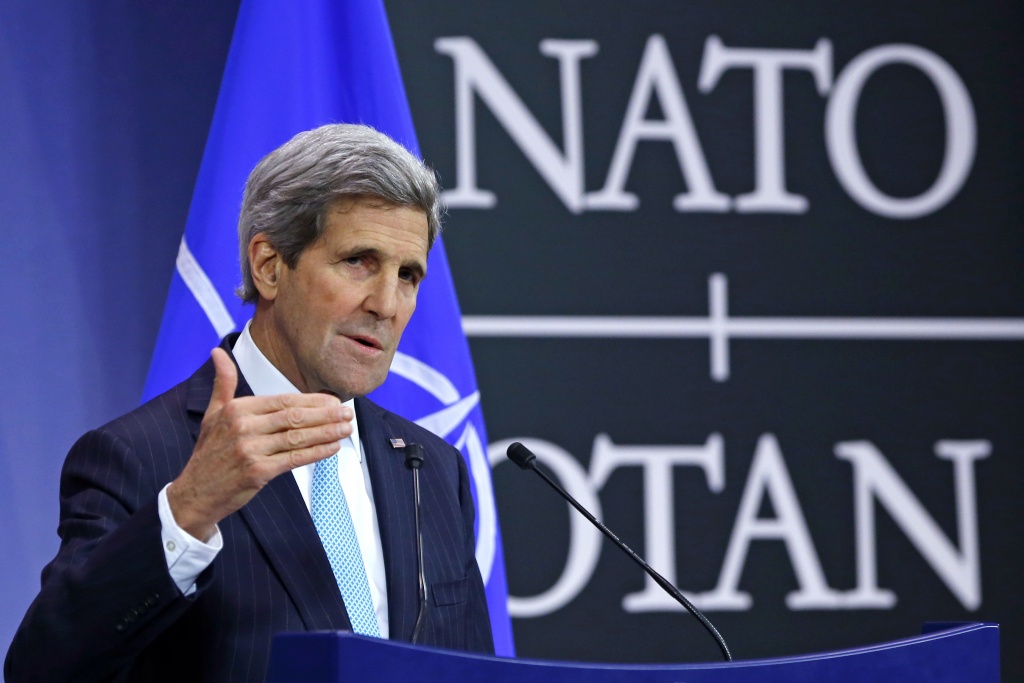
US Secretary of State John Kerry at a meeting of the heads of the Foreign Ministry of NATO countries/ Photo: Reuters/ Yves Herman
The united operational group of increased combat readiness of Spearhead force (Spearhead - UNITARY TOMENT - English), on the basis of NATO response forces, will be created at the beginning of next year - this was announced on December 2 in Brussels following a meeting of the Council of Foreign Affairs of the Alliance countries.
In the event of an exacerbation of the situation on the eastern lines of the Alliance, their military will be used in the group, Germany, the Netherlands and Norway will be sent, and its estimated number will be 4-5 thousand soldiers and officers. At the same time, NATO emphasizes that we are talking about an “intermediate” format. “So far it is until 2016, and we'll see there,” NATO source told The New Times. According to him, the plan of tasks and the framework of the preparation of the new unit will be indicated at a meeting of the Council of Ministers of Defense of NATO countries in February. In a wider way, the general secretary of the Alliance Jens Stoltenberg emphasized, we are talking about the constant operational presence of NATO forces at his eastern borders, first of all, in the Baltic countries.
For the first time, plans to create a new unit in connection with the “new challenges on the eastern borders of NATO” were announced at the September Summit in Wales.
Ukraine on the agenda
All programs of assistance to Ukraine, which were announced during the September Summit of NATO in Wales, are already “in working condition”, the NATO-Ukraine commission, published as part of the final meeting of the heads of the Ministry of Foreign Affairs of the Alliance for 2014, said. This applies primarily to the launch of five targeted trust funds for supporting Ukraine with a volume of 10 million euros due to which equipment will be delivered. “We intend to promote better interaction between NATO forces and the Ukrainian army,” the statement said. It also follows that in Kyiv there is already an expanded group of NATO advisers and consultants, and advisory assistance will only increase in the future. “There was a direct request from Ukraine on this score,” said in a conversation with The New Times, an informed source at the NATO headquarters. “They (Ukrainians) want a comprehensive examination of the defense and security sphere, they want to reconsider everything that has been so far.”
According to the source, the “many member countries” of the Alliance already supply “non-lethal equipment”, but “act independently, not within NATO”.
In general, at the interinistering meeting on December 2 in Brussels, Ukraine enjoyed increased attention. The NATO Secretary General, going out to reporters after the morning meeting, explained in detail that the meeting of the NATO-Ukraine commission was held without the Foreign Minister of Ukraine Pavel Klimkin-he was forced to stay in Kyiv at a meeting of the Rada, where the creation of a new coalition government was about to be announced. However, Klimkin talked with NATO colleagues in video communication and heard many encouraging words: “NATO again declares that independent, sovereign and stable Ukraine, committed to democracy and respecting power - is a key element of security in the Euro -Atlantic region.” Or "NATO will continue to provide support to President Poroshenko and the new Ukrainian government as difficult reforms are held." And, on the contrary, Moscow once again announced the complete rejection of her policy in the Crimea and Ukraine. NATO condemned the increase in the Russian military presence in the Crimea and in the Black Sea region, and "a deterioration in the person’s rights on the peninsula."
The resumption of military contacts with Moscow, while it “continues to violate international law”, is impossible, made to understand Stoltenberg. But the channel for political contacts, the Secretary General explained, is still open. Relations between Russia and NATO are still built on the principles of the fundamental act of Russia-NATO. In the act, the NATO resembles, it is said about the obligations of the parties to respect the principle of the inviolability of borders in Europe, but it was Moscow that violated it. “If Russian combat aircraft dangerously maneuver 5-10 kilometers from NATO naval borders, intentionally turning off the transponders, and without responding to the requests of civilian dispatchers, is this act much?” - In the conversation, one of the high -ranking alliance employees asked in a conversation. Nevertheless, the correspondent of The New Times asked the Secretary General of NATO Stoltenberg - is it possible at least in a hypothetical manner to assume that next year there will be another meeting within the framework of the Russian -NATO Council? Indeed, for example, after the 2008 war in Georgia in Russia and NATO it took less than a year to resume contacts in the previous format. Stoltenberg replied that he had no reason to be an optimist. Moreover, Moscow, in the general opinion of NATO, has not yet fulfilled even obligations within the framework of the Minsk agreements, including, first of all, the withdrawal of troops and military equipment from Ukrainian territory. ”
Accelerated membership
At a press conference in the afternoon, Stoltenberg had to answer the same question more than once (albeit restrained in different formulations): does Ukraine have a chance to become a member of NATO? Moreover, one Ukrainian journalist, referring to the fact that the unresolved situation in the southeast may become an obstacle to the country's entry into the alliance, suggested that an obstacle to jump over this: “If we decide to give in to part of our territory, will we be able to enter into NATO taking into account this”?
But Stoltenberg was adamant: the Ukrainian people themselves should solve the issue of membership in NATO. “NATO pursues open door policies, which has already proved its success. At the summit in 2008, we confirmed our commitment to this policy. And if the Ukrainian people speak out for the country's accession to NATO, we will respect this decision. In the meantime, the country declares its non -block status, so to discuss the issue of Ukraine’s membership in NATO. ” And then, with one phrase, the Secretary General shared all the conversations about a certain possibility of “accelerated entry into the Alliance” for Ukraine: “If we are talking about Ukraine’s entry into NATO, then it will have to go the same path, through the same procedures as all other candidates, it will have to fully comply with all the conditions and rules of the Alliance.”
But judging by the fact that the same question, despite the explanations of the Secretary General, asked again and again - it really is already hanging in the air