
Translated material
Tamerlan is to blame for everything
The trial of Chechen Johar Tsarnaev, accused of explosion of homemade bombs at the finish of last year's marathon in Boston, will begin on January 5. The New Times found out the tactics of protection on the case file
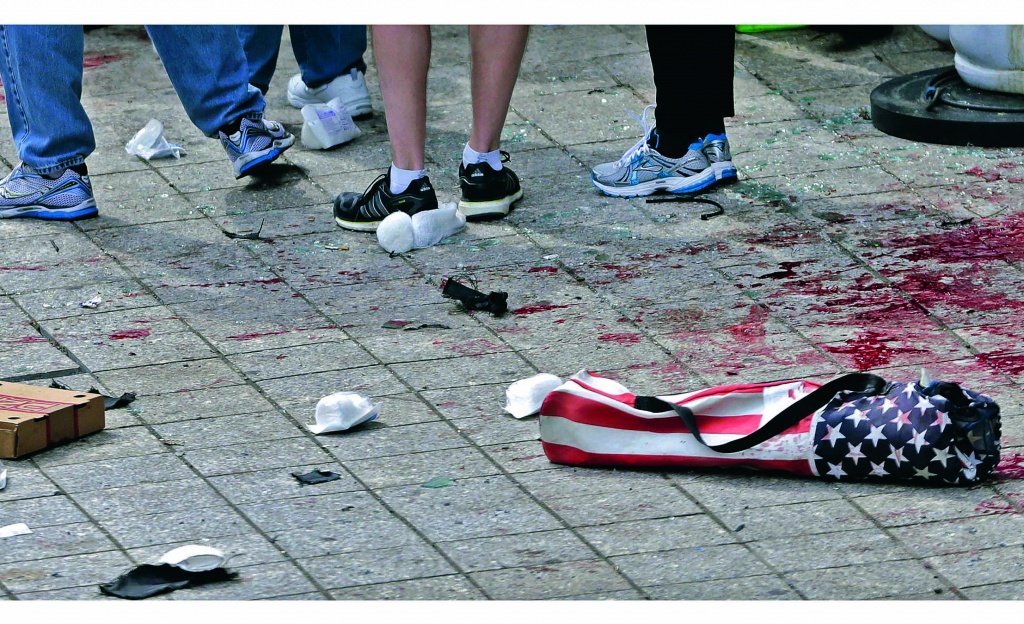
As a result of the attack on the Boston Marathon, three were killed and 264 people were injured. USA, Boston. April 15, 2013/ Photo: AP
On April 15, 2013, bombs made of pressure cooks, which were stuffed with smoky gunpowder gutted from fireworks, killed three people and wounded 264. A dozen and a half of them lost their limbs. Johar Tsarnaev at that moment was 19.
The accusation has long informed the federal judge George O'Tul that he intends to demand a highest penalty for a 21-year-old Chechen. Protection will try to insist on a life sentence. Free lawyers provided to Tsarnaev do not lose heart and continue the struggle, although they know very well that their wards are almost certainly found guilty. But they are preparing to give the prosecutor's office in the second stage of the process, when the same jury as in the first will solve the issue of the measure of punishment.
Under the influence of brother
Johar Tsarnaev is also accused of the fact that three days after the attack on the marathon, they, together with the older brother, 26-year-old Tamerlan, shot a policeman who was sitting in their patrol car, and tried to pick up his table weapons. But the brothers did not manage to unfasten the holster with a cunning constipation and left for the use of sinking.
A few hours later, Tamerlan was mortally wounded in a shootout with the police, and Johar finally accidentally moved his brother’s body and was that. The next day, he was found under a tarp in a strange boat, the board of which he managed to write down with jihadist slogans.
Johar did not plead guilty, but few doubt that it will do 12 Massachusetts jury for him, the selection of which begins on January 5. Trying to convince them to limit themselves to a lifelong term, the protection will transfer the arrows to Tamerlane and prove that Johar acted under the influence of his brother and even was afraid of him. To prove the latter, lawyers use the testimony of Chechens Ibrahim Todashev, who was a friend of Tamerlana and in May 2013 admitted during interrogation that two years before the Boston terrorist attack they committed a triple murder together.
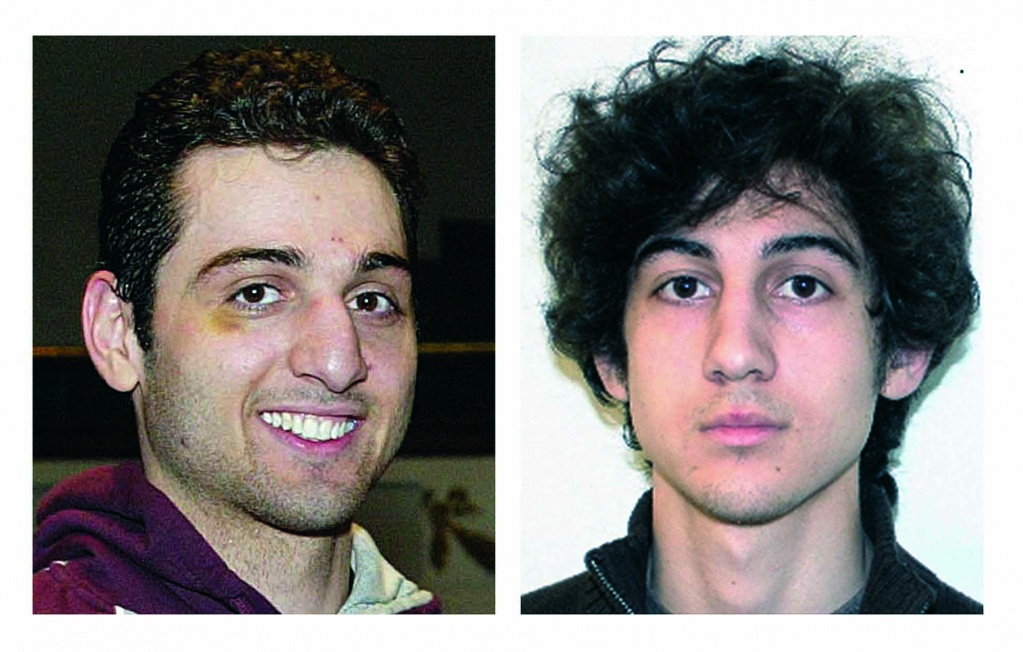
Brothers Tamerlan (left) and Johar Tsarnaeva/ Photo: AP
If you believe the authorities, Todashev began to state his recognition on paper, but then he suddenly rushed at the investigator of the FBI who interrogated him and was shot by him. The relatives of the Chechens do not believe in the authorities.
Passion for witnesses
The defense of Johar is to ensure that the prosecutor’s office gives her all the evidence of Tamerlane’s involvement in the murder in the suburbs of three people who had a throat to be cut and the bodies are sprinkled with marijuana on top. The prosecutor's office claims that, in addition to the recognition of Todashev, she has nothing. According to her, the investigation of the triple murder is conducted by the local police, and the federals have neither access to the materials of this case, nor the right to request them.
"
“Many victims of the explosion on the marathon are afraid to testify against a person who is accused of crippled or injured them with his terrorist attack”
“In addition, the defense applied that the judge allowed her not to show the charge of his witnesses before the process - since otherwise they may undergo pressure and threats and even refuse to testify. But the prosecutor’s office recalled that the parties usually present the lists of their witnesses a few days before the court. She doesn’t have it. ”
The prosecutor’s office has in mind that preliminary acquaintance with the list of defense witnesses gives the prosecution the opportunity to study their summary for subsequent use at cross -interrogation. And without this, the accusation is dealing with a cat in a bag.
Unexpected witnesses in the USA are only in the cinema. In life, the parties should know about them in advance.
As the prosecutors assured Judge O'Tula, there was no data that witnesses in this case could be intimidated. The accusation, however, admits: witnesses do not always easily agree to testify. “Many victims of the explosion on the marathon, for example, are afraid (although they do not refuse) to testify against the person who is accused of crippled or injured them with his terrorist attack,” the prosecutor's office said. But at the same time, the defense still has funds, including a call on the agenda, to receive readings of any witnesses, prosecutors recalled.
As a result, Judge O'Tul heeded their arguments, ordering lawyers to submit a list of their witnesses to the prosecution until the end of December.
Orgy of classifying
The parties are also bickering about the documents received by the US Ministry of Justice from the Russian authorities. At the end of October, the defense wrote to Judge O'Tulu that the charge handed her a number of texts taken from the materials “provided by the Russian government on April 22, 2013 or after this date”. Lawyers attached the texts to the letter, but the court in the spirit of the trend of recent years to classify - ordered them not to be announced, as well as, and all other applications to this defense petition.
In the old days, in the US judicial archives, one could come across confidential documents that fell into open access on the negligence of archivists. In the 90s, the author of these lines, for example, stumbled upon the archive of the Manhattan Federal Court at the request of the prosecutor’s office to the judge to transfer one accused due to the fact that she signed up for informants and helps to develop a Russian criminal group.
In order to get some document from the case, in those days it was necessary to come to court, fill out the form, defend in line and pay 25 cents for copying each page. The reporters are lazy to go to court and were in no hurry, so the secrets were in relative security.
"
"The Russian government warned the United States before April 2013 that Tamerlan Tsarnaev, possibly radical"
“The clamp began after the 2001 attacks and took a completely Arakcheevsky character in 2004 due to the appearance of the Pacer website, through which all the federal courts of America can be extended to the databases at least from Moscow (by the way, Rapsey (the Russian Agency of Legal and Judicial Information.-NT), which sometimes significantly states that such and such a document, and at the very same time, and at our disposal. The case is simply bought on Pacer at a price of 10 cents per page).
If earlier in someone’s criminal case there were several classified documents, then it was possible to conclude with a high degree of probability that this person is working with the investigation. Now in almost every business a bunch of closed papers, including in Tsarnaevsky, although, as far as is known, Johar Tsarnaev does not cooperate with the investigation, that is, “did not enter the cooperative movement,” as Russians are acutely acutely called “cooperators” in official jargon. Moreover, judge O'Tul classes the most interesting documents in the Tsarnaev case.
The defense complains that the documents that came from Russia were issued to her with bills, dates and weekends were seized in them, or entire pages were missed, and some pages were cut off with careless scanning. Meanwhile, according to lawyers, these documents are important for protection, since they contain data on how Tamerlan Tsarnaev during, at least in 2010, he became an increasingly radical Muslim and how his intention to join jihad matured when he went to Russia in 2012. All the foregoing defense just intends to use as evidence that Tamerlan, who had dominated his brother, pushed Johara on the path of Jihad.
Protection requires a judge to be given copies of Russian documents in the form in which they were received from Moscow. Lawyers also requested copies of warning about Tamerlane, who received from the Russian authorities even to the Boston terrorist attack.
In response, the prosecution wrote that “the Russian government warned the United States before April 2013, that Tamerlan Tsarnaev was possibly a radical, but at that moment it did not report what this warning was based on. After April 2013, the Russian government reported what it was based on, and we have already provided you with this information. We do not think that you have the right to receive the text of the original warning. ”
The defense continues to insist on his own, and also asks her to be provided with both the audio recordings of Johar's telephone conversations with her parents and their printouts in English translation.
As the defense honestly admits, it will be cheaper than making them yourself.
As a rule, American judges prefer to act on the principle of “ours and yours” and satisfy the petitions of the parties more or less equally. Judge O'Tul seems to be inclined to reject the vast majority of defense petitions. Including her attempt to force the accusation to share the originals with her or more intelligible copies of correspondence from the Russian authorities, as well as the materials of the investigation of the triple murder in which Tamerlan could be involved.
The widow is under suspicion
However, the more the protection of the grounds for the future appeal has. And just the number of these grounds has completely increased sharply: on November 25, the judge rejected half a dozen lawyer petitions at once, not satisfying a single one.
In particular, he refused to appoint a special hearing regarding the drain of closed information about the Tsarnaev case - the defense accused the law enforcement agencies in the plum, based on the two paragraphs of the article published on October 16, 2014 in the Newsweeek journal.
In the first paragraph, the author of the article refers to “numerous sources in law enforcement agencies”, who confidentially informed him: investigators involved in Boston explosions are still developing the widow of Tamerlan Catherine Russell. According to them, she is “under suspicion” and is survived from the time of terrorist attacks.
According to media reports, Russell had a second time and continues to communicate with the sister of Johar and Tamerlan-24-year-old Ailina Tsarnaeva, who in early November pleaded guilty of threats (she told her opponent that she had people who would explode) and was sentenced to 30 days probation.
In the second paragraph, which alerted the defense, a certain “high -ranking source in law enforcement agencies” is quoted. He said that Johar Tsarnaev and Junes Umarov, the brother of the 23-year-old Heed Umarova, friend of Tsarnaev, who in July 2013 moved from Boston to Chechnya, “bosom friends” and “exchanged dubious public messages that can be interpreted as related to the explosion at the Boston Marathon.”
The prosecutor’s office in response wrote to the judge that even if these quotes really came from the inquiry organs, they are not a “drain of closed information” and will not sow prejudices at the jury.
However, the lawyer Russell and the truth repeatedly told reporters that his client was under suspicion. In the same way, the friendship of Umarov with Johar is widely known from the words of the first. And his tweets to Johar, which he sent on behalf of XXJUNGAXX, are also known for a long time, and some observers suggested that some of them are related to the terrorist attack.
Since all this is published information, the prosecutor’s office also wrote about any “plum” of it, so additional hearings on this subject are not permanent.
Judge O'Tul agreed with this argument, although, taking the opportunity, he again called on investigators to keep his mouth shut and issued another order prohibiting the parties to share the materials with outsiders.
A few years ago, there were almost no such orders in America, but now the judges wave them selflessly. And the impression is that the fault of this is far from only prunes.