
Translated material
Swamp paradoxes
Three years ago, protests gave rise to power, the actions of which will lead to the emergence of a real opposition in Russia
On December 5, it performs three years, as first on the purebred boulevard later, the next day, on the triumphal square and further on Bolotnaya, Sakharov - in the capital, and in various squares in 90 cities of Russia and in large cities of Europe and North America, mass protests under the slogans “Putin must leave” and “return the elections to the people”. This ended with searches and arrests, three processes and 12 prisoners sent for different periods to the camps. Why did the protest turned out to be so easily suppressed, whether it made sense whether to wait for the new spring in Russia - The New Times represents two views on the court of readers both on the past and the future protest
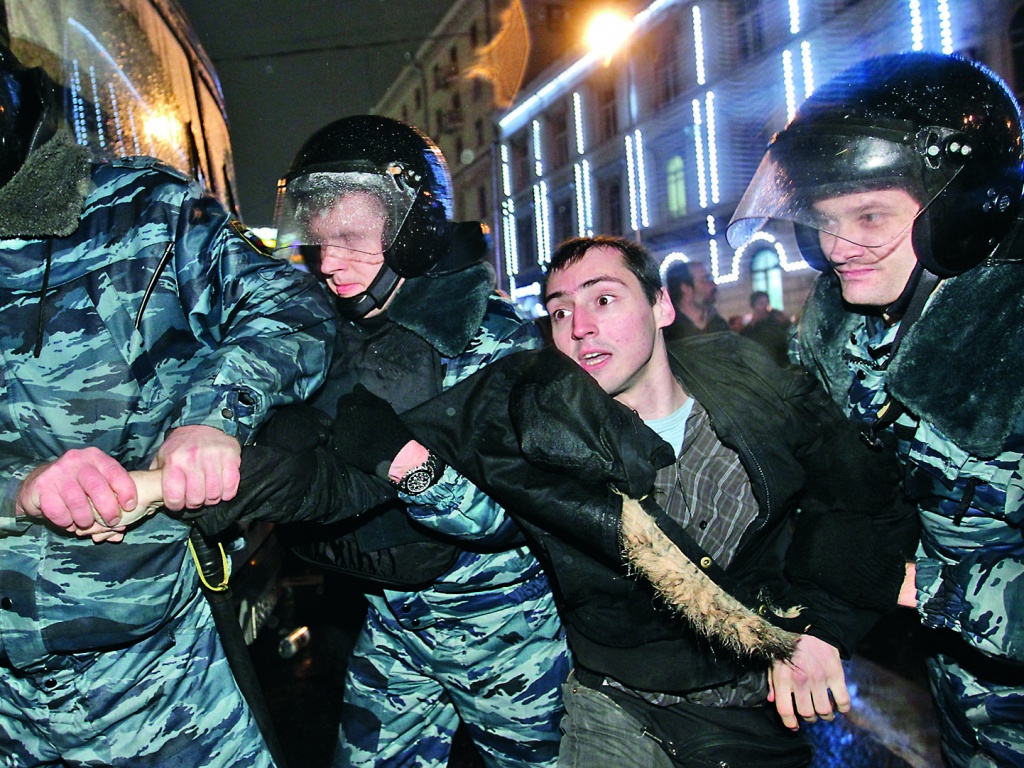
Moscow, December 5, 2011: On this day, people were still grabbed on the streets/ photo: Reuters
Autumn is a source of depression for the Russian political class. Too many uncomfortable anniversary. In October, it was 25 years old to fall in the Berlin wall. In November - a year to the start of Euromaidan. In early December - three years since the beginning of the "swamp" protests in Russia. The first two dates are considered victorious, the third social networks have long passed the sentence: "The protest is merged."
Meanwhile, there is no need to talk about the failure of the opposition. Firstly, because she was not in reality, therefore, she could not be defeated. Secondly, because that “Russian Spring” of a very cold winter of 2011-2012 radically changed Russia.
Diagnosis
So, about the opposition. There is no opposition in Russia. More precisely, there are a lot of these oppositions. But one that can withstand the authorities is not. And I do not mean the seeming pernicious schisms between the systemic and non -systemic parties, between supporters of the electoral or street struggle, between old and new generations, between left and rights or even between the capital's opposition and the Ssevokadovskaya. The point is not that the conditional Ryzhkov cannot agree with the conditional Navalny or someone Prokhorov with a certain Kasyanov. The surname has nothing to do with it.
"
*** Three years ago, the swamp movement gave rise to power, which inevitably, in turn, would give rise to a real opposition in Russia. And in this - the real success of Bolotnaya ***
“Axiom: Any power gives rise to the opposition. Any power makes decisions that are beneficial, and the others are not very good, because there are always winners and losers. The latter, of course, resist: first trying to reduce the costs of their defeat, and then recoup. Success largely depends on their perseverance and intensity of the struggle, and this, in turn, in the price of the issue. In the same countries, where power is smarter or more smart It is more visible, she tries to redistribute the resources from the losers to the winners more conservatively, the other - on a scale.
This is all a political science for dummies. But there is another, more subtle moment.
Power and citizens
The classical political theory proceeds from the fact that both democratic and authoritarian power refers to each of his citizen impersonally - she is not interested in Petrov, Ivanov, Sidorov, but social groups, which differ on the basis of gender or ethnicity and race, or positions on the social ladder.
But in Russia it is not entirely true. A Russian citizen, coming to the authorities throughout the post -Soviet period, was a participant in a purely individual bargain with a specific official. Corruption, which is obvious and universal, has not only its hierarchy, but also different rules for each individual person. Therefore, the knowledge of how Petrov managed to “solve” questions with the official of the X, gives little to a neighbor on the landing of Sidorov or a colleague in the workshop Ivanov, or the tribesman Rabinovich. And since someone else's experience in overcoming problems does not help, then, therefore, there is no reason to unite to solve similar issues.
In other words, the government that creates different rules of the game for different people (which means that there are no rules at all), cannot give rise to a single opposition. Everyone - for himself, everyone, as Hans Fallas wrote, “dies alone” and lives alone.
This does not exclude the possibility of a collective struggle. Where power offends entire groups of people - they willingly unite. So - as doctors and teachers who do not accept the reforms of hospitals and schools are uniting and coming up and are now united. The deceived equity holders and the inhabitants of Khimki and Zhukovsky also united, for the same reason the movement of ecologists, motorists and guardians of the historical appearance of Moscow and St. Petersburg arose. The trouble is that the individual solution of sick issues in Russia is almost always more effective than collective.
From the Berlin wall to the marsh
The protests of the winter of 2011-2012 were an attempt to establish a connection between personal problems and the general state of affairs. The falsification of parliamentary elections (and problems that arise for many) could not be solved individually. Was this attempt in vain? No, not.
Let us return for a minute to the anniversary mentioned above. The Berlin wall fell 25 years ago because it became meaningless. The wall prevented many (although not everyone), but prevented everyone in different ways. Therefore, someone with a risk to life decided to escape, but someone-no. But the wall falls when people realized that the best way to minimize the personal losses of everyone is to simply demolish it together.
About the same story happened with Viktor Yanukovych. He annoyed many people: someone took a business from someone, put someone in jail, overlapping someone through the laws adopted by Rada. He lost and was forced to escape from the country when the participants of Euromaidan (and even some part of his party of regions) realized that the price of a collective solution to the problem of rotten power is lower than the price of individual decisions. Moreover, many of them came to the conclusion that dividends from a collective solution (European integration) are higher than the possible benefit from any personal action.
The swamp movement, like any collective action, developed according to the same principle. When on September 24, 2011, Vladimir Putin at the Congress of United Russia reported that he was going to return to the Kremlin for at least 12 years, when he made it clear that he was going to throw out even half -hearted and sluggish Medvedev’s modernization and was going to proclaim a conservative agenda instead, then part of the society realized that the price of her patience and attempts to adapt to the Putin regime became too high. In other words, screaming about politics on the street has become more profitable than grumbling about it in the kitchen.
And many tens of thousands of people went to the square and avenues. There were so many of them that the authorities did not dare to disperse or beat them with batons, the State Unities could not show these protests, and even Putin was forced to react. But when the time of the presidential election came, the white -open movement realized: they are too few so as not to let Putin go to the Kremlin. To win - “demolish the wall” - they could not.
Another Kremlin
Three years have passed. The Russian political space finally turned into the battlefield of “ours” with “not ours”. The ideology returned, which a couple of years ago for the ruling groups was an anathema.
All this is a sign of not the failure of Bolotnaya, but its success. It was this protest that prompted the ruling elite to take on the path of confrontation with society. The fear that the street can return, and today it makes the country's leadership move further towards the ideologization of policy and strengthening control over the media and the Internet - they may not really want to, but they can no longer afford to relax or catch their breath.
Finally, it was the Bolotnaya who made Putin change. He is no longer a national leader - the leader of a large part of society, but not the whole society. It was once he claimed the role of the president of all Russians, but now he is forced to rely on supporting their units. With the help of ideology, he and his team successfully marginalize those who do not agree with him, but thereby he creates the ground for their solidarization. The pressure on the media, at NPOs, on politicians independent of the power, just suggests that the authorities are forced to reckon with that part, albeit small, society that does not support Putin. Otherwise, what's the point of crushing those you are not afraid of?
Today Russians have many challenges and many ambiguous issues. Russians or Russians? The role of the church? What should be ideology? How to arrange a relationship with the outside world? To Bolotnaya, these and similar questions were purely rhetorical. The unconditional national leader decided them at his discretion: today - so, tomorrow - otherwise.
And now such questions have acquired an essence. Putin, constrained by political scrapes, does not decide “one way or another”, but now decides only “like that”. Those who would prefer “otherwise” are forced to admit that “otherwise” under this power will no longer be. And since it will not, then the causal relationship between today and tomorrow becomes clearer. And since the connection between today and tomorrow is clearer, then you can clearly set the price of patience.
In other words, three years ago, the swamp movement gave rise to power, which inevitably, in turn, would give rise to a real opposition in Russia. And this is the real success of Bolotnaya.